Wednesday, November 02, 2005


Tuesday, November 01, 2005
TAX ADVISORY COMMISION REPORTS
TRAP DOOR IS SET
http://www.taxreformpanel.gov/
10/25/2005 Tax Reform Panel Conference Call Tax Reform Panel Conference Call Today the Panel on Federal Tax Reform announced that the public teleconference call previously scheduled for Thursday, October 27th, will take place on Monday, October 31st.
Monday's Conference Call The President's Advisory Panel on Federal Tax Reform has canceled Monday's conference call.
Tax Commission to Recommend Major Changes
http://www.inc.com/criticalnews/articles/200510/tax.html
A tax advisory panel plans to recommend limits in deductions, including those from employer-paid health insurance.
By: Kevin Ohannessian
Oct. 13--The President's advisory panel on federal tax reform is scheduled to report its findings to the President on November 1st. Among the panel’s expected recommendations are an end to the controversial Alternative Minimum Tax, a limit on health insurance deductions, and caps on mortgage interest deductions.
THAT IS TODAY!!!! brudda's!!! same day as FED meeting!!! WHO indeed will be watching , who will tell us if ANY DRAMATIC changes wil be suggested, and can they pass it?
DEM'S would LOVE to see caps on home mortgage int deductions, as MOST of their constituents don't own $M houses.
TRAP DOOR is set, change in backruptcy laws, doubling of minimum credit card payments, increase in mortage debt, increases in property taxes, increases in energy costs, 70% OWN HOMES and would be adversely effected by any tax code change limiting deductions. (GEE wish you would have told me!)
10/25/2005 Tax Reform Panel Conference Call Tax Reform Panel Conference Call Today the Panel on Federal Tax Reform announced that the public teleconference call previously scheduled for Thursday, October 27th, will take place on Monday, October 31st.
Monday's Conference Call The President's Advisory Panel on Federal Tax Reform has canceled Monday's conference call.
Tax Commission to Recommend Major Changes
http://www.inc.com/criticalnews/articles/200510/tax.html
A tax advisory panel plans to recommend limits in deductions, including those from employer-paid health insurance.
By: Kevin Ohannessian
Oct. 13--The President's advisory panel on federal tax reform is scheduled to report its findings to the President on November 1st. Among the panel’s expected recommendations are an end to the controversial Alternative Minimum Tax, a limit on health insurance deductions, and caps on mortgage interest deductions.
THAT IS TODAY!!!! brudda's!!! same day as FED meeting!!! WHO indeed will be watching , who will tell us if ANY DRAMATIC changes wil be suggested, and can they pass it?
DEM'S would LOVE to see caps on home mortgage int deductions, as MOST of their constituents don't own $M houses.
TRAP DOOR is set, change in backruptcy laws, doubling of minimum credit card payments, increase in mortage debt, increases in property taxes, increases in energy costs, 70% OWN HOMES and would be adversely effected by any tax code change limiting deductions. (GEE wish you would have told me!)
Monday, October 31, 2005

Sunday, October 30, 2005
THIS AND THAT AND THE NOW AND FUTURE
It really hard to sum up in a few words what is wrong with the FED policy last 30 years, and from what BB has said we get a feel more of the same and then some is coming.
WE did get a wild ride and 20 yr plus bull cycle, at the end of which it bubblized (not a word). Technology was the driver of economy in the 90's, and was responsable for the good economy, not any policy. Thank Bill Gates maybe?
WHat is MUST HAVE NOW? if you have a perfectly good IPOD will you ignore it to buy another that plays some video? I thought it was for LISTENING? the screen is TINY. But there are devices that let you hook it up to your stereo. OK
MOST EVERYONE'S computer is now running a chip that will not ever do all it is capable, the upgrades needed when a 500 MGZ speed was tops is now gone with 2.5 G considered entry level.
I think XMAS might be OK, but it is usually graded on how much MORE people spent than previous, there it might dissapoint IF FLAT, FLAT would be good IMHO
If A bear market and slowing economy is SNIFFED OUT 6-12 months early by stock market, and a guy smart like Leuthold feel ones coming in early 2006, we're in that time frame now. 6,000-8,000 is my bottom number for Dow. 1000 for naz 600-800 for SPX not a penny more.
Its almost guaranteed by history, SECULAR market follow each other, a 3 yr bear is cyclical, but it followed the longest running bullmkt in history. 3 years is LONG IN THE TOOTH for a cyclical bull mkt, going long even for yr end rally is fools play for me, I await other opportunities. HIGHS FOR ALL INDEXES ARE IN IMHO
For what BUSH did to undercover CIA agent, for LYING to AMerican people when he KNOWINGLY used the African "yellow cake" story where IRAQ was SAID to have been trying to buy African uranium, a NEAR CERTAINTY, even as he was told it was a LIE, he used that to make his case for a liars was, why IMPEACHMENT procedings have not begun I do not understand.
He has misused the ultimate sacred power of making war.....for his OWN purposes. He stains the white house more than any MOnica dress ever could!
D
WE did get a wild ride and 20 yr plus bull cycle, at the end of which it bubblized (not a word). Technology was the driver of economy in the 90's, and was responsable for the good economy, not any policy. Thank Bill Gates maybe?
WHat is MUST HAVE NOW? if you have a perfectly good IPOD will you ignore it to buy another that plays some video? I thought it was for LISTENING? the screen is TINY. But there are devices that let you hook it up to your stereo. OK
MOST EVERYONE'S computer is now running a chip that will not ever do all it is capable, the upgrades needed when a 500 MGZ speed was tops is now gone with 2.5 G considered entry level.
I think XMAS might be OK, but it is usually graded on how much MORE people spent than previous, there it might dissapoint IF FLAT, FLAT would be good IMHO
If A bear market and slowing economy is SNIFFED OUT 6-12 months early by stock market, and a guy smart like Leuthold feel ones coming in early 2006, we're in that time frame now. 6,000-8,000 is my bottom number for Dow. 1000 for naz 600-800 for SPX not a penny more.
Its almost guaranteed by history, SECULAR market follow each other, a 3 yr bear is cyclical, but it followed the longest running bullmkt in history. 3 years is LONG IN THE TOOTH for a cyclical bull mkt, going long even for yr end rally is fools play for me, I await other opportunities. HIGHS FOR ALL INDEXES ARE IN IMHO
For what BUSH did to undercover CIA agent, for LYING to AMerican people when he KNOWINGLY used the African "yellow cake" story where IRAQ was SAID to have been trying to buy African uranium, a NEAR CERTAINTY, even as he was told it was a LIE, he used that to make his case for a liars was, why IMPEACHMENT procedings have not begun I do not understand.
He has misused the ultimate sacred power of making war.....for his OWN purposes. He stains the white house more than any MOnica dress ever could!
D
WHERE DOES GROWTH COME FROM
http://www.epinet.org/content.cfm/webfeatures_snapshots_10292004
Last year almost $600 Billion for consumer spending came from the home ATM machine, as rising home values led to cashing out.
If anyone mortgage debt grew because of this, savings dropped to decades low.
It should be obvious that homes have given us near all they can, so how will spending be sustained?
D
Last year almost $600 Billion for consumer spending came from the home ATM machine, as rising home values led to cashing out.
If anyone mortgage debt grew because of this, savings dropped to decades low.
It should be obvious that homes have given us near all they can, so how will spending be sustained?
D
Saturday, October 29, 2005
DR COPPER
 http://www.elliottwave.com/features/default.aspx?cat=mw&aid=2017&time=pm
Parabolic moves gets retraced.
D
WORLD RECESSION COMING
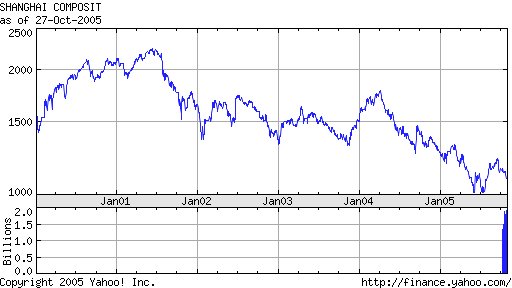 ISn't THIS where ALL the action is? WHy is the Chinese stock market SINKING like a stone then?
Bombay market
Falling recently after rocket shot bull.
D
FED RESERVE IS OPEN FOR BUSINESS
http://www.libertydollar.org/Federal_Reserve_Articles/Federal_Reserve_06.htm
And hardly anyone knows the scoop!
D
And hardly anyone knows the scoop!
D
GDP OPINION and MORE
http://safehaven.com/article-4028.htm GDP analysis
http://research.stlouisfed.org/publications/usfd/page3.pdf Rise to adj monetary base after steep slide
Prudent Bear's Doug Noland Credit Bubble Report from buble link:
Broad money supply (M3) surged $40.6 billion (week of October 17). Over the past 22 weeks, M3 has surged $442.6 billion, or 10.9% annualized. **(THAT IS CRISIS PUMPING MY FRIENDS)
We continue to exist in an environment of economic uncertainty, our economy dependant mostly on consumer and gov spending, NOT investment. Wage growth still mostly non existant. Lifestyles maintained through borrowing.
However, housing prices have topped or are very near to doing so, this will not allow such rampant cashouts from rising valuations to stimulate economy as before.
HEAVY debt loads, and higher costs are pressuring consumers, already RETAILERS are running heavy discount sales to beat the xmas rush, one of the earliest pushes I can remember.
The gov is being pressured to CUT spending to help pay for Katrina expenses and war related spending.
Knowing that, the wonderful HYPED 3.8 GDP of Friday was mostly because of consumer and gov spending, you dont freakin' say?!
SAVINGS near or below ZERO, so you knwo where the spending is coming from....piling on more debt just when stricter bankruptcy laws and higher minimum credit card payments are enacted.
As I said yesterday, it was my opinion that IF GDP was so peachy why didn't market rally on that by 11 AM???? A break of opening level could have led to a rush to 10K IMHO as interest rates are RESISTING any fall, higher than expected GDP numbers do not support falling rates.
As jiggy as it looked we had new lows outpacing highs on the NAZ and NYSE.
ONLY SCOOTER nabbed? no Chenney, No Rove....yet? there is your basis for the rally IMHO, I see nothing else. The shame is if these traitor cronies get off.
D
http://research.stlouisfed.org/publications/usfd/page3.pdf Rise to adj monetary base after steep slide
Prudent Bear's Doug Noland Credit Bubble Report from buble link:
Broad money supply (M3) surged $40.6 billion (week of October 17). Over the past 22 weeks, M3 has surged $442.6 billion, or 10.9% annualized. **(THAT IS CRISIS PUMPING MY FRIENDS)
We continue to exist in an environment of economic uncertainty, our economy dependant mostly on consumer and gov spending, NOT investment. Wage growth still mostly non existant. Lifestyles maintained through borrowing.
However, housing prices have topped or are very near to doing so, this will not allow such rampant cashouts from rising valuations to stimulate economy as before.
HEAVY debt loads, and higher costs are pressuring consumers, already RETAILERS are running heavy discount sales to beat the xmas rush, one of the earliest pushes I can remember.
The gov is being pressured to CUT spending to help pay for Katrina expenses and war related spending.
Knowing that, the wonderful HYPED 3.8 GDP of Friday was mostly because of consumer and gov spending, you dont freakin' say?!
SAVINGS near or below ZERO, so you knwo where the spending is coming from....piling on more debt just when stricter bankruptcy laws and higher minimum credit card payments are enacted.
As I said yesterday, it was my opinion that IF GDP was so peachy why didn't market rally on that by 11 AM???? A break of opening level could have led to a rush to 10K IMHO as interest rates are RESISTING any fall, higher than expected GDP numbers do not support falling rates.
As jiggy as it looked we had new lows outpacing highs on the NAZ and NYSE.
ONLY SCOOTER nabbed? no Chenney, No Rove....yet? there is your basis for the rally IMHO, I see nothing else. The shame is if these traitor cronies get off.
D
Friday, October 28, 2005
DOUBLE EDGE SWORD
UPDATE AlERT
Cheney Adviser Resigns After IndictmentAP - 4 minutes ago
WASHINGTON - Vice presidential adviser I. Lewis "Scooter' Libby Jr. resigned Friday after being charged with obstruction of justice, perjury and making a false statement in the CIA leak investigation, a politically charged case that could throw a spotlight on President Bush's push to war.
Great news the last qtr GDP came in at 3.8 surprising the wiseguys. Now the funny thing the chain deflator makes it look like we have little inflation, and this little ruse INFLATES the GDP!! same time we have had pathetic readings for months in the LEI'S! Plain and simple the GOV statistics are nothing but pure BS.
NOT included in any CPI figuring is property tax increases NOR the rise in home prices! so what good is it?
CHI Consumer Sentiment fell below expectations and is down dramatically from its old highs.
The world economy depends on Americans consuming and taking on debt at continued historic levels. Our GDP doesnt show what we can make, it shows what we can consume!
On another jived rally day, we have new lows outpacing highs by 4 to 1 margin BULLY? on lower volume! BULLY?
Richard Russell's PTI has remained in bear territory and if when rising and positive you dont go against it? then when falling and negative.......
BOGUS GDP which also contains Hedonic gimmickery, might keep pressure on rising interest rates.......ouch
EDIT MKT CLOSE COMMENTS
Volume DID pick up near the close, but new lows paced new highs UP volume was 81%.
GDP figures came out at 8:30 1 hour before open, after gapping higher by 10:50 to 11:00 the market was near UNCHANGED, then BAMM at 11 AM the market didnt look back. WHAT changed at 11 AM for the near vertical rise? beats me.
Only SCOOTER getting indicted? wonderful.
D
D
Cheney Adviser Resigns After IndictmentAP - 4 minutes ago
WASHINGTON - Vice presidential adviser I. Lewis "Scooter' Libby Jr. resigned Friday after being charged with obstruction of justice, perjury and making a false statement in the CIA leak investigation, a politically charged case that could throw a spotlight on President Bush's push to war.
Great news the last qtr GDP came in at 3.8 surprising the wiseguys. Now the funny thing the chain deflator makes it look like we have little inflation, and this little ruse INFLATES the GDP!! same time we have had pathetic readings for months in the LEI'S! Plain and simple the GOV statistics are nothing but pure BS.
NOT included in any CPI figuring is property tax increases NOR the rise in home prices! so what good is it?
CHI Consumer Sentiment fell below expectations and is down dramatically from its old highs.
The world economy depends on Americans consuming and taking on debt at continued historic levels. Our GDP doesnt show what we can make, it shows what we can consume!
On another jived rally day, we have new lows outpacing highs by 4 to 1 margin BULLY? on lower volume! BULLY?
Richard Russell's PTI has remained in bear territory and if when rising and positive you dont go against it? then when falling and negative.......
BOGUS GDP which also contains Hedonic gimmickery, might keep pressure on rising interest rates.......ouch
EDIT MKT CLOSE COMMENTS
Volume DID pick up near the close, but new lows paced new highs UP volume was 81%.
GDP figures came out at 8:30 1 hour before open, after gapping higher by 10:50 to 11:00 the market was near UNCHANGED, then BAMM at 11 AM the market didnt look back. WHAT changed at 11 AM for the near vertical rise? beats me.
Only SCOOTER getting indicted? wonderful.
D
D
Thursday, October 27, 2005
WARNING SIGNS?
FDG and other Coal companies under pressure, TOPT etc tankers have sold off, XOM stock flat after HISTORIC earnings release...what gives?
what MEE FDG and BTU are trying to warn and XOM non reaction to HISTORIC earnings release.hmmmmmm lower oil coming....but me thinks from slack demand, then that means weaker economy than expcted IMHO
Mkt new lows still NOT receding and along with potential not seen in 3 years cross of 20 and 50 WK EMA on VIX portends potential for increased volatility is going to be here for awhile and most likely this is a negative.
http://stockcharts.com/def/servlet/SC.web?c=$VIX,uu[w,a]waclyiay[df][pc20!c50!f][vc60][iut!La12,26,9!Lb14]&pref=G
what MEE FDG and BTU are trying to warn and XOM non reaction to HISTORIC earnings release.hmmmmmm lower oil coming....but me thinks from slack demand, then that means weaker economy than expcted IMHO
Mkt new lows still NOT receding and along with potential not seen in 3 years cross of 20 and 50 WK EMA on VIX portends potential for increased volatility is going to be here for awhile and most likely this is a negative.
http://stockcharts.com/def/servlet/SC.web?c=$VIX,uu[w,a]waclyiay[df][pc20!c50!f][vc60][iut!La12,26,9!Lb14]&pref=G
Wednesday, October 26, 2005
Breakup or Breakdown?
At 1/2 hour to close 168 new NYSE lows with only 61 new highs. This isn't the technical backdrop I expected after 169 point reversal and looked for follow through, of course could lie ahead.
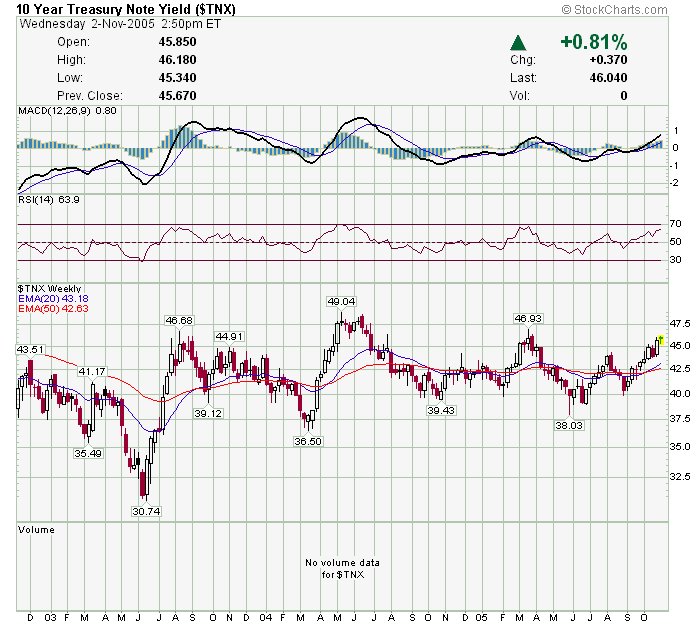
10 yr bond yields breaking out to upside. yields nearing 4.6% SHOW ME
D
10 yr bond yields breaking out to upside. yields nearing 4.6% SHOW ME
D
CHI FED
UPDATE 1-Chicago Fed national activity index falls in Sept
Wed Oct 26, 2005 10:33 AM ET (Adds details, table)
CHICAGO, Oct 26 (Reuters) - The Federal Reserve Bank of Chicago on Wednesday said its gauge of the U.S. economy fell in September as the impact of Hurricane Katrina was felt in production and employment indicators.
The Chicago Fed said its National Activity Index fell to minus 0.71 in September from a downwardly revised minus 0.09 in August, initially reported at plus 0.10.
The three-month moving average of the index was lower at minus 0.20 in September after being at plus 0.16 in August.
Any reading below zero for the three-month average suggests economic growth is below its historical trend. The average had shown above-trend growth for over two years until now.
Production-related indicators were hurt by a 1.3 percent drop in industrial production and a decline in capacity use.
Employment indicators were negative, mostly on a decline in September non-farm payrolls and a higher jobless rate, both tied to the after-effects of Katrina in the U.S. Gulf region.
Consumption and housing indicators made a positive contribution as housing starts and building permits rose and monthly retail sales were strong.
Overall, 36 of the 85 individual indicators tracked by the Chicago Fed made positive contributions in September while 48 made negative contributions and one was neutral.
Following are details of the index:
Monthly index:
Sep 05 Aug 05 (prev) Sep 04
-0.71 -0.09 +0.10 -0.29
Three-month moving average:
Sep 05 Aug 05 (prev) Sep 04
-0.20 +0.16 +0.26 +0.19
NOTES:
A zero shows an economy expanding at historical trends, negative values indicate below-trend growth and positive values signal growth above trend, the Chicago Fed said.
The 85 economic indicators that comprise the Chicago Fed's index are drawn from four categories: production and income; employment, unemployment and hours; personal consumption and housing; and sales, orders and inventories.
© Reuters 2005. All Rights Reserved.
Wed Oct 26, 2005 10:33 AM ET (Adds details, table)
CHICAGO, Oct 26 (Reuters) - The Federal Reserve Bank of Chicago on Wednesday said its gauge of the U.S. economy fell in September as the impact of Hurricane Katrina was felt in production and employment indicators.
The Chicago Fed said its National Activity Index fell to minus 0.71 in September from a downwardly revised minus 0.09 in August, initially reported at plus 0.10.
The three-month moving average of the index was lower at minus 0.20 in September after being at plus 0.16 in August.
Any reading below zero for the three-month average suggests economic growth is below its historical trend. The average had shown above-trend growth for over two years until now.
Production-related indicators were hurt by a 1.3 percent drop in industrial production and a decline in capacity use.
Employment indicators were negative, mostly on a decline in September non-farm payrolls and a higher jobless rate, both tied to the after-effects of Katrina in the U.S. Gulf region.
Consumption and housing indicators made a positive contribution as housing starts and building permits rose and monthly retail sales were strong.
Overall, 36 of the 85 individual indicators tracked by the Chicago Fed made positive contributions in September while 48 made negative contributions and one was neutral.
Following are details of the index:
Monthly index:
Sep 05 Aug 05 (prev) Sep 04
-0.71 -0.09 +0.10 -0.29
Three-month moving average:
Sep 05 Aug 05 (prev) Sep 04
-0.20 +0.16 +0.26 +0.19
NOTES:
A zero shows an economy expanding at historical trends, negative values indicate below-trend growth and positive values signal growth above trend, the Chicago Fed said.
The 85 economic indicators that comprise the Chicago Fed's index are drawn from four categories: production and income; employment, unemployment and hours; personal consumption and housing; and sales, orders and inventories.
© Reuters 2005. All Rights Reserved.
DOSE OF RICHEBACHER
**(see also my friends how my use of 20EMA has kept us on sidelines with bonds, they have broken out large today. Commercial traders, smart money near record LONG.stay tuned)
The Daily Reckoning PRESENTS: Did Hurricane Katrina strike a robust or a fragile and vulnerable U.S. economy? According to many, the economy was expanding strongly - however, Dr. Richebächer thinks otherwise...
AMERICA'S REALITY
by Dr. Kurt Richebächer
Corroboration was seen in particular in recent job gains that were fast enough to lower the unemployment rate to a four-year low of 4.9%. In our view, the plethora of statistical data was overwhelmingly pointing to slowing economic growth.
Consumer spending may have remained surprisingly resilient, but considering its feeble underpinnings in the housing bubble, the time before a marked pullback is, in any case, rather limited. All that is needed to stop the consumer borrowing-and-spending spree in its tracks is a halt to the rise in house prices, implicitly finishing the provision of increasing collateral for higher borrowing.
Reported payroll growth over the first eight months of 2005 has been 1,506,000, averaging 188,000 per month. To those who are impressed, we have to say that this gain is 40% below the average job growth at this stage in past business cycles. Apparently, most economists have jumped to the happy conclusion that ample construction efforts will soon more than offset the initial hit to economic growth. Devastations are not subtracted from growth, while reconstruction is added to it. Such damage has, therefore, generally tended to boost economic growth.
But this time there is a big difference. Past hurricanes have generally hit resort and retirement areas. Katrina has shut down significant regional economic production and port facilities. The Gulf of Mexico accounts for 30% of U.S. oil production and 23% of natural gas production. Economic activity will be significantly constrained from the supply side. In 2004, Louisiana and Mississippi produced 1.2% and 0.6% of U.S. GDP growth.
To quote John Williams' Shadow Government Statistics: "The U.S. statistical bureaus face a reporting nightmare in the months ahead. Door-to-door surveying, telephone surveying and company reporting from the storm-damaged area will not be possible for a month or two, perhaps longer. Many businesses no longer exist. That means that employment and unemployment data, in particular, will have to be guesstimated, and those guesses mean that the Bureau of Labor Statistics can come up with any numbers it desires."
With great interest and attention, we are pursuing the struggle in the U.S. bond market between a large bearish community apparently betting on an impending recession or a period of slow growth triggering the accustomed "Greenspan put" - and a Federal Reserve displaying unprecedented determination to enforce higher long-term rates, so as to slow the housing bubble, increasingly fueled by speculative fervor.
In our view, the bond bulls are right about the economy's weakness. The U.S. recovery is grossly ill-natured, depending fatally on continuous strong support from "asset-driven" consumer spending. Stopping the housing bubble is sure to stop the mortgage refinancing bubble. To us, this seems like pulling the rug from under the table.
While the bond bulls appear perfectly right in their dire assessment of the economy, we think they are playing a dangerous game. Under apparently tremendous pressure to produce profits, they risk a clash with the Fed. For the Fed people, on the other hand, their credibility is at stake.
This might well force them to go further with their rate hikes than they intended.
Further, it has to be realized that today's U.S. bond market is a house of cards. Maintaining long-term interest rates at their present level needs a steady, huge stream of carry trade creating artificial demand for assets. Financial credit soared in the second quarter to $1.124.8 billion at an annual rate, from $648.8 billion in the prior quarter.
If the Fed cracks this trade by inverting the yield curve, this would send long-term rates steeply up. A fire sale of unimaginable proportions could begin, with bond prices crashing. Comparing the credit explosion with the savings implosion and also with a consumer inflation rate now up 3.6% year over year, U.S. interest rates are, in any case, ridiculously low.
Lately, another conundrum has caught our attention: the unprecedented huge and growing wedge between soaring credit growth and dwindling money growth. Our investigations identified two main culprits: the U.S. trade deficit and escalating Ponzi financing of unpaid interest.
The best-known fact about the U.S. economy's recession in 2001 is its extraordinary mildness. There were only two quarters with negative growth. For the year as a whole, real GDP increased 0.8%. This compares with an average decline of real GDP by 2% during previous postwar recessions.
An economy's performance during recession, generally lasting one year, is certainly an interesting aspect. Yet far more important are the strength and pattern of the ensuing recovery over three, four or more years. In essence, it lays the foundation for future longer-term growth. Its composition between consumption, investment, net exports and government spending is, therefore, of utmost importance.
In actual fact, the 2001 recession already had a totally unusual pattern. Prior recessions were triggered by monetary tightening responding to rising inflation rates. Essentially, this put a sharp curb on all credit-financed spending. In practice, these were mainly business investment, both fixed and inventories; residential building; and consumer durables.
Unlike all prior experience, the economic downturn that developed in 2001 clearly had its cause not in tight money and credit. True, during the first half of 2000 the Fed had hiked its federal funds rate in three steps to 6.5%. Yet with a generous provision of bank liquidity, it accommodated a credit expansion of record pace. For the first time ever, the U.S. economy went with roaring money and credit growth into recession - a mild one, though.
Business fixed investment plunged over two years virtually in splendid isolation. Measured in real terms, it fell by 4.2% in 2001 and by 9.2% in 2002, followed by unusually weak growth of 1.3% in 2003. It was by far its worst performance in any postwar business cycle. This investment slump unequivocally broke the boom.
What followed the unique 2001 recession pattern was an equally unique pattern of economic recovery. Still, the unusually fast and aggressive easing had its spectacular immediate and widely trumpeted success in the mildest postwar recession.
Consumer spending never paused, increasing by 2.5% in 2001 and 2.7% in 2002. Its largely credit-financed component of spending on durable consumer goods raced ahead by 4.3% in 2001 and 11.7% in 2002. Equally exceptional was the behavior of residential building. After a slow start, it took off into the famous housing bubble.
Business fixed investment, normally a main driver of recoveries, refused to respond at all. Rather, it accelerated its decline during 2002. And this, in fact, has become and remains America's central structural problem. Though it has recovered from its lows, it is no higher than in 2000. As the recovery developed, American publicity kept hammering into people's heads that the U.S. economy is greatly outperforming Japan and Europe. This conveniently diverted attention from the fact that in reality America had its most anemic recovery in the whole postwar period by any measure.
Still, different measures show very different results. By the reported productivity growth, this recovery resembles a "new paradigm" miracle. By the real GDP numbers, the economy appeared to be doing quite well, though much worse than in past cycles. But in terms of employment and wage and salary growth, this recovery has been and remains a disaster.
Regards,
Dr. Kurt Richebächer
for The Daily Reckoning
The Daily Reckoning PRESENTS: Did Hurricane Katrina strike a robust or a fragile and vulnerable U.S. economy? According to many, the economy was expanding strongly - however, Dr. Richebächer thinks otherwise...
AMERICA'S REALITY
by Dr. Kurt Richebächer
Corroboration was seen in particular in recent job gains that were fast enough to lower the unemployment rate to a four-year low of 4.9%. In our view, the plethora of statistical data was overwhelmingly pointing to slowing economic growth.
Consumer spending may have remained surprisingly resilient, but considering its feeble underpinnings in the housing bubble, the time before a marked pullback is, in any case, rather limited. All that is needed to stop the consumer borrowing-and-spending spree in its tracks is a halt to the rise in house prices, implicitly finishing the provision of increasing collateral for higher borrowing.
Reported payroll growth over the first eight months of 2005 has been 1,506,000, averaging 188,000 per month. To those who are impressed, we have to say that this gain is 40% below the average job growth at this stage in past business cycles. Apparently, most economists have jumped to the happy conclusion that ample construction efforts will soon more than offset the initial hit to economic growth. Devastations are not subtracted from growth, while reconstruction is added to it. Such damage has, therefore, generally tended to boost economic growth.
But this time there is a big difference. Past hurricanes have generally hit resort and retirement areas. Katrina has shut down significant regional economic production and port facilities. The Gulf of Mexico accounts for 30% of U.S. oil production and 23% of natural gas production. Economic activity will be significantly constrained from the supply side. In 2004, Louisiana and Mississippi produced 1.2% and 0.6% of U.S. GDP growth.
To quote John Williams' Shadow Government Statistics: "The U.S. statistical bureaus face a reporting nightmare in the months ahead. Door-to-door surveying, telephone surveying and company reporting from the storm-damaged area will not be possible for a month or two, perhaps longer. Many businesses no longer exist. That means that employment and unemployment data, in particular, will have to be guesstimated, and those guesses mean that the Bureau of Labor Statistics can come up with any numbers it desires."
With great interest and attention, we are pursuing the struggle in the U.S. bond market between a large bearish community apparently betting on an impending recession or a period of slow growth triggering the accustomed "Greenspan put" - and a Federal Reserve displaying unprecedented determination to enforce higher long-term rates, so as to slow the housing bubble, increasingly fueled by speculative fervor.
In our view, the bond bulls are right about the economy's weakness. The U.S. recovery is grossly ill-natured, depending fatally on continuous strong support from "asset-driven" consumer spending. Stopping the housing bubble is sure to stop the mortgage refinancing bubble. To us, this seems like pulling the rug from under the table.
While the bond bulls appear perfectly right in their dire assessment of the economy, we think they are playing a dangerous game. Under apparently tremendous pressure to produce profits, they risk a clash with the Fed. For the Fed people, on the other hand, their credibility is at stake.
This might well force them to go further with their rate hikes than they intended.
Further, it has to be realized that today's U.S. bond market is a house of cards. Maintaining long-term interest rates at their present level needs a steady, huge stream of carry trade creating artificial demand for assets. Financial credit soared in the second quarter to $1.124.8 billion at an annual rate, from $648.8 billion in the prior quarter.
If the Fed cracks this trade by inverting the yield curve, this would send long-term rates steeply up. A fire sale of unimaginable proportions could begin, with bond prices crashing. Comparing the credit explosion with the savings implosion and also with a consumer inflation rate now up 3.6% year over year, U.S. interest rates are, in any case, ridiculously low.
Lately, another conundrum has caught our attention: the unprecedented huge and growing wedge between soaring credit growth and dwindling money growth. Our investigations identified two main culprits: the U.S. trade deficit and escalating Ponzi financing of unpaid interest.
The best-known fact about the U.S. economy's recession in 2001 is its extraordinary mildness. There were only two quarters with negative growth. For the year as a whole, real GDP increased 0.8%. This compares with an average decline of real GDP by 2% during previous postwar recessions.
An economy's performance during recession, generally lasting one year, is certainly an interesting aspect. Yet far more important are the strength and pattern of the ensuing recovery over three, four or more years. In essence, it lays the foundation for future longer-term growth. Its composition between consumption, investment, net exports and government spending is, therefore, of utmost importance.
In actual fact, the 2001 recession already had a totally unusual pattern. Prior recessions were triggered by monetary tightening responding to rising inflation rates. Essentially, this put a sharp curb on all credit-financed spending. In practice, these were mainly business investment, both fixed and inventories; residential building; and consumer durables.
Unlike all prior experience, the economic downturn that developed in 2001 clearly had its cause not in tight money and credit. True, during the first half of 2000 the Fed had hiked its federal funds rate in three steps to 6.5%. Yet with a generous provision of bank liquidity, it accommodated a credit expansion of record pace. For the first time ever, the U.S. economy went with roaring money and credit growth into recession - a mild one, though.
Business fixed investment plunged over two years virtually in splendid isolation. Measured in real terms, it fell by 4.2% in 2001 and by 9.2% in 2002, followed by unusually weak growth of 1.3% in 2003. It was by far its worst performance in any postwar business cycle. This investment slump unequivocally broke the boom.
What followed the unique 2001 recession pattern was an equally unique pattern of economic recovery. Still, the unusually fast and aggressive easing had its spectacular immediate and widely trumpeted success in the mildest postwar recession.
Consumer spending never paused, increasing by 2.5% in 2001 and 2.7% in 2002. Its largely credit-financed component of spending on durable consumer goods raced ahead by 4.3% in 2001 and 11.7% in 2002. Equally exceptional was the behavior of residential building. After a slow start, it took off into the famous housing bubble.
Business fixed investment, normally a main driver of recoveries, refused to respond at all. Rather, it accelerated its decline during 2002. And this, in fact, has become and remains America's central structural problem. Though it has recovered from its lows, it is no higher than in 2000. As the recovery developed, American publicity kept hammering into people's heads that the U.S. economy is greatly outperforming Japan and Europe. This conveniently diverted attention from the fact that in reality America had its most anemic recovery in the whole postwar period by any measure.
Still, different measures show very different results. By the reported productivity growth, this recovery resembles a "new paradigm" miracle. By the real GDP numbers, the economy appeared to be doing quite well, though much worse than in past cycles. But in terms of employment and wage and salary growth, this recovery has been and remains a disaster.
Regards,
Dr. Kurt Richebächer
for The Daily Reckoning
Tuesday, October 25, 2005
BEWARE THE ENEMY IS "I"
http://www.mises.org/story/1947
What is wrong with the popular definition of inflation?
According to Mises,
Inflation, as this term was always used everywhere and especially in this country, means increasing the quantity of money and bank notes in circulation and the quantity of bank deposits subject to check. But people today use the term `inflation' to refer to the phenomenon that is an inevitable consequence of inflation, that is the tendency of all prices and wage rates to rise. The result of this deplorable confusion is that there is no term left to signify the cause of this rise in prices and wages. There is no longer any word available to signify the phenomenon that has been, up to now, called inflation.
By responding to the symptoms of inflation that the Fed has itself created the US central bank gives the impression that it fights inflation. Once it is realized that inflation is increases in the money supply, it becomes obvious that the source of inflation is the Fed and fractional reserve banking. It also becomes obvious that rather than fighting inflation, it is the Fed itself that generates the inflationary process.
Conclusions
For the past several weeks, Fed officials have warned the public about the growing inflation threat. Officials blame the growing risk of inflation on the rising price of gasoline as a result of the rise in crude oil prices and hurricane Katrina. Despite all this Fed officials are resolute that it is their duty to protect the US economy from the inflation menace.
According to officials, what is needed to counter the looming inflation threat is to prevent an acceleration in inflationary expectations. This, it is held, can be achieved by pursuing a transparent and credible policy to counter inflation. It is overlooked by most experts that the source of inflation has nothing to do with the high price of oil and high gasoline prices.
The main source of inflation is the Fed itself. Various measures that Fed officials are promising to employ in the fight against inflation rather than fixing the problem will make things much worse. These policies only generate a further misallocation of resources, which in turn undermines the process of wealth generation.
What is wrong with the popular definition of inflation?
According to Mises,
Inflation, as this term was always used everywhere and especially in this country, means increasing the quantity of money and bank notes in circulation and the quantity of bank deposits subject to check. But people today use the term `inflation' to refer to the phenomenon that is an inevitable consequence of inflation, that is the tendency of all prices and wage rates to rise. The result of this deplorable confusion is that there is no term left to signify the cause of this rise in prices and wages. There is no longer any word available to signify the phenomenon that has been, up to now, called inflation.
By responding to the symptoms of inflation that the Fed has itself created the US central bank gives the impression that it fights inflation. Once it is realized that inflation is increases in the money supply, it becomes obvious that the source of inflation is the Fed and fractional reserve banking. It also becomes obvious that rather than fighting inflation, it is the Fed itself that generates the inflationary process.
Conclusions
For the past several weeks, Fed officials have warned the public about the growing inflation threat. Officials blame the growing risk of inflation on the rising price of gasoline as a result of the rise in crude oil prices and hurricane Katrina. Despite all this Fed officials are resolute that it is their duty to protect the US economy from the inflation menace.
According to officials, what is needed to counter the looming inflation threat is to prevent an acceleration in inflationary expectations. This, it is held, can be achieved by pursuing a transparent and credible policy to counter inflation. It is overlooked by most experts that the source of inflation has nothing to do with the high price of oil and high gasoline prices.
The main source of inflation is the Fed itself. Various measures that Fed officials are promising to employ in the fight against inflation rather than fixing the problem will make things much worse. These policies only generate a further misallocation of resources, which in turn undermines the process of wealth generation.
CLUELESS IN CONGRESS
October 26, 2005
Misreading Bernankeby T. Stein / S. McIntyre
So it finally happened. On a chilly Monday morning in October, news surfaced that the nomination of Ben Bernanke as new Fed chairman was imminent. Immediately, the stock market rallied as the selection of the Wall Street-friendly Bernanke (who was the odds-on favorite) was seen as a positive development. Likewise, the Dollar dropped slightly and the precious metals edged up as most traders recalled Bernanke as the monetary dove who once declared that the U.S. Government could prevent deflation because the Fed/Treasury can "helicopter" money in to stimulate the economy. Likewise, his musings about "a technology called the printing press" have sent hearts racing in today's momentum driven equity markets and emboldened U.S. Dollar bears to know that however bad Greenspan was, Bernanke is likely to be worse. You see, Greenie followed a central banking legend in Paul Volcker, but at least the economy was fundamentally sound when it was handed over in 1987. In contrast, Helicopter Ben, whether he comprehends it or not, is inheriting a fundamentally flawed economy in early 2006. The mind-numbingly large credit and debt imbalances that have been stoked over Greenspan's 18 years will in all likelihood be unraveled sometime fairly early on in Bernanke's tenure.
According to Briefing.com, the Bernanke announcement "dispelled uncertainty over the Fed Chairman's successor a couple of months earlier than investors had anticipated, and Bernanke's stated intention of maintaining continuity during the transition, as well as a confirmation that Greenspan will remain Fed Head until the official end of his 18 year term in January, seemed to relieve stock investors."
So what are we to make of the market's reaction to the Bernanke announcement? Not much. Actually, we wouldn't be surprised if the investing public is misreading Bernanke. Think about it, a new Fed Chairman's immediate priority is always to establish credibility as a rock-solid central banker willing to maintain political independence. It would be foolish for Bernanke to give into political pressure early in his term by reversing the Fed's direction on interest rates.
Yet there has been dissension among the ranks of FOMC members (votes haven't been unanimous lately) and we really don't know what Bernanke will do. Frankly, long-term investors shouldn't loose any sleep over trying to predict interest rates over the short term. Instead, investors should be focused on the consequences of Alan Greenspan "the icon" being replaced by Ben Bernanke "the unknown".
The most important element of our financial system today is confidence. While he lacks charisma, Alan Greenspan is the perfect confidence artist. He is everything an all-powerful central banker should be: boring, elderly, brainy, long-winded, and most importantly LUCKY. Easy Al has been able to paper over all of the U.S.' problems over the last decade or so and to date a drunken U.S. economy has yet to feel the real hangover. There was Mexico in '94, Asian Meltdown/LTCM in '98, Y2K, and the Internet bubble bursting/911 from '00-'02 where Greenspan (frightened at the thought of a normal recession and the accompanying political fallout it might bring) did everything in his power to try and avert the business cycle. Whether it be by lowering the price of money (interest rates) or ramping up the availability of credit through monetary supply increases and the prompting of GSEs and banks to stimulate lending, Alan Greenspan has perpetuated a recession-less economy mentality that will ultimately lead to the mother of all recessions when the giant U.S. real estate bubble he created pops slowing our heavily-levered consumption-driven country and sparking a nasty time in America. Bernanke will be the man in charge of trying to put Humpty Dumpty back together again.
We would guess that 99% of those working in the investment industry never take the time to read through Greenspan's speeches on the Fed's Web Site. Why should they? Substance is not nearly as important as delivery is because body language and tonality make up 93% of communication. As long as Americans can run on their treadmills with boring old Greenspan on CNBC, confidence remains high. Even most members of congress and the media remain utterly clueless about the effects of monetary policy. The ill-winds blowing beneath the surface of the U.S. economy largely go unnoticed. Apart from Bernie Sanders (I-VT) and Ron Paul (R-TX), most congressmen fail to make good use of Greenspan's appearances on Capitol Hill. Republicans and Democrats will either ask elementary school level questions or try to get the chairman to endorse (or reject) a particular policy position.
This will all change once Bernanke takes over. Bernanke, who is younger, speaks a lot less eloquently than Greenspan. Bernanke has been interviewed on CNBC multiple times over the last year, and looks shaky at best. We expect him to struggle mightily when put under the microscope the next time the markets turn lower with vengeance. Never before has the Fed chairmanship changed hands with so many economic headwinds blowing.
Todd Stein & Steven McIntyreTexas Hedge Report
Misreading Bernankeby T. Stein / S. McIntyre
So it finally happened. On a chilly Monday morning in October, news surfaced that the nomination of Ben Bernanke as new Fed chairman was imminent. Immediately, the stock market rallied as the selection of the Wall Street-friendly Bernanke (who was the odds-on favorite) was seen as a positive development. Likewise, the Dollar dropped slightly and the precious metals edged up as most traders recalled Bernanke as the monetary dove who once declared that the U.S. Government could prevent deflation because the Fed/Treasury can "helicopter" money in to stimulate the economy. Likewise, his musings about "a technology called the printing press" have sent hearts racing in today's momentum driven equity markets and emboldened U.S. Dollar bears to know that however bad Greenspan was, Bernanke is likely to be worse. You see, Greenie followed a central banking legend in Paul Volcker, but at least the economy was fundamentally sound when it was handed over in 1987. In contrast, Helicopter Ben, whether he comprehends it or not, is inheriting a fundamentally flawed economy in early 2006. The mind-numbingly large credit and debt imbalances that have been stoked over Greenspan's 18 years will in all likelihood be unraveled sometime fairly early on in Bernanke's tenure.
According to Briefing.com, the Bernanke announcement "dispelled uncertainty over the Fed Chairman's successor a couple of months earlier than investors had anticipated, and Bernanke's stated intention of maintaining continuity during the transition, as well as a confirmation that Greenspan will remain Fed Head until the official end of his 18 year term in January, seemed to relieve stock investors."
So what are we to make of the market's reaction to the Bernanke announcement? Not much. Actually, we wouldn't be surprised if the investing public is misreading Bernanke. Think about it, a new Fed Chairman's immediate priority is always to establish credibility as a rock-solid central banker willing to maintain political independence. It would be foolish for Bernanke to give into political pressure early in his term by reversing the Fed's direction on interest rates.
Yet there has been dissension among the ranks of FOMC members (votes haven't been unanimous lately) and we really don't know what Bernanke will do. Frankly, long-term investors shouldn't loose any sleep over trying to predict interest rates over the short term. Instead, investors should be focused on the consequences of Alan Greenspan "the icon" being replaced by Ben Bernanke "the unknown".
The most important element of our financial system today is confidence. While he lacks charisma, Alan Greenspan is the perfect confidence artist. He is everything an all-powerful central banker should be: boring, elderly, brainy, long-winded, and most importantly LUCKY. Easy Al has been able to paper over all of the U.S.' problems over the last decade or so and to date a drunken U.S. economy has yet to feel the real hangover. There was Mexico in '94, Asian Meltdown/LTCM in '98, Y2K, and the Internet bubble bursting/911 from '00-'02 where Greenspan (frightened at the thought of a normal recession and the accompanying political fallout it might bring) did everything in his power to try and avert the business cycle. Whether it be by lowering the price of money (interest rates) or ramping up the availability of credit through monetary supply increases and the prompting of GSEs and banks to stimulate lending, Alan Greenspan has perpetuated a recession-less economy mentality that will ultimately lead to the mother of all recessions when the giant U.S. real estate bubble he created pops slowing our heavily-levered consumption-driven country and sparking a nasty time in America. Bernanke will be the man in charge of trying to put Humpty Dumpty back together again.
We would guess that 99% of those working in the investment industry never take the time to read through Greenspan's speeches on the Fed's Web Site. Why should they? Substance is not nearly as important as delivery is because body language and tonality make up 93% of communication. As long as Americans can run on their treadmills with boring old Greenspan on CNBC, confidence remains high. Even most members of congress and the media remain utterly clueless about the effects of monetary policy. The ill-winds blowing beneath the surface of the U.S. economy largely go unnoticed. Apart from Bernie Sanders (I-VT) and Ron Paul (R-TX), most congressmen fail to make good use of Greenspan's appearances on Capitol Hill. Republicans and Democrats will either ask elementary school level questions or try to get the chairman to endorse (or reject) a particular policy position.
This will all change once Bernanke takes over. Bernanke, who is younger, speaks a lot less eloquently than Greenspan. Bernanke has been interviewed on CNBC multiple times over the last year, and looks shaky at best. We expect him to struggle mightily when put under the microscope the next time the markets turn lower with vengeance. Never before has the Fed chairmanship changed hands with so many economic headwinds blowing.
Todd Stein & Steven McIntyreTexas Hedge Report
MORE OF THE SAME, A GOOD THING?
http://biz.yahoo.com/ap/051025/bush_fed.html?.v=4 A GREENSPAN CLONE?
Ben Bernanke, current chairman of the administration’s council of economic advisors, is President Bush’s nominee to succeed Alan Greenspan as chairman of the Federal Reserve. We believe will see more fine tuning of monetary policy with potentially negative implications for the dollar. We have extensively commented on Bernanke for over a year:
· Bernanke is on record as a supporter of policy that seeks to manage the entire yield curve. See Is a Dollar Crisis Looming? (October 10, 2005); see also The Modern Command Economy: the 30-Year Bond is Returning (August 4, 2005)
· Bernanke is a supply side economist. See Greenspan: "We can guarantee Cash, but we cannot guarantee purchasing power!” (February 16, 2005)
· In my view, Bernanke uses communication seeking to manage expectations in lieu of transparency. See The Fed Embraces Public Perception in Place of Sound Monetary Policy (April 18, 2005)
· We comment on how Ben Bernanke is getting more influential in The Emperor's New Clothes (October 6, 2004) , and forecast that he will succeed Greenspan in Fed May Not Stop Inflation (August 18, 2005)
· We believe Bernanke promoted the plan to hand out $2,000 to hurricane victims. It is an indication of more micro-management to come. See China Is Open for Business: Will China’s growth eliminate inflation? (September 21, 2005)
· Let us not wrap up a discussion about “Helicopter Ben” without a reference to his infamous comments that throwing money out of helicopters is an appropriate way to manage monetary policy. See China's Basket of Currencies (July 26, 2005).
Axel Merk
Axel Merk is Manager of the Merk Hard Currency Fund
Ben Bernanke, current chairman of the administration’s council of economic advisors, is President Bush’s nominee to succeed Alan Greenspan as chairman of the Federal Reserve. We believe will see more fine tuning of monetary policy with potentially negative implications for the dollar. We have extensively commented on Bernanke for over a year:
· Bernanke is on record as a supporter of policy that seeks to manage the entire yield curve. See Is a Dollar Crisis Looming? (October 10, 2005); see also The Modern Command Economy: the 30-Year Bond is Returning (August 4, 2005)
· Bernanke is a supply side economist. See Greenspan: "We can guarantee Cash, but we cannot guarantee purchasing power!” (February 16, 2005)
· In my view, Bernanke uses communication seeking to manage expectations in lieu of transparency. See The Fed Embraces Public Perception in Place of Sound Monetary Policy (April 18, 2005)
· We comment on how Ben Bernanke is getting more influential in The Emperor's New Clothes (October 6, 2004) , and forecast that he will succeed Greenspan in Fed May Not Stop Inflation (August 18, 2005)
· We believe Bernanke promoted the plan to hand out $2,000 to hurricane victims. It is an indication of more micro-management to come. See China Is Open for Business: Will China’s growth eliminate inflation? (September 21, 2005)
· Let us not wrap up a discussion about “Helicopter Ben” without a reference to his infamous comments that throwing money out of helicopters is an appropriate way to manage monetary policy. See China's Basket of Currencies (July 26, 2005).
Axel Merk
Axel Merk is Manager of the Merk Hard Currency Fund
** When most figure greenspan has led us into the black hole it will be too late
D
Subscribe to:
Posts (Atom)