WASHINGTON, Sept 12 (Reuters) - Federal Reserve Bank of Dallas President Richard Fisher on Monday said the U.S. economy would rebound from the damage of Hurricane Katrina, but it was unclear what the devastation meant for monetary policy.
"How does Katrina alter the outlook? The truth is, we don't really know," he said in a speech to the Texas Banking Department, a text of which was made available in Washington.
"My inclination is to read, listen and watch and not rush to judgment about how the disaster will impact the economy or how monetary policy ought to respond," he said.
Fisher is a voting member of the central bank's policy setting Federal Open Market Committee this year.
It meets on Sept. 20, and some in the markets suspect Katrina could cause the U.S. central bank to pause a 15-month long campaign of raising interest rates in steady, quarter percentage point steps after the next hike, at 3.75 percent.
But these bets have been trimmed somewhat after oil prices retreated back under $64 a barrel, and amid a chorus of Fed policymakers stressing that the U.S. central bank must stick to its goal of keeping inflation under control -- implying it will keep raising rates.
Fisher sounded open-minded on what Katrina meant for the Fed, but made plain that he was not panicking about the implications for U.S. growth.
Drawing the comparison with the 1995 earthquake that flattened Kobe, Japan's second largest port, Fisher noted that despite colossal damage, Japanese growth rebounded strongly in subsequent quarters and the U.S. may be even more resilient.
"Every natural disaster is unique and no two countries are the same. Japan's economy in 1995 was nowhere near as dynamic and flexible as ours is today," he said.
"Among the American economy's strength are its size, diversity, interconnections and resiliency. I fully expect the economy to rebound from this disaster," he said.
Tuesday, September 13, 2005


Monday, September 12, 2005
ORACLE BUYS SIEBEL
REDWOOD SHORES, Calif. - The business software company Oracle Corp. on Monday said it will acquire Siebel Systems Inc., which makes software to help companies manage relationships with their customers, in a deal worth about $5.85 billion in cash and stock.
Oracle is offering $10.66 per Siebel share, an 16.8 percent premium above Siebel's closing price of $9.13 on Friday.
Shares of Siebel rose $1.22, or 13.4 percent, to $10.35 in premarket trading following the news, while Oracle shares fell 28 cents, or 2.1 percent to $13.
"In a single step, Oracle becomes the number one CRM applications company in the world," said Oracle Chief Executive Larry Ellison in a statement. "Siebel's 4,000 applications customers and 3.4 million CRM users strengthen our number one position in applications in North America and move us closer to the number one position in applications globally."
Oracle said the companies' joint customers have recommended the transaction to both of them for more than a year.
The deal is expected to boost Oracle's earnings, excluding items, in fiscal 2007, and contribute to Oracle's goal of 20 percent annual earnings growth on a long-term basis.
Oracle said Siebel's board approved the deal, and Chairman Thomas M. Siebel agreed to vote his shares in favor of the acquisition. The purchase is expected to close in early 2006, subject to regulatory and Siebel shareholder approval.
In addition, Oracle said it plans to repurchase shares equal to the number of shares issued for the transaction.
Oracle is offering $10.66 per Siebel share, an 16.8 percent premium above Siebel's closing price of $9.13 on Friday.
Shares of Siebel rose $1.22, or 13.4 percent, to $10.35 in premarket trading following the news, while Oracle shares fell 28 cents, or 2.1 percent to $13.
"In a single step, Oracle becomes the number one CRM applications company in the world," said Oracle Chief Executive Larry Ellison in a statement. "Siebel's 4,000 applications customers and 3.4 million CRM users strengthen our number one position in applications in North America and move us closer to the number one position in applications globally."
Oracle said the companies' joint customers have recommended the transaction to both of them for more than a year.
The deal is expected to boost Oracle's earnings, excluding items, in fiscal 2007, and contribute to Oracle's goal of 20 percent annual earnings growth on a long-term basis.
Oracle said Siebel's board approved the deal, and Chairman Thomas M. Siebel agreed to vote his shares in favor of the acquisition. The purchase is expected to close in early 2006, subject to regulatory and Siebel shareholder approval.
In addition, Oracle said it plans to repurchase shares equal to the number of shares issued for the transaction.
Sunday, September 11, 2005
UP AGAINST IT
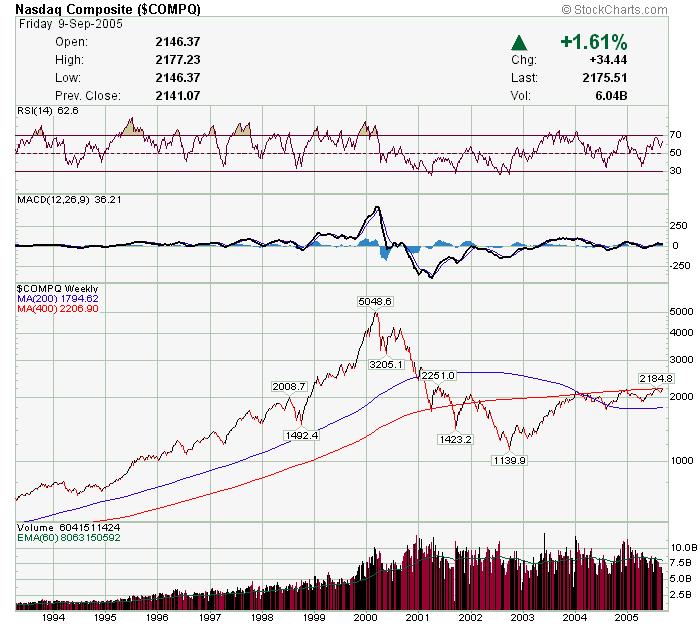
click to enlarge
As you can see, the 400 WK SMA is just above current trading area. The NAZ has lagged this rally, high beta usually leads it. INTC sold off FRI. MACD is weak and weaker still during entire rally from 2003. Bouncing off overbought RSI.
400 WK should provide stiff resistance.
D
How Often are Economists Right?
WASHINGTON (MarketWatch) - Hurricane Katrina hit the U.S. economy just when it was beginning to slowdown, but even the bad timing won't be enough to cause a recession, economists said Tuesday.
Let's make this quote of the year!
D
Let's make this quote of the year!
D
A REAL SOAKING And a National Disgrace
As I suggested double, maybe triple any estimate of KAtrina damage rebuilding, click on red for link to story, all red phrases are links if you hadn't realized that.
The demand for credit is rising rapidly, it would seem when demand rises by such a large figure, over and beyond the already staggering amounts, that to entice buyers of debt price must fall and yields must rise.
These addt'l $100B $200B $300B appropriation amounts are not counted when you consider the deficits we are running, nor are the Iraq war spending.
I guess are "friends" will keep showing up at the auctions, anf our China friend says thank you for providing it with what it needed to build itself into a world super power as it steadily builds its military might.
INterest alone on debt to US is $335 Billion in 2005!!
The demand for credit is rising rapidly, it would seem when demand rises by such a large figure, over and beyond the already staggering amounts, that to entice buyers of debt price must fall and yields must rise.
These addt'l $100B $200B $300B appropriation amounts are not counted when you consider the deficits we are running, nor are the Iraq war spending.
I guess are "friends" will keep showing up at the auctions, anf our China friend says thank you for providing it with what it needed to build itself into a world super power as it steadily builds its military might.
INterest alone on debt to US is $335 Billion in 2005!!
National debt is said to be $7.9 TRILLION
Do we need a balanced budget amendment?
Raising the debt a "National Disgrace" Ron Paul
The BRUNT of my argument
"Furthermore, increasing the national debt will provide more incentive for foreign investors to stop buying federal debt instruments at the current interest rates. Mr. Speaker, what will happen to our already fragile economy if the Federal Reserve must raise interest rates to levels unseen since the seventies to persuade foreigners to buy government debt instruments?" Ron Paul
My friends, aren't we THERE? Is it possible by NOT raisng rate at next FED meeting, would mean the dollar falls causing LONG TERM rates to shoot upwards?
Isn't the rebound in the dollar helping keep long term yields down? Is it good if foreign holders of debt see value plummet because of weakening dollar? Might they not SELL of refuse to gobble up all that debt KNOWING dollar value at risk?
This is why I feel those who feel KAtrina is reason to rally and be bullish, they OBVIOUSLY haven't thought it out to the end game, and are delusional.
We exist in environment now where costs are being passed through to consumer, and that IS inflationary, but because there is ample supply of MOST THINGS, that is not inflationary, description from investopedia:
Stagflation
A condition of slow economic growth and relatively high unemployment - a time of stagnation - accompanied by a rise in prices, or inflation.
Stagflation occurs when the economy isn't growing but prices are - not a good situation for a country to be in. This happened to a great extent during the 1970s, when world oil prices rose dramatically, fueling sharp inflation in developed countries. For these countries, including the U.S., the effects of inflation were considerably made worse because of this stagnation.
*Maybe this doesn't fit perfectly but could occur down the road.
As I have said, NEGATIVE SAVINGS and RECORD DEBT ALL AROUND, and the swapping of asset inflation is not a recipe for a sound economy. MAN are we going to pay at some point and if you carry heavy debt load........
Duratek
Saturday, September 10, 2005
YOUR CASH AIN'T NOTHING BUT TRASH?
FED has arrived to that place, the rock and hard one, where they be dammned if they don't.Katrina spending most don't understand would ADD to inflationary pressures, and only replace what was there and redirect resources, not the boondoogle 'sperts and others claim so I hear.(see "broken window fallacy)http://www.econlib.org/library/Bastiat/BasEss1.html
Gas may fall but by the last few years standards is staying high, and winter approaches.Everything we touch must GET THERE by transportation, and so EX food and energy a f'ing joke. I am getting 15% and higher fuel surcharges and permanent price increases by vendors, and I have to finally PASS IT ON.Oddly, I see this "inflation" given record debt and lowest savings rate (NEG .6%) on record since 1959, as DEFLATIONARY, because there does not exists with excess capacity awash in system, too FEW GOODS being chased by TOO MANY dollars.On the contrary,there seems to be plenty around of whatever consumers want.Not (I havent read RR 9/9 yet) only that, but Transports are not confirming this UP move in DOW, so it is BOGUS IMHO.$69 BILLION in new funny money last 2 weeks, is your answer.I, think is in no win scenario, and might even RAISE RATES, it would CRUSH this Katrina BS fed will stop rasing rally dead in its tracks IMHO.Forget Iraq? $2 B a day spent here, already $60B appropriated (from where?) and if they say $125B needed then DOUBLE THAT! from where?NOT continuing the rise in rates will FEED inflation and crush the dollar, and maybe gold sees that, but there again why the reluctance of Silver? so odd eh? BOTH MUST move as one for the move to be real IMHO.We already knew the BLS or the BSBLS did not include the rise in housing prices or property taxes into its inflation indicator, and I say what good is it?Now, what part of your life doesn't cost more, and we see the vapid fed using the same damn elixr that got us here in the first place. We are near $10 TRILLION FIAT sheets in circulation, damn them to hell!
In reply to: RR John Wagner
http://www.financialsense.com/editorials/benson/2005/0909.html
Gas may fall but by the last few years standards is staying high, and winter approaches.Everything we touch must GET THERE by transportation, and so EX food and energy a f'ing joke. I am getting 15% and higher fuel surcharges and permanent price increases by vendors, and I have to finally PASS IT ON.Oddly, I see this "inflation" given record debt and lowest savings rate (NEG .6%) on record since 1959, as DEFLATIONARY, because there does not exists with excess capacity awash in system, too FEW GOODS being chased by TOO MANY dollars.On the contrary,there seems to be plenty around of whatever consumers want.Not (I havent read RR 9/9 yet) only that, but Transports are not confirming this UP move in DOW, so it is BOGUS IMHO.$69 BILLION in new funny money last 2 weeks, is your answer.I, think is in no win scenario, and might even RAISE RATES, it would CRUSH this Katrina BS fed will stop rasing rally dead in its tracks IMHO.Forget Iraq? $2 B a day spent here, already $60B appropriated (from where?) and if they say $125B needed then DOUBLE THAT! from where?NOT continuing the rise in rates will FEED inflation and crush the dollar, and maybe gold sees that, but there again why the reluctance of Silver? so odd eh? BOTH MUST move as one for the move to be real IMHO.We already knew the BLS or the BSBLS did not include the rise in housing prices or property taxes into its inflation indicator, and I say what good is it?Now, what part of your life doesn't cost more, and we see the vapid fed using the same damn elixr that got us here in the first place. We are near $10 TRILLION FIAT sheets in circulation, damn them to hell!
In reply to: RR John Wagner
http://www.financialsense.com/editorials/benson/2005/0909.html
ROTTEN AAPLE?? and VIXXED
Click to enlarge
I think after besting its bubble mania high by 30% the top is in, but a test again of 118 is possible before we turn down.The rise from the low in 2003( and the steepness of its climb) expresses the degree the FED flooded the market with liquidity and 45 yr lows in rates. The balloon was deflated and he couldn't stand being responsible so he reflated again, and now again with $69B in 2 weeks.
I am one of FEW who believe this is done not just because of Katrina, but to soften the blow when he disapoints and raises .25 on Sept 20th, just my hunch. We are either going to get deflated or inflated, to my seeing there is NO MORE middle ground left! Inflating is seen better than deflating because of RECORD DEBT, but inflating would bring with it HIGHER interest rates and a lower dollar (maybe GOLD senses it, but silver hasn't?) In the past the FED has shown an abhorance for inflation like terrets syndrome, we'll soon see.
*(great trade Matt)
Just as AAPLE hits a new high, this article casts doubts onto what is the near term driver for the stock. I am expecting the stock to experience some weakness ahead.
TXN was hyped but stock looks toppy. INTC was hyped at mid term and stock gassed 3%. NAZ underperformed compared to DOW.
Duratek

I think after besting its bubble mania high by 30% the top is in, but a test again of 118 is possible before we turn down.The rise from the low in 2003( and the steepness of its climb) expresses the degree the FED flooded the market with liquidity and 45 yr lows in rates. The balloon was deflated and he couldn't stand being responsible so he reflated again, and now again with $69B in 2 weeks.
I am one of FEW who believe this is done not just because of Katrina, but to soften the blow when he disapoints and raises .25 on Sept 20th, just my hunch. We are either going to get deflated or inflated, to my seeing there is NO MORE middle ground left! Inflating is seen better than deflating because of RECORD DEBT, but inflating would bring with it HIGHER interest rates and a lower dollar (maybe GOLD senses it, but silver hasn't?) In the past the FED has shown an abhorance for inflation like terrets syndrome, we'll soon see.
*(great trade Matt)
Just as AAPLE hits a new high, this article casts doubts onto what is the near term driver for the stock. I am expecting the stock to experience some weakness ahead.
TXN was hyped but stock looks toppy. INTC was hyped at mid term and stock gassed 3%. NAZ underperformed compared to DOW.
Duratek
ONE MORE WEEK OF FUN!
Bulls enjoy it! Please read newest from John Mauldin
Write it down on your calendar, Spet 20th, Sept Fed meeting. A) markets EXPECT the FED to pause because of Katrina, so IMHO the rally you see is baking that into cake. B) Fed surprises because of FEAR of inflation raises .25 and friends we have a REAL competitor to stocks SHORT TERM money is outperforming stocks! Now a FED raise imho is NOT in the cake!
Either way, historic Sept weakness should show during this period and the real question is where it takes us.
A break of 2005 highs would leave door open to more of course, but a KAtrina super bull is just plain BS IMHO, or lets destroy each city and we're back to partying like its 1999!
Price tag $125B, gov data? double it, no triple it!! IF FED does not continue raising rates what will support the Dollar? more debt issuance?
Could this explain recent gold strength?
But alas, like the Transports falling as the Dow rises, Silver has NOT (and it is a manufacturing component) come along as yet to the party.If it does catch up, end of one of my arguments and we might see gold finally take out an old high, but MAN has it taken its time, would this not dilute any message or question the direction it might break? JUST as every damn gold bull worth his "metal" has hopped on lock and loaded.
D
Write it down on your calendar, Spet 20th, Sept Fed meeting. A) markets EXPECT the FED to pause because of Katrina, so IMHO the rally you see is baking that into cake. B) Fed surprises because of FEAR of inflation raises .25 and friends we have a REAL competitor to stocks SHORT TERM money is outperforming stocks! Now a FED raise imho is NOT in the cake!
Either way, historic Sept weakness should show during this period and the real question is where it takes us.
A break of 2005 highs would leave door open to more of course, but a KAtrina super bull is just plain BS IMHO, or lets destroy each city and we're back to partying like its 1999!
Price tag $125B, gov data? double it, no triple it!! IF FED does not continue raising rates what will support the Dollar? more debt issuance?
Could this explain recent gold strength?
But alas, like the Transports falling as the Dow rises, Silver has NOT (and it is a manufacturing component) come along as yet to the party.If it does catch up, end of one of my arguments and we might see gold finally take out an old high, but MAN has it taken its time, would this not dilute any message or question the direction it might break? JUST as every damn gold bull worth his "metal" has hopped on lock and loaded.
D
LIQUIFY YOUR LOVE
Justify your love, the FED is back in full swing to liquify mode, no matter the consequence, and it may be back to stock market asset inflation from housing inflation.Dow and SPX likely now to push to next closest high and test.
Broad money supply (M3) expanded $10.2 billion to a record $9.913 Trillion (week of August 29). from Doug Noland Spet 9th no matter what Greenspan says,just pay attention to what he does@!!!
Even though I have posted essays to the non viability of hydrogen using current methods to extact hydrogen, as it is MORE COSTLY takes MORE FOSSIL ENERGY which in turns creates more pollution (read article by Beard in Sept Car and Driver) the specualtors have been hyping these alternative energy stocks as oil and gas have soared.
96% bullish sentiment towards energy stocks, not much room left.
Market rallies in face of tradegy, but it is hope for business to rebuild, not from anything else except they feel NOW Greenspan MUST stop raising rates.
from Q and A section of EWT, courtesy of, CAN THERE BE A KATRINA BULL?
The New Orleans disaster will prompt a large fiscal stimulus. Could the $100+ billion they will spend on hurricane relief in the months ahead halt the deflation? How do you see this cash inflow affecting the U.S. economy and investments?
Responder: Steve Hochberg
Date: 9/9/2005
The rebuilding of the coastal infrastructure will not compensate for its destruction by "growing the economy," as some contend. The French economist Frederic Bastiat exposed this erroneous idea over a century and a half ago. (Type “broken window fallacy, economist” into Google search for the reasons explaining why.)
Bush rating below 40% and FALLING. Consumer confidence FALLING. Savings rate below 0 and FALLING. Disposable income falling, as gas prices tear us a new one.
Everybody is rushing to donate, more disposable income gone. The American public is generous and caring at large.
Did anyone notice the weakness in Transports, they have declined as DOw and SPX have pushed forward a MAJOR non confirmation is taking place a Dow Theory Bugaboo!
So though most do not agree, Katrina is not a boondoggle to economy, and when asked by LArry King a BUsh official of course didn;t directly answer how it would be paid for.
High energy costs are even hurting gold producers profits! Gold is at a crossroads and I feel one way or another will violently show its hand very soon!
Inflation is trickling into every orifice of economy but it isn't the kind where too much money is chasing too few goods it is oddly too little money chasing too many goods (deflationary!!!) yet those too many goods are increasing in price or the profits of sellers is declining.
We are going to have a point where inventories back up across the board if consumers cut back, and if they don't cut back how do they magically fill the void?
Truckers of everything are adding huge fuel surcharges to everything they move.
Traders are back and have given the indexes a ride, but remember, Transports are not coming along and you better ask why.
Duratek
Broad money supply (M3) expanded $10.2 billion to a record $9.913 Trillion (week of August 29). from Doug Noland Spet 9th no matter what Greenspan says,just pay attention to what he does@!!!
Even though I have posted essays to the non viability of hydrogen using current methods to extact hydrogen, as it is MORE COSTLY takes MORE FOSSIL ENERGY which in turns creates more pollution (read article by Beard in Sept Car and Driver) the specualtors have been hyping these alternative energy stocks as oil and gas have soared.
96% bullish sentiment towards energy stocks, not much room left.
Market rallies in face of tradegy, but it is hope for business to rebuild, not from anything else except they feel NOW Greenspan MUST stop raising rates.
from Q and A section of EWT, courtesy of, CAN THERE BE A KATRINA BULL?
The New Orleans disaster will prompt a large fiscal stimulus. Could the $100+ billion they will spend on hurricane relief in the months ahead halt the deflation? How do you see this cash inflow affecting the U.S. economy and investments?
Responder: Steve Hochberg
Date: 9/9/2005
The rebuilding of the coastal infrastructure will not compensate for its destruction by "growing the economy," as some contend. The French economist Frederic Bastiat exposed this erroneous idea over a century and a half ago. (Type “broken window fallacy, economist” into Google search for the reasons explaining why.)
Bush rating below 40% and FALLING. Consumer confidence FALLING. Savings rate below 0 and FALLING. Disposable income falling, as gas prices tear us a new one.
Everybody is rushing to donate, more disposable income gone. The American public is generous and caring at large.
Did anyone notice the weakness in Transports, they have declined as DOw and SPX have pushed forward a MAJOR non confirmation is taking place a Dow Theory Bugaboo!
So though most do not agree, Katrina is not a boondoggle to economy, and when asked by LArry King a BUsh official of course didn;t directly answer how it would be paid for.
High energy costs are even hurting gold producers profits! Gold is at a crossroads and I feel one way or another will violently show its hand very soon!
Inflation is trickling into every orifice of economy but it isn't the kind where too much money is chasing too few goods it is oddly too little money chasing too many goods (deflationary!!!) yet those too many goods are increasing in price or the profits of sellers is declining.
We are going to have a point where inventories back up across the board if consumers cut back, and if they don't cut back how do they magically fill the void?
Truckers of everything are adding huge fuel surcharges to everything they move.
Traders are back and have given the indexes a ride, but remember, Transports are not coming along and you better ask why.
Duratek
Friday, September 09, 2005
NDX MIRAGE??
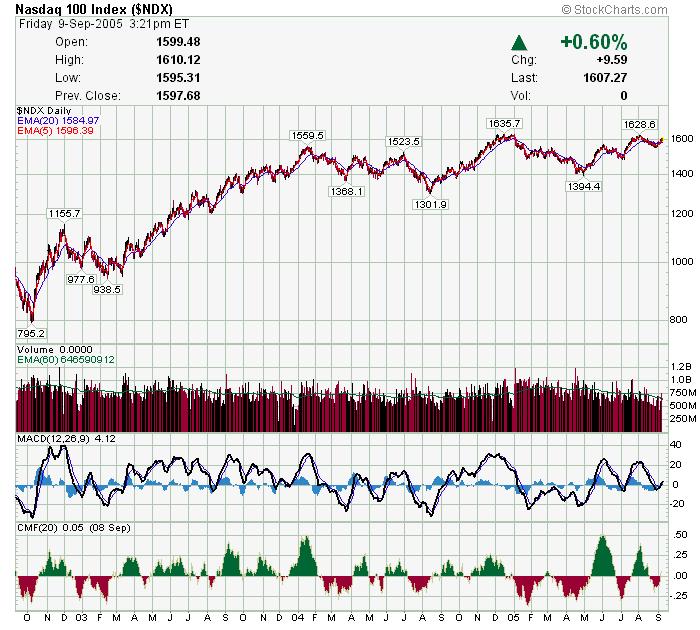
click to enlarge
Money flow divergence, and no green to be seen, set up same for MACD weakness. we'll see
Bulls Ignoring
Confidence? A BOUNCE back not likely quick as pump prices have stayed high and 24/7 coverage

FED SHOWDOWN and VIX
Fed announces 2005 meeting schedulePublished 6/25/2004 11:05 AM
WASHINGTON, June 25 (UPI) -- The U.S. Federal Reserve announced Friday the tentative meeting schedule for policy-makers next year.
The Federal Open Market Committee is slated to meet a total of eight times in 2005, namely Feb. 1 to 2, March 22, May 3, June 29 to 30, Aug. 9, Sept. 20, Nov. 1, and Dec. 13.
In addition, the Fed said the FOMC will meet Jan. 31 to Feb. 1 in 2006.
FOMC usually meet for a day on a regular basis to vote on whether or not to adjust interest rates. But twice a year, they also hold two-day meetings to discuss the U.S. economic outlook for the next six months.
Copyright © 2001-2005 United Press International
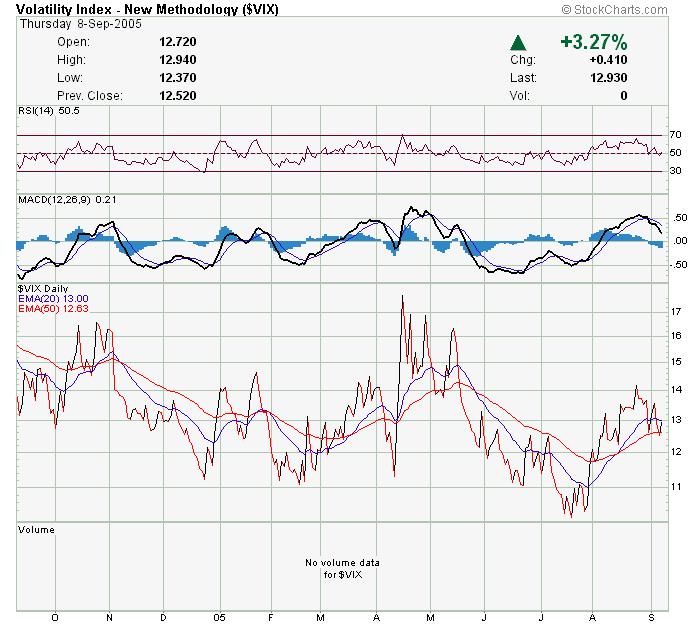
**In a surprise move to contain inflation, I suspect FED will raise rates again at next meeting with caveat to be wary from Katrina.
I also expect volatility to begin to increase as the year goes on. As shown above a rise above previous high now would be bearish as 20 and 50 should add support and would begin to rise. the 20 could act as resistance here, so stay tuned.
Thursday, September 08, 2005
Roundup or Weed Killer
yhoo finance
As for the nine losers, the Consumer Discretionary sector fared worst, off 0.9% on the combined factors of oil's rebound and negative news on the corporate front. Most notably, Sears Holdings (SHLD 127.81 -7.04) reported Q2 earnings below consensus this morning, sending shares down 5.3%, and the retail group (1.3%) down with it. A 2.0% sell-off in the Homebuilding group, after Hovnanian Enterprises (HOV 57.75 -3.84) delivered a disappointing FY06 earnings outlook, also bogged down the sector...
*Yet stocks weren't that bad. No fear here, Katrina patuueeee!
The midpoint of Intel's revenue target -- $9.9 billion -- represented a 15% increase from the same quarter last year and a 5.7% rise from the second quarter. Intel typically garners sequential growth in the third quarter closer to 7%. INTC off a hair in AH
Some see rosey Sept
If 911 comes and goes quietly, and fed continues liquidity surge and maybe STOPS raising (would they cut?) sure, I can see amild Sept as possibility
As for the nine losers, the Consumer Discretionary sector fared worst, off 0.9% on the combined factors of oil's rebound and negative news on the corporate front. Most notably, Sears Holdings (SHLD 127.81 -7.04) reported Q2 earnings below consensus this morning, sending shares down 5.3%, and the retail group (1.3%) down with it. A 2.0% sell-off in the Homebuilding group, after Hovnanian Enterprises (HOV 57.75 -3.84) delivered a disappointing FY06 earnings outlook, also bogged down the sector...
*Yet stocks weren't that bad. No fear here, Katrina patuueeee!
The midpoint of Intel's revenue target -- $9.9 billion -- represented a 15% increase from the same quarter last year and a 5.7% rise from the second quarter. Intel typically garners sequential growth in the third quarter closer to 7%. INTC off a hair in AH
Some see rosey Sept
If 911 comes and goes quietly, and fed continues liquidity surge and maybe STOPS raising (would they cut?) sure, I can see amild Sept as possibility
BAD COMBO
U.S. Economy: Labor Costs Rise, Productivity Slows (Update2) Listen
Sept. 7 (Bloomberg) -- U.S. labor costs rose by the most in almost five years and productivity growth slowed in the second quarter, suggesting the Federal Reserve will resist calls from Congress to stop raising interest rates.
The cost to companies of employing workers was 4.2 percent higher in the second quarter than in the year-earlier period, the Labor Department said today. Productivity, a measure of how much an employee produces for every hour worked, rose at a revised 1.8 percent annual rate from April through June, the slowest in nine months, after a 3.2 percent increase.
Lawmakers from both parties yesterday urged the Fed to forgo raising rates Sept. 20 to help consumers and businesses recover from the destruction of Hurricane Katrina. The increase in labor costs, following unexpected strength in the services industry for August reported yesterday, may give the Fed support to keep raising rates at a so-called measured pace, economists said.
``I'm concerned about core inflation running at the upper end of the range that I feel is consistent with price stability,'' said Michael Moskow, president of the Fed Bank of Chicago, in a speech to the Futures Industry Association today. Concerns that inflation might jump need to be kept in check with ``appropriate'' increases in interest rates even though the hurricane may slow growth, he said.
Hiring accelerated in the past three months as companies kept pace with consumer and corporate demand. Gains in wages and labor costs, which account for two-thirds of the cost of goods and services, threaten to push up inflation as energy prices hold close to records following last week's storm.
Labor Costs
``Labor costs are quite firm and combined with slowing productivity, that is something that is going to concern the Fed,'' said David Sloan, senior economist at 4Cast Inc. in New York, in an interview. ``This is an argument for the Fed raising rates. We expect they'll continue to do so even with the effects of the hurricane.''
The average increase in labor costs over the past four quarters was 4.3 percent, more than double the 2 percent average of the record 10-year expansion that ended in March 2001. Treasuries maturing in 10 years or more fell after the report. The benchmark 10-year note fell 3/32, pushing up the yield 2 basis points to 4.12 percent at 1:06 p.m. in New York.
The year-over-year gain in labor costs was the most since the final three months of 2000.
Labor costs rose at a 2.5 percent annual rate during the quarter compared with the previous three months, the most since the end of last year. The median forecast in a Bloomberg News survey was for a 1.4 percent gain. Productivity was forecast to grow at a 2.1 percent rate after a previously reported 2.2 percent pace, according to the median of 60 forecasts.
Hiring Plans
In the 12 months that ended in March, labor costs rose 2 percent, compared with a previously estimated 2.3 percent gain. Year-over-year unit labor costs were revised from the 4.3 percent increase previously reported.
The U.S. added jobs every month since June 2003 and the labor force participation rate in August was the highest in more than a year. The unemployment rate fell to 4.9 percent last month, the lowest in four years, and companies added 169,000 jobs. Employers created an average of 195,000 jobs in the past three months, up from 180,000 for the previous three months.
U.S. corporate leaders were more optimistic about the economy in August than they were three months earlier, according to a survey of chief executives taken before Hurricane Katrina and released today.
Business Roundtable
The Business Roundtable's outlook index for the next six months rose to 95.9 from 94.3 in May, according to a poll of 117 members of the Washington-based lobbying group, which represents chief executives of the largest U.S. companies. The survey was taken Aug. 9 to Aug. 26.
``While it's too early to determine the exact toll Hurricane Katrina will have on the U.S. economy, the strength of the economy's fundamentals just prior to the disaster may prove to cushion its full impact,'' Hank McKinnell, chairman and chief executive officer of Pfizer Inc. and chairman of the business group, said in a statement.
Seventy-six percent said they expected hiring to increase or remain the same, up from 70 percent in May, the survey showed. They have to pull from a pool of available workers that fell in August to the lowest since September 2001, recent Labor Department data show.
Talent Shortage
``I think there is a looming shortage of talent coming,'' Joe Griesedieck, vice chairman of employment agency Korn/Ferry International, said in an interview on Sept. 2. ``The demand is such that the salaries will go up in all sectors of the market.''
Swift Transportation Co., the No. 3 U.S. trucking company, raised experienced drivers' pay earlier this year by 14 percent in an effort to attract qualified employees.
Among manufacturers, labor costs rose 4.7 percent and productivity increased 3.6 percent, today's report showed. For non- financial corporations, costs fell 2.6 percent and productivity surged 6.8 percent.
The Labor Department's measure of non-farm business output increased at a 4.1 percent annual rate in the second quarter after a 4.3 percent pace in the prior three months. At the same time, the index of the number of hours worked increased at a 2.2 percent pace in the second quarter, twice as fast as in the first three months.
To keep inflation from accelerating, Fed policy makers have raised interest rates 10 times since June of last year. Last month, they boosted their benchmark overnight bank lending rate a quarter percentage point to 3.5 percent.
Lawmakers
Some economists, including those at Goldman Sachs, Merrill Lynch and UBS Securities, predict the Fed may pause at its meeting on Sept. 20 because of the potential disruption to growth from Hurricane Katrina. Goldman Sachs lowered its third-quarter growth forecast to 3.5 percent from 5 percent.
Senate Finance Committee Chairman Charles Grassley, an Iowa Republican, said in an interview yesterday that a pause in the Fed's cycle of rate increases ``would probably bring some confidence to people that are concerned about the overall economy'' following Hurricane Katrina.
The Congressional Budget Office said today in a letter to congressional leaders yesterday that growth will be slowed by 0.5 percentage point to 1 percentage point. The CBO also said the hurricane would result in the loss of 400,000 jobs.
Treasury Secretary John Snow, citing private forecasts, said yesterday that ``it would seem to make sense'' that higher energy prices, lost jobs and closed businesses stemming from Hurricane Katrina may slow U.S. economic growth by about 0.5 percent ``in the quarters ahead.''
Gasoline
Crude oil futures traded at a record $70.85 on Aug. 30 on the New York Mercantile Exchange after the hurricane curtailed production along the Gulf Coast.
Regular-grade gasoline, averaged nationwide, fell 1.6 cents to $3.041 a gallon Sept. 5, according to AAA, the nation's largest motoring organization. Prices surged to a record $3.057 on Sept. 2. Pump prices jumped 16 percent in the last week and are 64 percent higher than a year ago.
The higher costs could cut into corporate and consumer spending, and economists have been lowering their forecasts for economic growth.
``I think we will immediately see slower growth, but it will pick up eventually,'' former Fed Governor Susan M. Phillips said in an interview on Sept. 2. Phillips, now dean of George Washington University's business school in Washington, said third- quarter economic growth may be reduced by 0.5 percentage point to 1.5 percentage points.
`Robust Employment'
Bruce Kasman, head of economic research at JPMorgan Securities Inc. in New York, lowered his forecast for second-half growth by 0.75 percentage point, to 3.25 percent. He also raised his expectations for the first six months of next year to 3.75 percent, saying gasoline prices will fall and that businesses will boost hiring and spending.
``We're still looking at very robust employment at BankAtlantic Bancorp,'' Alan Levan, chief executive of BankAtlantic, said in an interview Sept. 2. ``We're hiring at every level of the organization.''
Today's productivity revision reflects the government's latest estimate on second-quarter gross domestic product, which was released on Aug. 30. The economy grew at a 3.3 percent annual pace from April through June, compared with the 3.4 percent estimated in July's report and down from 3.8 percent the first three months of the year. To contact the reporter on this story:
Courtney Schlisserman in Washington at cschlisserma@bloomberg.net.
Last Updated: September 7, 2005 13:09 EDT
Sept. 7 (Bloomberg) -- U.S. labor costs rose by the most in almost five years and productivity growth slowed in the second quarter, suggesting the Federal Reserve will resist calls from Congress to stop raising interest rates.
The cost to companies of employing workers was 4.2 percent higher in the second quarter than in the year-earlier period, the Labor Department said today. Productivity, a measure of how much an employee produces for every hour worked, rose at a revised 1.8 percent annual rate from April through June, the slowest in nine months, after a 3.2 percent increase.
Lawmakers from both parties yesterday urged the Fed to forgo raising rates Sept. 20 to help consumers and businesses recover from the destruction of Hurricane Katrina. The increase in labor costs, following unexpected strength in the services industry for August reported yesterday, may give the Fed support to keep raising rates at a so-called measured pace, economists said.
``I'm concerned about core inflation running at the upper end of the range that I feel is consistent with price stability,'' said Michael Moskow, president of the Fed Bank of Chicago, in a speech to the Futures Industry Association today. Concerns that inflation might jump need to be kept in check with ``appropriate'' increases in interest rates even though the hurricane may slow growth, he said.
Hiring accelerated in the past three months as companies kept pace with consumer and corporate demand. Gains in wages and labor costs, which account for two-thirds of the cost of goods and services, threaten to push up inflation as energy prices hold close to records following last week's storm.
Labor Costs
``Labor costs are quite firm and combined with slowing productivity, that is something that is going to concern the Fed,'' said David Sloan, senior economist at 4Cast Inc. in New York, in an interview. ``This is an argument for the Fed raising rates. We expect they'll continue to do so even with the effects of the hurricane.''
The average increase in labor costs over the past four quarters was 4.3 percent, more than double the 2 percent average of the record 10-year expansion that ended in March 2001. Treasuries maturing in 10 years or more fell after the report. The benchmark 10-year note fell 3/32, pushing up the yield 2 basis points to 4.12 percent at 1:06 p.m. in New York.
The year-over-year gain in labor costs was the most since the final three months of 2000.
Labor costs rose at a 2.5 percent annual rate during the quarter compared with the previous three months, the most since the end of last year. The median forecast in a Bloomberg News survey was for a 1.4 percent gain. Productivity was forecast to grow at a 2.1 percent rate after a previously reported 2.2 percent pace, according to the median of 60 forecasts.
Hiring Plans
In the 12 months that ended in March, labor costs rose 2 percent, compared with a previously estimated 2.3 percent gain. Year-over-year unit labor costs were revised from the 4.3 percent increase previously reported.
The U.S. added jobs every month since June 2003 and the labor force participation rate in August was the highest in more than a year. The unemployment rate fell to 4.9 percent last month, the lowest in four years, and companies added 169,000 jobs. Employers created an average of 195,000 jobs in the past three months, up from 180,000 for the previous three months.
U.S. corporate leaders were more optimistic about the economy in August than they were three months earlier, according to a survey of chief executives taken before Hurricane Katrina and released today.
Business Roundtable
The Business Roundtable's outlook index for the next six months rose to 95.9 from 94.3 in May, according to a poll of 117 members of the Washington-based lobbying group, which represents chief executives of the largest U.S. companies. The survey was taken Aug. 9 to Aug. 26.
``While it's too early to determine the exact toll Hurricane Katrina will have on the U.S. economy, the strength of the economy's fundamentals just prior to the disaster may prove to cushion its full impact,'' Hank McKinnell, chairman and chief executive officer of Pfizer Inc. and chairman of the business group, said in a statement.
Seventy-six percent said they expected hiring to increase or remain the same, up from 70 percent in May, the survey showed. They have to pull from a pool of available workers that fell in August to the lowest since September 2001, recent Labor Department data show.
Talent Shortage
``I think there is a looming shortage of talent coming,'' Joe Griesedieck, vice chairman of employment agency Korn/Ferry International, said in an interview on Sept. 2. ``The demand is such that the salaries will go up in all sectors of the market.''
Swift Transportation Co., the No. 3 U.S. trucking company, raised experienced drivers' pay earlier this year by 14 percent in an effort to attract qualified employees.
Among manufacturers, labor costs rose 4.7 percent and productivity increased 3.6 percent, today's report showed. For non- financial corporations, costs fell 2.6 percent and productivity surged 6.8 percent.
The Labor Department's measure of non-farm business output increased at a 4.1 percent annual rate in the second quarter after a 4.3 percent pace in the prior three months. At the same time, the index of the number of hours worked increased at a 2.2 percent pace in the second quarter, twice as fast as in the first three months.
To keep inflation from accelerating, Fed policy makers have raised interest rates 10 times since June of last year. Last month, they boosted their benchmark overnight bank lending rate a quarter percentage point to 3.5 percent.
Lawmakers
Some economists, including those at Goldman Sachs, Merrill Lynch and UBS Securities, predict the Fed may pause at its meeting on Sept. 20 because of the potential disruption to growth from Hurricane Katrina. Goldman Sachs lowered its third-quarter growth forecast to 3.5 percent from 5 percent.
Senate Finance Committee Chairman Charles Grassley, an Iowa Republican, said in an interview yesterday that a pause in the Fed's cycle of rate increases ``would probably bring some confidence to people that are concerned about the overall economy'' following Hurricane Katrina.
The Congressional Budget Office said today in a letter to congressional leaders yesterday that growth will be slowed by 0.5 percentage point to 1 percentage point. The CBO also said the hurricane would result in the loss of 400,000 jobs.
Treasury Secretary John Snow, citing private forecasts, said yesterday that ``it would seem to make sense'' that higher energy prices, lost jobs and closed businesses stemming from Hurricane Katrina may slow U.S. economic growth by about 0.5 percent ``in the quarters ahead.''
Gasoline
Crude oil futures traded at a record $70.85 on Aug. 30 on the New York Mercantile Exchange after the hurricane curtailed production along the Gulf Coast.
Regular-grade gasoline, averaged nationwide, fell 1.6 cents to $3.041 a gallon Sept. 5, according to AAA, the nation's largest motoring organization. Prices surged to a record $3.057 on Sept. 2. Pump prices jumped 16 percent in the last week and are 64 percent higher than a year ago.
The higher costs could cut into corporate and consumer spending, and economists have been lowering their forecasts for economic growth.
``I think we will immediately see slower growth, but it will pick up eventually,'' former Fed Governor Susan M. Phillips said in an interview on Sept. 2. Phillips, now dean of George Washington University's business school in Washington, said third- quarter economic growth may be reduced by 0.5 percentage point to 1.5 percentage points.
`Robust Employment'
Bruce Kasman, head of economic research at JPMorgan Securities Inc. in New York, lowered his forecast for second-half growth by 0.75 percentage point, to 3.25 percent. He also raised his expectations for the first six months of next year to 3.75 percent, saying gasoline prices will fall and that businesses will boost hiring and spending.
``We're still looking at very robust employment at BankAtlantic Bancorp,'' Alan Levan, chief executive of BankAtlantic, said in an interview Sept. 2. ``We're hiring at every level of the organization.''
Today's productivity revision reflects the government's latest estimate on second-quarter gross domestic product, which was released on Aug. 30. The economy grew at a 3.3 percent annual pace from April through June, compared with the 3.4 percent estimated in July's report and down from 3.8 percent the first three months of the year. To contact the reporter on this story:
Courtney Schlisserman in Washington at cschlisserma@bloomberg.net.
Last Updated: September 7, 2005 13:09 EDT
Wednesday, September 07, 2005
WMT cutting up and random thoughts
or actually down, vowing to get aggressive this XMAS and will this make it more difficult for other retailers to make the big bucks accustomed?
Costs going up, prices going down...........profits going down?
Caustic brew in NO is being flushed into the Gulf, g-d knows what will do to environment. When drained where does the muck and tons of contaminated trash go? We have a potential epidemic of ghastly proportions here.where is this shit going to go?
MANY MANY vowed never to return, what is the future of this city that is under water that is below sea level? How many billions will be spent bulding it back up? If they $100B, double it.
Do you look at the underwater city and think ohhhh the rebuilding contracts? This might be like 3mile ISland land.How about the lives of those displaced, and where are the jobs for them? Have you sent money yet? please do it now!
$2 B a day now is being spent. Shouldn't NO families get millions like was given to more well to do 911 families?
Gas comes down 20 cents reason to rally? we have lost refinery capacity its still offline, OIL could fall as gas doesn't budge.
After MEGA doses of fiat reflation in 2003 resurection, will same work now? the end result is the destruction of our currency isn't it?
There is NO bull from destruction. We have negative savings, we have record debt and have expanded credit to never before seen levels.
Only an idiot would think we are at the beginning of something good, sustainable, when we already sit on the friggen precipice that Alan built.
What, another $50 B from FED this week? youch! WHAT will $$$ do when Greenspan halts rate increases? all that is holding it up. Can he? will he? I am not so sure, but visit with Bush has me leaning that way but not 100%
Can't keep borrowing against rising home values like before. LOOK into the sky for that helicoptor dropping cash, and then see who will except it in trade or take it and wipe their ass with it for all its worth.
I'm paying my home down, trying to keep credit card debt reasonable, what are you doing?
Duratek
Costs going up, prices going down...........profits going down?
Caustic brew in NO is being flushed into the Gulf, g-d knows what will do to environment. When drained where does the muck and tons of contaminated trash go? We have a potential epidemic of ghastly proportions here.where is this shit going to go?
MANY MANY vowed never to return, what is the future of this city that is under water that is below sea level? How many billions will be spent bulding it back up? If they $100B, double it.
Do you look at the underwater city and think ohhhh the rebuilding contracts? This might be like 3mile ISland land.How about the lives of those displaced, and where are the jobs for them? Have you sent money yet? please do it now!
$2 B a day now is being spent. Shouldn't NO families get millions like was given to more well to do 911 families?
Gas comes down 20 cents reason to rally? we have lost refinery capacity its still offline, OIL could fall as gas doesn't budge.
After MEGA doses of fiat reflation in 2003 resurection, will same work now? the end result is the destruction of our currency isn't it?
There is NO bull from destruction. We have negative savings, we have record debt and have expanded credit to never before seen levels.
Only an idiot would think we are at the beginning of something good, sustainable, when we already sit on the friggen precipice that Alan built.
What, another $50 B from FED this week? youch! WHAT will $$$ do when Greenspan halts rate increases? all that is holding it up. Can he? will he? I am not so sure, but visit with Bush has me leaning that way but not 100%
Can't keep borrowing against rising home values like before. LOOK into the sky for that helicoptor dropping cash, and then see who will except it in trade or take it and wipe their ass with it for all its worth.
I'm paying my home down, trying to keep credit card debt reasonable, what are you doing?
Duratek
BLOG SPAM
It is getting ugly, these bastards invade your email and now they spam our blogs!!
I ask you NOT to read any of the comments, unfortunately it voids the few which are valid, but most are sickening spam, and no way to stop it.
If you would like to contact me for any reason, I would like to hear from you, just email Duratek@yahoo.com
D
I ask you NOT to read any of the comments, unfortunately it voids the few which are valid, but most are sickening spam, and no way to stop it.
If you would like to contact me for any reason, I would like to hear from you, just email Duratek@yahoo.com
D
MATERIAL-ISTIC
(click to enlarge)
If I wasn't half LOCO, I would say this sector is near finito! New high above $30 was NOT accompanied by a higher MACD as you can see nor RSI !!
And I also observe potential weak right shoulder of a H and S formation from the '05 high. It appears the 20WK and 50 WK EMA are now going to act as resistance and drag this thing down!
Since breakout in 03 the 20WK has stayed above 50WK and they moved as one.We'll know more if and when 20 moves thru the 50 and they both dance downward.
I like the weekly charts as it lets you step back and see THE trend and how the shorter term is acting against it.

If I wasn't half LOCO, I would say this sector is near finito! New high above $30 was NOT accompanied by a higher MACD as you can see nor RSI !!
And I also observe potential weak right shoulder of a H and S formation from the '05 high. It appears the 20WK and 50 WK EMA are now going to act as resistance and drag this thing down!
Since breakout in 03 the 20WK has stayed above 50WK and they moved as one.We'll know more if and when 20 moves thru the 50 and they both dance downward.
I like the weekly charts as it lets you step back and see THE trend and how the shorter term is acting against it.
You could have stayed with trend from '03 breakout and exited when lower MACD appeared along with 05 new high.
WHat does this say for housing and economy? TOPPED OUT IMHO.....damn good chance......
Duratek
Tuesday, September 06, 2005
Last Thoughts
Watch NIKK, I say reversal must be near or could bust a gut. Is Japan showing a few signs of life because of equip selling to China? Is that adding more capacity>?
A rally for awhile? who knows, what I do know is it can't last, you don't grow an economy by switching asset inflation for another, you impoverish her, enslave her, sell her out!!!!
300,000 or more thrown out of work in Katrina path? when they begin resurrection, we basically do nothing more than replace what was taken gaining nothing. And those dispalced do they get their old jobs back?
SO much to think about, so many cross currents and conflicts and imbalances swirling around, I agree with RR when he says most difficult market he can remember.
D
A rally for awhile? who knows, what I do know is it can't last, you don't grow an economy by switching asset inflation for another, you impoverish her, enslave her, sell her out!!!!
300,000 or more thrown out of work in Katrina path? when they begin resurrection, we basically do nothing more than replace what was taken gaining nothing. And those dispalced do they get their old jobs back?
SO much to think about, so many cross currents and conflicts and imbalances swirling around, I agree with RR when he says most difficult market he can remember.
D
Hydrogen the ruse? or we can't afford hydrogen
Renewables, Not Hydrogen, Is The Answerposted June 19,
2004Congressman Wamp's June 17 op-ed "Time to Get Serious About Hydrogen" just shows how misinformed the general public and most politicians are about the hydrogen economy. Dr. Joe Romm, former Director of Energy Efficiency and Renewables at DOE, in his just released book, The Hype About Hydrogen, discusses the huge challenges posed by a hydrogen economy. He says hydrogen is unlikely to have a significant impact before 2050 and we can't wait that long. It is becoming increasingly more clear to a growing group of distinguished scientists that the 'hydrogen economy' is really a ruse -- a distraction -- and our only viable, long-term, transportation option is renewables. The National Academy of Science and National Academy of Engineering (NAS/NAE) have recently released the most thorough study thus far on the 'hydrogen economy', The Hydrogen Economy: Opportunities, Costs, Barriers, and R&D Needs, http://www.nap.edu/books/0309091632/html/ This study definitely gets it right on most accounts, but still understates the hydrogen challenges. First, the NAS/NAE study gets it right on both current fuel-cell (FC) state-of-the-art and on CO2 emissions from hydrogen production. Production of liquid hydrogen (which is required for practical distribution) from natural gas, results in the release of over 20 kg of CO2 for every kilogram of liquid hydrogen (H2) produced (1 kg of H2 has the energy of 1 gal. of gasoline). Liquid hydrogen from coal, which is what we'll be using in 25 years, results in the release of 30 kg of CO2 per kg of H2 (unless the CO2 is sequestered, which adds $1 per kg of H2). After another decade of progress, hydrogen vehicles (with production-grade FCs then getting 38% efficiency) will cause over three times as much CO2 to be released per mile as advanced diesel hybrids -- and that's without even using biodiesel. However, the NAS/NAE report fails to address the seriousness of the issue of FC vehicle cost. After more than a decade of intensive FC R&D, there is still no basis for the hope that it will eventually be possible to produce vehicle-grade FC systems priced within a factor of 10 of what will be required to compete with the advanced diesel hybrid. The NAS/NAE study notes that 75 kW (100 hp) proton exchange membrane fuel cells (PEMFCs) with unimpressive efficiency (30-35%) are finally commercially available in the range of $3,000-$5,500/kW for stationary applications, but these FCs (which would come to $500K for a typical car) would be quickly and seriously incapacitated under road conditions -- by vibration, freezing temperatures, or the air pollution levels often encountered in heavy traffic. They typically last less than 30,000 miles. A second major problem in the NAS/NAE study was its hydrogen price estimates. The DOE/EIA has been forced to make major upward revisions in their price projections every year for the past six years. More realistic projections expect natural gas in 2025 to cost $16/GJ at the city gate, which is still only 50% above recent peaks but 3.5 times the price assumed in the NAS/NAE report. Realistic hydrogen price projections (see 'A Realistic Look at Hydrogen Price Projections', http://www.dotynmr.com/PDF/Doty_H2Price.pdf ) indicate hydrogen will cost 3 to 6 times what they are expecting, and the fuel cost per mile in the FC vehicle will be 4 to 8 times that in the advanced bio-diesel hybrid in 2025. The NAS/NAE report should have emphasized that next-generation biofuels for future transportation fuels need greatly increased attention and funding. (For more detailed information, see 'Fuels for Tomorrow's Vehicles', http://www.dotynmr.com/PDF/Doty_FutureFuels.pdf .) Major investments are needed into advanced diesel hybrids, cellulosic ethanol, bio-methanol, high-oil algae, and advanced catalysts for standard fuels from methanol. Responsible planning to avert a looming energy crisis would have us re-direct much of the hydrogen funding to next-generation liquid biofuels, renewable fertilizers, wind, and solar. With modest increases in funding of advanced concepts in liquid biofuels, much better options are possible. F. David Doty, Ph.D.PresidentDoty Scientific, Inc.Columbia, SC david@dotynmr.com
2004Congressman Wamp's June 17 op-ed "Time to Get Serious About Hydrogen" just shows how misinformed the general public and most politicians are about the hydrogen economy. Dr. Joe Romm, former Director of Energy Efficiency and Renewables at DOE, in his just released book, The Hype About Hydrogen, discusses the huge challenges posed by a hydrogen economy. He says hydrogen is unlikely to have a significant impact before 2050 and we can't wait that long. It is becoming increasingly more clear to a growing group of distinguished scientists that the 'hydrogen economy' is really a ruse -- a distraction -- and our only viable, long-term, transportation option is renewables. The National Academy of Science and National Academy of Engineering (NAS/NAE) have recently released the most thorough study thus far on the 'hydrogen economy', The Hydrogen Economy: Opportunities, Costs, Barriers, and R&D Needs, http://www.nap.edu/books/0309091632/html/ This study definitely gets it right on most accounts, but still understates the hydrogen challenges. First, the NAS/NAE study gets it right on both current fuel-cell (FC) state-of-the-art and on CO2 emissions from hydrogen production. Production of liquid hydrogen (which is required for practical distribution) from natural gas, results in the release of over 20 kg of CO2 for every kilogram of liquid hydrogen (H2) produced (1 kg of H2 has the energy of 1 gal. of gasoline). Liquid hydrogen from coal, which is what we'll be using in 25 years, results in the release of 30 kg of CO2 per kg of H2 (unless the CO2 is sequestered, which adds $1 per kg of H2). After another decade of progress, hydrogen vehicles (with production-grade FCs then getting 38% efficiency) will cause over three times as much CO2 to be released per mile as advanced diesel hybrids -- and that's without even using biodiesel. However, the NAS/NAE report fails to address the seriousness of the issue of FC vehicle cost. After more than a decade of intensive FC R&D, there is still no basis for the hope that it will eventually be possible to produce vehicle-grade FC systems priced within a factor of 10 of what will be required to compete with the advanced diesel hybrid. The NAS/NAE study notes that 75 kW (100 hp) proton exchange membrane fuel cells (PEMFCs) with unimpressive efficiency (30-35%) are finally commercially available in the range of $3,000-$5,500/kW for stationary applications, but these FCs (which would come to $500K for a typical car) would be quickly and seriously incapacitated under road conditions -- by vibration, freezing temperatures, or the air pollution levels often encountered in heavy traffic. They typically last less than 30,000 miles. A second major problem in the NAS/NAE study was its hydrogen price estimates. The DOE/EIA has been forced to make major upward revisions in their price projections every year for the past six years. More realistic projections expect natural gas in 2025 to cost $16/GJ at the city gate, which is still only 50% above recent peaks but 3.5 times the price assumed in the NAS/NAE report. Realistic hydrogen price projections (see 'A Realistic Look at Hydrogen Price Projections', http://www.dotynmr.com/PDF/Doty_H2Price.pdf ) indicate hydrogen will cost 3 to 6 times what they are expecting, and the fuel cost per mile in the FC vehicle will be 4 to 8 times that in the advanced bio-diesel hybrid in 2025. The NAS/NAE report should have emphasized that next-generation biofuels for future transportation fuels need greatly increased attention and funding. (For more detailed information, see 'Fuels for Tomorrow's Vehicles', http://www.dotynmr.com/PDF/Doty_FutureFuels.pdf .) Major investments are needed into advanced diesel hybrids, cellulosic ethanol, bio-methanol, high-oil algae, and advanced catalysts for standard fuels from methanol. Responsible planning to avert a looming energy crisis would have us re-direct much of the hydrogen funding to next-generation liquid biofuels, renewable fertilizers, wind, and solar. With modest increases in funding of advanced concepts in liquid biofuels, much better options are possible. F. David Doty, Ph.D.PresidentDoty Scientific, Inc.Columbia, SC david@dotynmr.com
Hydrogen not practical
http://www.leanleft.com/archives/002390.html
AGain, this ADM has shown by vetoing any bill to require higher mileage vehicles what true intentions are.
D
AGain, this ADM has shown by vetoing any bill to require higher mileage vehicles what true intentions are.
D
PLUG Nickle?
Plug Power Announces Closing of Over-Allotment in Connection With Common Stock OfferingFriday September 2, 4:10 pm ET
LATHAM, N.Y., Sept. 2 /PRNewswire/ -- Plug Power Inc. (Nasdaq: PLUG - News) today announced that it has completed the sale of 1,000,000 additional shares of its common stock pursuant to the underwriters exercise of their over-allotment option in connection with the Company's recent common stock offering. The shares were sold at the public offering price of $6.25 per share for aggregate proceeds to the Company of $6.25 million, before underwriting discounts and commissions and other offering expenses. The Company intends to use the net proceeds of the offering for working capital purposes, funds for operations, capital expenditures, research and product development, potential future acquisitions and other general corporate purposes.
**what the H is the stock doing at $7 if all they could get was $6.25?
Revenue of $16M you really gotta be an optimist here IMHO
Hydrogen economy is not likely around corner.
D
LATHAM, N.Y., Sept. 2 /PRNewswire/ -- Plug Power Inc. (Nasdaq: PLUG - News) today announced that it has completed the sale of 1,000,000 additional shares of its common stock pursuant to the underwriters exercise of their over-allotment option in connection with the Company's recent common stock offering. The shares were sold at the public offering price of $6.25 per share for aggregate proceeds to the Company of $6.25 million, before underwriting discounts and commissions and other offering expenses. The Company intends to use the net proceeds of the offering for working capital purposes, funds for operations, capital expenditures, research and product development, potential future acquisitions and other general corporate purposes.
**what the H is the stock doing at $7 if all they could get was $6.25?
Revenue of $16M you really gotta be an optimist here IMHO
Hydrogen economy is not likely around corner.
D
More EMPTY Threats from US the new paper tiger
U.S. warns China on energy ties to Iran
By Carol Giacomo, Diplomatic Correspondent
China will be increasingly in conflict with the United States if it continues to pursue energy deals with countries like Iran and is unlikely to gain the energy security it seeks, a senior U.S. official said on Tuesday.
Deputy Secretary of State Robert Zoellick said he was not sure how much of Beijing's energy drive was propelled by new Chinese oil companies or by a government "strategic plan."
But he told a group of reporters it was unlikely that Beijing could guarantee its own energy security through contracts with countries which Washington and other states consider troublesome "because you can't lock up energy resources" in a global marketplace.
Instead, the Bush administration was encouraging China to adopt a broader definition of energy that included cooperative efforts with Washington and others to develop energy sources beyond oil and gas, expanding sources of oil and gas and improving energy efficiency, he said.
Zoellick, in charge of what Washington calls a new U.S. strategic dialogue with Beijing, discussed key issues facing the two powers ahead of Chinese President Hu Jintao's attendance at the United Nations summit in New York next week.
Hu had been due to make his first official visit to the White House on Wednesday but it was canceled so President George W. Bush could focus on the Hurricane Katrina aftermath.
The two are still expected to meet on the fringes of the U.N. summit. Cooperation on trying to end the North Korean and Iranian nuclear programs will be on the U.S. agenda.
Zoellick launched the strategic dialogue on a trip to Beijing last month amid rising U.S. concern over China's growing economic and military clout. Washington aims to foster greater cooperation and avoid dangerous miscalculation by examining Sino-American relations in a larger framework.
Zoellick acknowledged "there are questions that are being asked not only in the U.S. but other parts of Asia and Europe about how China will use this growing power."
CHINA AS WORLD POWER
China became the world's third largest importer of oil in 2003. It sought energy and mineral deals with Iran, whom the United States and Europe accuse of pursuing nuclear weapons, with Sudan, accused of genocide in the Darfur region, and Venezuela, where the president has allied with Cuba, a U.S. adversary.
Zoellick said he told Chinese officials that from a U.S. perspective "it looked like Chinese companies had been unleashed to try to lock up energy resources."
This is an elusive goal because even when governments think they "own" the resources of another country, that country could nationalize the assets, he said.
He said Beijing's ties to what the United States considered troublesome states -- the list also included Burma and Zimbabwe -- were "going to have repercussions elsewhere" and the Chinese would have to decide if they wanted to pay the price.
China must choose whether to work with the United States to ameliorate problems posed by these states -- while still protecting Beijing's energy interests -- or whether it "want(ed) to be against us and perhaps others in the international system as well," Zoellick said.
The State Department's former chief China official, Randall Schriver, told Reuters last week he feared the two powers were on a "collision course" over the ties Beijing is forging in its search for energy to feed its growing economy.
Some U.S. experts worry Beijing is gobbling up energy assets to secure control over vital resources that would allow it eventually to supplant the United States as the world's dominant power. China this year made a bid for a U.S.-owned oil giant but withdrew after a torrent of criticism from the U.S. Congress.
Copyright © 2005 Reuters Limited. All rights reserved.
By Carol Giacomo, Diplomatic Correspondent
China will be increasingly in conflict with the United States if it continues to pursue energy deals with countries like Iran and is unlikely to gain the energy security it seeks, a senior U.S. official said on Tuesday.
Deputy Secretary of State Robert Zoellick said he was not sure how much of Beijing's energy drive was propelled by new Chinese oil companies or by a government "strategic plan."
But he told a group of reporters it was unlikely that Beijing could guarantee its own energy security through contracts with countries which Washington and other states consider troublesome "because you can't lock up energy resources" in a global marketplace.
Instead, the Bush administration was encouraging China to adopt a broader definition of energy that included cooperative efforts with Washington and others to develop energy sources beyond oil and gas, expanding sources of oil and gas and improving energy efficiency, he said.
Zoellick, in charge of what Washington calls a new U.S. strategic dialogue with Beijing, discussed key issues facing the two powers ahead of Chinese President Hu Jintao's attendance at the United Nations summit in New York next week.
Hu had been due to make his first official visit to the White House on Wednesday but it was canceled so President George W. Bush could focus on the Hurricane Katrina aftermath.
The two are still expected to meet on the fringes of the U.N. summit. Cooperation on trying to end the North Korean and Iranian nuclear programs will be on the U.S. agenda.
Zoellick launched the strategic dialogue on a trip to Beijing last month amid rising U.S. concern over China's growing economic and military clout. Washington aims to foster greater cooperation and avoid dangerous miscalculation by examining Sino-American relations in a larger framework.
Zoellick acknowledged "there are questions that are being asked not only in the U.S. but other parts of Asia and Europe about how China will use this growing power."
CHINA AS WORLD POWER
China became the world's third largest importer of oil in 2003. It sought energy and mineral deals with Iran, whom the United States and Europe accuse of pursuing nuclear weapons, with Sudan, accused of genocide in the Darfur region, and Venezuela, where the president has allied with Cuba, a U.S. adversary.
Zoellick said he told Chinese officials that from a U.S. perspective "it looked like Chinese companies had been unleashed to try to lock up energy resources."
This is an elusive goal because even when governments think they "own" the resources of another country, that country could nationalize the assets, he said.
He said Beijing's ties to what the United States considered troublesome states -- the list also included Burma and Zimbabwe -- were "going to have repercussions elsewhere" and the Chinese would have to decide if they wanted to pay the price.
China must choose whether to work with the United States to ameliorate problems posed by these states -- while still protecting Beijing's energy interests -- or whether it "want(ed) to be against us and perhaps others in the international system as well," Zoellick said.
The State Department's former chief China official, Randall Schriver, told Reuters last week he feared the two powers were on a "collision course" over the ties Beijing is forging in its search for energy to feed its growing economy.
Some U.S. experts worry Beijing is gobbling up energy assets to secure control over vital resources that would allow it eventually to supplant the United States as the world's dominant power. China this year made a bid for a U.S.-owned oil giant but withdrew after a torrent of criticism from the U.S. Congress.
Copyright © 2005 Reuters Limited. All rights reserved.
TAIL OF 2 CITIES

*(click to enlarge)
With today's wiseguy rally, you can see it doesn't mean a thing in the scheme of things.
But we one of 2 things, a continuation of the topping process, staying withing the 10K area trading range OR
we are putting in right shoulder of a possible reverse head and shouders formation. The head being the 2002 v shaped low and then all that action in the 10K range on both sides. A breakout would send the dow to 12,000 IMHO
or higher, I mean if it doesn't, then the other side is f'ing oblivion as the historic liquifying act and fiat printing press have ran nonstop! AGAIN I repeat the FED added $59 Billion last week alone, they are expecting a big bang for their buck.
We have the Katrina Bull hype or not, all that spending next year. Are the traders positioning for that?
I mean, our job is not to fight the trend but to reveal it and ride it if you will while seeing the big picture, that we are riding down a one way road that leads to purgatory. You can manipulate and delay what will be for just so long.
Credit MUST continue to be expanded even from historic levels or bust!
But above, unlike going into 2000 as the MACD get rising, the MACD has been weak on this side of the bubble. ALSO, as far back as this chart can go you see the 20wk above the 50 wk EMA, all the way up to the top of 2000, the it broke down. It came back up during the counter bear rally of 2003, but now they are converging together, and it could break either way, but this action is weak, compared to prior bull and is something to watch closely.
Duratek
DATA from Bloomberg
Treasuries Fall as ISM Services Index Increases, Oil Declines Listen
Sept. 6 (Bloomberg) -- U.S. Treasuries fell after the Institute for Supply Management's services index unexpectedly rose and oil prices declined, bolstering the case for a Federal Reserve interest-rate increase this month.
Ten-year notes declined the most in three weeks. The ISM report follows a rally last week that pushed 10-year yields to the lowest since July as high energy prices and damage caused by Hurricane Katrina caused traders to pare their estimates for how many more times the Fed will raise rates.
``The idea that one storm could change our economic future is a bit overblown,'' said Mark MacQueen, co-founder of Sage Advisory Services Ltd. in Austin, Texas, which manages about $3.9 billion in fixed-income investments. ``The Fed is going to stay the course and keep tightening rates.''
The yield on the benchmark 10-year note rose 5 basis points, or 0.05 percentage point, to 4.08 percent at 12:31 p.m. in New York, according to bond broker Cantor Fitzgerald LP. Bond yields move inversely to prices. The yield fell 15 basis points last week and is down from last month's high of 4.44 percent on Aug. 9. MacQueen expects the yield to reach 4.40 percent by year-end. Two-year yields increased 7 basis points to 3.81 percent.
The price of the 4 1/4 percent note maturing August 2015 declined about 3/8, or $3.75 per $1,000 face amount, to 101 3/8. Markets in the U.S. were closed yesterday for the Labor Day holiday.
The ISM's non-manufacturing index was 65 last month, compared with 60.5 in July. A reading of 60 was expected, according to the median estimate of 55 economists in a Bloomberg survey. Measures greater than 50 signify expansion.
Four-Week Surge
A four-week surge in bonds may end as oil producers and refineries resume operations shut by Katrina. Economists at Lehman Brothers Inc. and Bear Stearns & Co. kept their predictions for the Fed to raise rates at its three remaining meetings this year, even as they cut forecasts for growth.
``This level of yields is too low and we'd look to sell Treasuries,'' said Michael Markovic, a fixed-income strategist at Credit Suisse Group in Zurich. ``As oil prices are coming down people are seeing that the economic outlook for the U.S. is still strong and the Fed will keep going.''
Markovic said the 10-year yield may rise to 4.6 percent by year-end.
The Treasury today said in Washington today that it will sell $13 billion of five-year notes tomorrow and $8 billion of 10-year notes a day later. The amount was in line with the estimate from Wrightson ICAP, a Jersey City, New Jersey-based government finance research firm.
Oil and Fed
Crude oil has declined about 6.4 percent since reaching a record high of $70.85 a barrel on Aug. 30 on the New York Mercantile Exchange. It was $66 today, down 2.32 percent.
Oil prices and 10-year Treasury yields moved in the opposite direction 76 percent of the time in the last 20 days, according to Bloomberg correlation data. The inverse correlation started in July. In the last year, oil prices and yields moved in the same direction about 5 percent of the time.
Fed policy makers may conclude that the hurricane poses more risk of inflation than of an economic slowdown, and probably will raise rates on Sept. 20, comments by current and former policy makers at the central bank have suggested.
``If you look at the record at how the U.S. has weathered shocks, we have a very, very resilient economy,'' Harvey Rosenblum, director of research at the Fed Bank of Dallas, said in an interview. Fed policy makers are likely to weigh their response to Katrina against how strong the economy was before the storm. ``Initial conditions matter,'' he said.
Yield Curve
The difference in yield between two- and 10-year notes was 28 basis points today, unchanged from the end of last week. The spread has widened from 12 basis points on Aug. 29, as traders increased bets the Fed would pause in its rate increases. The difference in yields between short- and long-maturity debt is known as the yield curve.
The Fed has raised its target for overnight loans between banks by a quarter-point at each of its 10 meetings since June 2004, bringing the rate to 3.5 percent.
The yield on the September federal fund futures contract was 3.565 percent, showing traders see more than an 80 percent chance the Fed will boost its key rate by another quarter percentage point to 3.75 percent at their next meeting on Sept. 20.
`Some Confidence'
``The Fed could forego one (rate increase) and it would probably bring some confidence to people that are concerned about the overall economy and not hurt our fight against inflation,'' Sen. Charles Grassley, chairman of the U.S. Senate Finance Committee and a Republican from Iowa, said in an interview.
U.S. Treasury Secretary John Snow on Sept. 2 said damage from the hurricane will slow economic growth for at least a quarter and won't cause significant longer-term effects. Snow, who met with Fed Chairman Alan Greenspan on the same day, said they had a ``shared view'' of the economic outlook.
``People are trying to figure out what's the effect on the economy going to be and what's the Fed going to do about it,'' said Scott Gewirtz, head of Treasury note and bond trading at New York-based Lehman. Lehman is one of the 22 primary dealers of U.S. government bonds that trade with the Fed. ``The market still expects them to raise rates.''
Auctions
Borrowing costs at the 10-year note sale may decline as demand from international investors grows. At last month's sale of the 10-year securities, foreign buyers bought 46.9 percent of the notes, compared with 10.8 percent in June.
``The Fed is closer to done than most people think,'' said Thomas Tucci, head of government bond trading at Mizuho Securities USA Inc. in Hoboken, New Jersey. ``It seems to be a bit premature'' to expect inflation to accelerate because of higher oil prices, he said.
Before the hurricane, the U.S. economy was expected to grow 4.1 percent this quarter, up from a 3.3 percent pace in the second quarter, a monthly Bloomberg survey showed.
The Labor Department on Sept. 2 said the economy added 169,000 jobs in August, fewer than the median forecast in a Bloomberg survey. The hurricane may cut 500,000 jobs from U.S. payrolls this month, economist Ian Shepherdson of High Frequency Economics in Valhalla, New York, wrote in a research note last week.
Hedge-fund managers and other large speculators decreased their so-called ``net long'' positions in 10-year note futures in the week ended Aug. 30, according to U.S. Commodity Futures Trading Commission data, released Sept. 2.
Speculative long positions, or bets prices will rise, outnumbered short positions by 26,703 contracts on the Chicago Board of Trade. The week before, traders were net-long 58,841 contracts. To contact the reporters on this story:
Joshua Krongold in New York at jkrongold2@bloomberg.net;
Elizabeth Stanton in New York at estanton@bloomberg.net.
Last Updated: September 6, 2005 12:32 EDT
Sept. 6 (Bloomberg) -- U.S. Treasuries fell after the Institute for Supply Management's services index unexpectedly rose and oil prices declined, bolstering the case for a Federal Reserve interest-rate increase this month.
Ten-year notes declined the most in three weeks. The ISM report follows a rally last week that pushed 10-year yields to the lowest since July as high energy prices and damage caused by Hurricane Katrina caused traders to pare their estimates for how many more times the Fed will raise rates.
``The idea that one storm could change our economic future is a bit overblown,'' said Mark MacQueen, co-founder of Sage Advisory Services Ltd. in Austin, Texas, which manages about $3.9 billion in fixed-income investments. ``The Fed is going to stay the course and keep tightening rates.''
The yield on the benchmark 10-year note rose 5 basis points, or 0.05 percentage point, to 4.08 percent at 12:31 p.m. in New York, according to bond broker Cantor Fitzgerald LP. Bond yields move inversely to prices. The yield fell 15 basis points last week and is down from last month's high of 4.44 percent on Aug. 9. MacQueen expects the yield to reach 4.40 percent by year-end. Two-year yields increased 7 basis points to 3.81 percent.
The price of the 4 1/4 percent note maturing August 2015 declined about 3/8, or $3.75 per $1,000 face amount, to 101 3/8. Markets in the U.S. were closed yesterday for the Labor Day holiday.
The ISM's non-manufacturing index was 65 last month, compared with 60.5 in July. A reading of 60 was expected, according to the median estimate of 55 economists in a Bloomberg survey. Measures greater than 50 signify expansion.
Four-Week Surge
A four-week surge in bonds may end as oil producers and refineries resume operations shut by Katrina. Economists at Lehman Brothers Inc. and Bear Stearns & Co. kept their predictions for the Fed to raise rates at its three remaining meetings this year, even as they cut forecasts for growth.
``This level of yields is too low and we'd look to sell Treasuries,'' said Michael Markovic, a fixed-income strategist at Credit Suisse Group in Zurich. ``As oil prices are coming down people are seeing that the economic outlook for the U.S. is still strong and the Fed will keep going.''
Markovic said the 10-year yield may rise to 4.6 percent by year-end.
The Treasury today said in Washington today that it will sell $13 billion of five-year notes tomorrow and $8 billion of 10-year notes a day later. The amount was in line with the estimate from Wrightson ICAP, a Jersey City, New Jersey-based government finance research firm.
Oil and Fed
Crude oil has declined about 6.4 percent since reaching a record high of $70.85 a barrel on Aug. 30 on the New York Mercantile Exchange. It was $66 today, down 2.32 percent.
Oil prices and 10-year Treasury yields moved in the opposite direction 76 percent of the time in the last 20 days, according to Bloomberg correlation data. The inverse correlation started in July. In the last year, oil prices and yields moved in the same direction about 5 percent of the time.
Fed policy makers may conclude that the hurricane poses more risk of inflation than of an economic slowdown, and probably will raise rates on Sept. 20, comments by current and former policy makers at the central bank have suggested.
``If you look at the record at how the U.S. has weathered shocks, we have a very, very resilient economy,'' Harvey Rosenblum, director of research at the Fed Bank of Dallas, said in an interview. Fed policy makers are likely to weigh their response to Katrina against how strong the economy was before the storm. ``Initial conditions matter,'' he said.
Yield Curve
The difference in yield between two- and 10-year notes was 28 basis points today, unchanged from the end of last week. The spread has widened from 12 basis points on Aug. 29, as traders increased bets the Fed would pause in its rate increases. The difference in yields between short- and long-maturity debt is known as the yield curve.
The Fed has raised its target for overnight loans between banks by a quarter-point at each of its 10 meetings since June 2004, bringing the rate to 3.5 percent.
The yield on the September federal fund futures contract was 3.565 percent, showing traders see more than an 80 percent chance the Fed will boost its key rate by another quarter percentage point to 3.75 percent at their next meeting on Sept. 20.
`Some Confidence'
``The Fed could forego one (rate increase) and it would probably bring some confidence to people that are concerned about the overall economy and not hurt our fight against inflation,'' Sen. Charles Grassley, chairman of the U.S. Senate Finance Committee and a Republican from Iowa, said in an interview.
U.S. Treasury Secretary John Snow on Sept. 2 said damage from the hurricane will slow economic growth for at least a quarter and won't cause significant longer-term effects. Snow, who met with Fed Chairman Alan Greenspan on the same day, said they had a ``shared view'' of the economic outlook.
``People are trying to figure out what's the effect on the economy going to be and what's the Fed going to do about it,'' said Scott Gewirtz, head of Treasury note and bond trading at New York-based Lehman. Lehman is one of the 22 primary dealers of U.S. government bonds that trade with the Fed. ``The market still expects them to raise rates.''
Auctions
Borrowing costs at the 10-year note sale may decline as demand from international investors grows. At last month's sale of the 10-year securities, foreign buyers bought 46.9 percent of the notes, compared with 10.8 percent in June.
``The Fed is closer to done than most people think,'' said Thomas Tucci, head of government bond trading at Mizuho Securities USA Inc. in Hoboken, New Jersey. ``It seems to be a bit premature'' to expect inflation to accelerate because of higher oil prices, he said.
Before the hurricane, the U.S. economy was expected to grow 4.1 percent this quarter, up from a 3.3 percent pace in the second quarter, a monthly Bloomberg survey showed.
The Labor Department on Sept. 2 said the economy added 169,000 jobs in August, fewer than the median forecast in a Bloomberg survey. The hurricane may cut 500,000 jobs from U.S. payrolls this month, economist Ian Shepherdson of High Frequency Economics in Valhalla, New York, wrote in a research note last week.
Hedge-fund managers and other large speculators decreased their so-called ``net long'' positions in 10-year note futures in the week ended Aug. 30, according to U.S. Commodity Futures Trading Commission data, released Sept. 2.
Speculative long positions, or bets prices will rise, outnumbered short positions by 26,703 contracts on the Chicago Board of Trade. The week before, traders were net-long 58,841 contracts. To contact the reporters on this story:
Joshua Krongold in New York at jkrongold2@bloomberg.net;
Elizabeth Stanton in New York at estanton@bloomberg.net.
Last Updated: September 6, 2005 12:32 EDT
Broken Window
Prices paid unexpectedly fell off to 67.1 despite the rise in energy prices. (From AM data!)
by Fred E. Foldvary, Senior Editor
If someone throws a stone into a shop window, the owner needs to repair it. This puts people to work and increases total output. Since this creates jobs, would we be better off breaking lots of windows and repairing them?
Most folks would say this would be nonsense, since although it would employ labor, there would be no net benefit to society. Yet many similar schemes are promoted by politicians and supported by the public in the name of jobs, jobs, jobs!
This is the "broken window" fallacy exposed long ago by the French economist Frederic Bastiat in his essay Ce qu'on voit et ce qu'on ne voit pas, or "what is seen and what is not seen." Bastiat recognized that what economics should teach us is to understand the economic reality beneath the superficial appearance of everyday economic life.
What is seen is the broken window repairing and the workers that get employed, and the money they in turn spend. What is not seen is that these workers and resources would have been employed in something else if not for the broken window. What ultimately benefits society is not jobs but goods.
There is a minor economics classic book entitled Economics in One Lesson, by the late Henry Hazlitt. Much of the book elaborates on Bastiat, uncovering the unseen economic reality behind bad economic policy. Hazlitt points out that the public will never see the new suit that would have been made had it not been for the broken window.
War is a good example. War puts many people to work. It also puts people to death. After mass destruction, there is mass rebuilding, which is "good" for the economy. Does that make war productive? No, since they just rebuild what was there, or shift resources from other goods that would have added to what was there. Hazlitt noted that "the broken-window fallacy, under a hundred disguises, is the most persistent in the history of economics."
This is the fallacy involved when Congressmen resist closing a military base, because it would cost some jobs. What is not seen is the civilian uses that land could be put to, and the housing and jobs that would replace the useless military work.
Hazlitt noted that "everything we get, outside the free gifts of nature, must in some way be paid for." Government spending ultimately comes from taxes. What is seen is the benefits of the spending, and often they are truly benefits to some people. But what is not seen is the goods that would have been bought had the workers not been forced to pay the taxes from their wages. The public as a whole loses, because the gain to some is less than the overall cost to the taxpayers and consumers.
Another economist good at uncovering what is not seen was Henry George. George noted that workers superficially get paid in money. But in economic reality, they are exchanging labor for consumer goods. Superficially, a homeowner is paying interest on a mortgage. In economic reality, the rent from that land is being transferred to the lender who deposited money that was loaned out.
Superficially, rent control limits the rental paid to the landlord. In economic reality, the rent is not reduced, but split among the landlord and tenant. Superficially, we pay taxes on money income and on sales. In economic reality, wages are transferred from workers to landowners in the form of higher rents due to government-funded public works, and folks pay twice, once as rent and again as taxes.
Superficially, we are living in a wonderland of jobs, high tech, and a booming stock market. In economic reality, Americans are wasting a couple of trillion dollars a year from regulations and taxes. In economic reality, inflated land values and coming higher interest rates and other higher costs will someday cause a massive downturn and a depression. The volcanic forces are building up beneath the surface, where they are not seen.
That is the key function of economics: to help us see beneath the superficial appearance to the reality that can only be understood when we learn a bit of economics. We would then know how foolish it is to break windows just to make a job.
by Fred E. Foldvary, Senior Editor
If someone throws a stone into a shop window, the owner needs to repair it. This puts people to work and increases total output. Since this creates jobs, would we be better off breaking lots of windows and repairing them?
Most folks would say this would be nonsense, since although it would employ labor, there would be no net benefit to society. Yet many similar schemes are promoted by politicians and supported by the public in the name of jobs, jobs, jobs!
This is the "broken window" fallacy exposed long ago by the French economist Frederic Bastiat in his essay Ce qu'on voit et ce qu'on ne voit pas, or "what is seen and what is not seen." Bastiat recognized that what economics should teach us is to understand the economic reality beneath the superficial appearance of everyday economic life.
What is seen is the broken window repairing and the workers that get employed, and the money they in turn spend. What is not seen is that these workers and resources would have been employed in something else if not for the broken window. What ultimately benefits society is not jobs but goods.
There is a minor economics classic book entitled Economics in One Lesson, by the late Henry Hazlitt. Much of the book elaborates on Bastiat, uncovering the unseen economic reality behind bad economic policy. Hazlitt points out that the public will never see the new suit that would have been made had it not been for the broken window.
War is a good example. War puts many people to work. It also puts people to death. After mass destruction, there is mass rebuilding, which is "good" for the economy. Does that make war productive? No, since they just rebuild what was there, or shift resources from other goods that would have added to what was there. Hazlitt noted that "the broken-window fallacy, under a hundred disguises, is the most persistent in the history of economics."
This is the fallacy involved when Congressmen resist closing a military base, because it would cost some jobs. What is not seen is the civilian uses that land could be put to, and the housing and jobs that would replace the useless military work.
Hazlitt noted that "everything we get, outside the free gifts of nature, must in some way be paid for." Government spending ultimately comes from taxes. What is seen is the benefits of the spending, and often they are truly benefits to some people. But what is not seen is the goods that would have been bought had the workers not been forced to pay the taxes from their wages. The public as a whole loses, because the gain to some is less than the overall cost to the taxpayers and consumers.
Another economist good at uncovering what is not seen was Henry George. George noted that workers superficially get paid in money. But in economic reality, they are exchanging labor for consumer goods. Superficially, a homeowner is paying interest on a mortgage. In economic reality, the rent from that land is being transferred to the lender who deposited money that was loaned out.
Superficially, rent control limits the rental paid to the landlord. In economic reality, the rent is not reduced, but split among the landlord and tenant. Superficially, we pay taxes on money income and on sales. In economic reality, wages are transferred from workers to landowners in the form of higher rents due to government-funded public works, and folks pay twice, once as rent and again as taxes.
Superficially, we are living in a wonderland of jobs, high tech, and a booming stock market. In economic reality, Americans are wasting a couple of trillion dollars a year from regulations and taxes. In economic reality, inflated land values and coming higher interest rates and other higher costs will someday cause a massive downturn and a depression. The volcanic forces are building up beneath the surface, where they are not seen.
That is the key function of economics: to help us see beneath the superficial appearance to the reality that can only be understood when we learn a bit of economics. We would then know how foolish it is to break windows just to make a job.
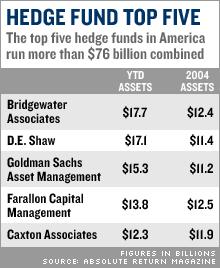
Recovery in What? asset inflation?

click to enlarge
In 1997 corporate profits actually peaked, but we know stock market didn't. We see workweek peaked at this time, and so did pressure for higher wages.
Now we know about record fiat inflation and stimulus, lowest interest rates in 45 years, record housing sales etc etc, but look at flacid work week!!!! literally NO improvement and I say WHAT RECOVERY!!
Duratek.....things are not what they seem, at least to people who don't read my blog! LOL
ONE SIDED CONVERSATION
Watchdog warns of global energy crisis
"Peak Oil" "Energy Crisis" and 10's of new titles blaring the new theme, "we're running out of oil". And you also see 100's of taglines "high energy prices causing inflation" or variation thereof.
What you don't read is a word about potential DEFLATION! Think about it, is the threat to our economy a lack of goods to buy?
Are too few homes for sale? Cars? Stuff at WalMart? NO! we have an overcapacity issue, not a shortage of goods to sell.
But when going out to buy, after paying more for gas, health care and tuition, you have LESS to spend on consumption, leading to "too few $$$ chasing too many goods", is that why last month the savings rate fell to its LOWEST record ever since it was tracked? a NEGATIVE value?
At the same time we have an energy crisis? addt'l RESERVE OIL is coming onto market, with higher prices isn't it possible demand will fall as consumers adjust their driving habbits? at the same time we have reports of highest bullish opinions towards energy in some cases 10 to 16 years?
Such a crowded play, don'T count me in. MANY investors are showing gains only dreamed of, and from what I hear, have NO reason to TAKE their paper profits.
The action of gold and silver IMHO do not back up idea of runaway inflation but speak volumes of another outcome.
Duratek
"Peak Oil" "Energy Crisis" and 10's of new titles blaring the new theme, "we're running out of oil". And you also see 100's of taglines "high energy prices causing inflation" or variation thereof.
What you don't read is a word about potential DEFLATION! Think about it, is the threat to our economy a lack of goods to buy?
Are too few homes for sale? Cars? Stuff at WalMart? NO! we have an overcapacity issue, not a shortage of goods to sell.
But when going out to buy, after paying more for gas, health care and tuition, you have LESS to spend on consumption, leading to "too few $$$ chasing too many goods", is that why last month the savings rate fell to its LOWEST record ever since it was tracked? a NEGATIVE value?
At the same time we have an energy crisis? addt'l RESERVE OIL is coming onto market, with higher prices isn't it possible demand will fall as consumers adjust their driving habbits? at the same time we have reports of highest bullish opinions towards energy in some cases 10 to 16 years?
Such a crowded play, don'T count me in. MANY investors are showing gains only dreamed of, and from what I hear, have NO reason to TAKE their paper profits.
The action of gold and silver IMHO do not back up idea of runaway inflation but speak volumes of another outcome.
Duratek
Monday, September 05, 2005
NIKK
Japan's market up again overnight, IMHO is coming BACK to underside of broken trendline formed from 2003 lows.
If I am right, a decline should begin from near these levels. If I am wrong, could be breaking out from reverse H and S formation, with much higher prices ahead.
D
If I am right, a decline should begin from near these levels. If I am wrong, could be breaking out from reverse H and S formation, with much higher prices ahead.
D
My email to Northern Trust and INSIGHTS
Paul,
Most intelligent and insightful. When I look at your charts I see parabolic moves across the board. Banks and Energy are carrying the SPX, and it has the false appearence of strength or unwillingness to decline.
I believe current makeup of profits for the SPX are rather unhealthy and unsustainable as is our economy under its current foundation of excesses and imbalances.
SHOULD there be any retrace in housing values caused by any number of reasons, the cookie will crumble. And it's possible the current "energy crisis" could be the fuse.
Most intelligent and insightful. When I look at your charts I see parabolic moves across the board. Banks and Energy are carrying the SPX, and it has the false appearence of strength or unwillingness to decline.
I believe current makeup of profits for the SPX are rather unhealthy and unsustainable as is our economy under its current foundation of excesses and imbalances.
SHOULD there be any retrace in housing values caused by any number of reasons, the cookie will crumble. And it's possible the current "energy crisis" could be the fuse.
Our facts are right, even if the future somehow turns out different than the implied outcome the historic extremes portend. I am in 100% Cash just in case.
Paul's response....."I think you are onto something."
Indeed I am! More random thoughts:
Cash levels at mutual funds now 3.9%, a tad below the 4% at bubble mania top.
Bond yield curve near to inverting= rcession=weakening corporate profits=lower prices.
Bullish plurality string remains unbroken approaching 150 consecutive weeks. only 9 bearish weeks since bear market began. Last bear market saw over 40 consecutive bearish plurality weeks.
AT last bear bottom SPX dividends appproached 6% they are now below 2%. PE ratio was single digits, now near 20, was 30 at OCT bottom. Dividend tax deductions have done little to raise this avgh.
Economy is sustained only by ability of consumers to take on more debt and expand credit beyond historic extremes.
Doug Noland writes: Broad money supply (M3) surged $59 billion to a record $9.898 Trillion (week of August 22). Year-to-date, M3 has expanded at a 6.8% rate, with M3-less Money Funds expanding at a 8.3% pace. M3 has expanded $273 billon over the past 14 weeks, or 10.5% annualized.
So no matter what Greenspan says or does, this is what matters. $59 B in one week is extroadinary and is a CRISIS level.
Inability to get long rates to rise, especially if now FED halts puny .25 short term moves, is perpetuating and exaserbating the Housing BUBBLE. Halt rates and is sign economy is in deep Kimchee, halt rise and watch the dollar tumble.
Gold remains below its 2004 highs.Silver as well, has the reflation attempt lost steam and is failing?
Hasn't energy crisis and housing fueled inflation in many sectors at same time we have world overcapacity feeding deflation?
Cost of fuel has nearly doubled in weeks, not months, strongly affecting consumers as seen in weak WMT stock. Financials are weak. ENERGY holds the SPX from tumbling profits, as I said early on, the SPX earnings are imbalanced and concentrated in a few issues.
BDI index has declined from std FIB retrace of initial plunge.Transports are weak, high fuel and less travel spell trouble for Airlines.
Institutions desperate for returns have flooded Hedge Funds with cash.
Beginning next week, traders at full strength, approaching markets weakest seasonal.
Large speculators historic long in gold, yet price below previous highs, what ammo left long?
It is taking exceedingly more and more fiat trash to stimulate less and less in the economy NOT more bang for buck.
Cash is OUTPERFORMING stock market since 1999!!!!!!!! Couldn't tell from bullish readings.
The whole world expects energy to continue higher, money flows into energy are dramatic and extreme ovebrought, ripe for correction.High prices could curtail consumption, less demand leads to lower prices just as extreme piling on long.
I am 100% cash, what are you?
Duratek
Saturday, September 03, 2005
Parabola Leads to Precipice

(click to enlarge)
Back in 2000 this indicator relating the fear to the price one would pay for the SPX topped out and was ONE relationship which helped to signal the long running bull was DOA. We rose to over 30% HIGHER than bubble reading during this "recovery". It appears this ratio has topped and is putting finishing touches of right shoulder.When 20 wk plows thru 50wk moving avg as it is leaning to do, it will be loud warning that Bear market phase II may have begun.A break of 10,000 on Dow thi stime will bring in heavy selling IMHO.
Now we had FED manning the money pumps night and day and damn if they didn't resuscitate the bitch! (up hefty $50B plus last week alone)
LOOK what it did to the housing market, brought in the f'ing speculators, banks are ill-prepared for loan defaults as they whored out loans using piggyback methods and interest only tags.......putting unsaavy new home owners in over their head, buying more house than they can afford.
FED cannot control long rates as they have fallen even as short ones rise??
Katrina moved the FED to pump $50 Billion into money supply last week. Will more money keep the ship afloat? ALL problems are solved the same way for this fleecing flim flam squad.
Alan G met with Bush last week, why do you suppose...."Mr G, hold back rate increases because of Katrina" Yields collapsed now 4%
Even if temporary high energy prices are never going back to the good old days. Past history, energy shocks have caused Recessions.
Consumer Confidence may fall, spending may fall further effecting corporate profits.
Is rebuilding below sea level a good idea? many will never return after this tragedy and trauma. Rebuilding will not begin for months and will cover many years, so its effect on economy won't be dramatic, it is balanced by what we lost.
We have bad government, run by special interest groups and the in crowd of which Bush shades.Cheating and stealing from the likes of Haliburton only caused stock to rise to new highs.Bills for energy give mostly to already rich energy companies, there is NOTHING for conservation or improving MPG!!?? we have bad government.
Some worthless Roads spending goes mostly to whom chairs the committee, like Alaska.
We are indirectly taxed when more fiat dollars flood the system and erode our purchasing power....and policies lead to ramapant housing inflation and parabola moves in commodities.
A box of f'ing cereal is $4. (BS Masters of Reality in background)
The spread between haves and nots going parabolic under Bush and his tax cuts for rich.
Jobs created mostly minimum wage jobs. 4.9% unemployment?????
Excuse me, shouldn't rampant need of workers cause a swell in their paychecks? NAGHHHHHH
Duratek
Economy Rests here

click to enlarge
The prime beneficiary of Greenspan reflation, a STEEP decline is imminent,IMHO, you will see it here. Banks are subject to serious losses should the housing bubble burst.
Weakness in MACD since 2003 peak is liken to an Olympic swimmer reduced to dog paddling.
MORE STRESS and TRUTH
Big oil's bigtime looting *(thanks to Eric S for the heads up) I can see my blood BOIL! D
By Derrick Z. Jackson September 2, 2005
PRESIDENT BUSH yesterday told ABC-TV, ''there ought to be zero tolerance of people breaking the law during an emergency such as this, whether it be looting or price-gouging at the gasoline pump or taking advantage of charitable giving or insurance fraud."
Zero tolerance is meaningless when the White House lets the biggest looters of Hurricane Katrina walk off with billions of dollars.
We are not referring to the people you currently see in endless footage, crashing through storefronts and wading through chest-high water with clothes, food, and pharmaceuticals. Some folks are disgusting in their thuggishness, but a great many others are simply desperate, having now gone three days without food or water. The latter are living out one of the most famous hypothetical problems in moral reasoning -- should a husband steal a cancer drug he cannot afford for his dying wife?
No such sympathy is to be extended to big oil. The nation has on its hands a disaster so profound that we have not even begun to seriously count the bodies in the floodwaters. It brings us as close as we may get in our lifetime to places like Bangladesh.
New Orleans is under martial law and will not return to normal for years. Members of the Red Cross, the Coast Guard, the National Guard, police agencies, and firefighters are sacrificing time and risking lives to save lives. Texas is opening up its school systems for homeless Louisiana children. Generous food wholesalers are giving away their stocks to passersby. The Astrodome is taking in the refugees of the Superdome.
In the midst of this charity, big oil looted the nation. The pumps instantly shot past $3 a gallon, with $4 a gallon well in sight.
In a thinly disguised attempt to act as if it cared about the people wading in the water, Chevron has pledged $5 million to relief efforts. ExxonMobil and Shell have pledged $2 million apiece. British Petroleum and Citgo have pledged $1 million each.
This is nothing next to their wealth. Of the world's seven most profitable corporations, four are ExxonMobil, Royal Dutch Shell, BP, and Chevron. ExxonMobil is the world's most profitable company, making $25.3 billion last year. It and the other three corporations had combined profits last year of $72.8 billion. ExxonMobil is also the world's most valuable company, with a market value, according to Forbes magazine, of $405 billion. The combined market value of ExxonMobil, BP, Royal Dutch Shell, and Chevron is nearly $1 trillion.
And that was last year. A month ago, ExxonMobil, Chevron, and ConocoPhillips announced record second-quarter profits of $7.6 billion, $3.7 billion, and $3.1 billion, respectively. Royal Dutch Shell's quarterly profits of $5.2 billion were up by 34 percent over the same period last year. Other well-known companies like Sunoco also had record second-quarter earnings.
If ExxonMobil were to maintain its current pace of profits, it would cross the $30 billion barrier for 2005. The company's chief financial officer, Henry Hubble, bragged in classic corporatese, ''Our disciplined project management and operating practices deliver the benefits of strong industry conditions to our shareholders."
Those disciplined operating practices are hardly confined to the oil fields. Everyone knows that Bush does not really mean what he says about price-gouging at the pump, since he just gave energy companies the bulk of $14.5 billion in tax breaks in the new energy bill. Surprise, surprise. In Bush's two elections, oil and gas companies gave Republicans 79 percent of their $61.5 million in campaign contributions, according to the Center for Responsive Politics.
If Bush really meant what he said, he would call for a freeze or cap on gasoline prices, especially in the regions affected most dramatically by Katrina. He would challenge big oil to come up with a much more meaningful contribution to relief efforts.
Insurance companies are expecting up to $25 billion in claims from Katrina. For ExxonMobil, which is headed to $30 billion in profits, to jack up prices at the pump and then only throw $2 million at relief efforts is unconscionable.
Stay fixated, if you wish, on the thieves and desperate families who are so much easier to catch on camera than comptrollers electronically stealing your cash. It is not pleasant to see anyone loot a store. But ExxonMobil and big oil are looting the nation, and no one declaring martial law on them.
Derrick Z. Jackson's e-mail address is jackson@globe.com.
By Derrick Z. Jackson September 2, 2005
PRESIDENT BUSH yesterday told ABC-TV, ''there ought to be zero tolerance of people breaking the law during an emergency such as this, whether it be looting or price-gouging at the gasoline pump or taking advantage of charitable giving or insurance fraud."
Zero tolerance is meaningless when the White House lets the biggest looters of Hurricane Katrina walk off with billions of dollars.
We are not referring to the people you currently see in endless footage, crashing through storefronts and wading through chest-high water with clothes, food, and pharmaceuticals. Some folks are disgusting in their thuggishness, but a great many others are simply desperate, having now gone three days without food or water. The latter are living out one of the most famous hypothetical problems in moral reasoning -- should a husband steal a cancer drug he cannot afford for his dying wife?
No such sympathy is to be extended to big oil. The nation has on its hands a disaster so profound that we have not even begun to seriously count the bodies in the floodwaters. It brings us as close as we may get in our lifetime to places like Bangladesh.
New Orleans is under martial law and will not return to normal for years. Members of the Red Cross, the Coast Guard, the National Guard, police agencies, and firefighters are sacrificing time and risking lives to save lives. Texas is opening up its school systems for homeless Louisiana children. Generous food wholesalers are giving away their stocks to passersby. The Astrodome is taking in the refugees of the Superdome.
In the midst of this charity, big oil looted the nation. The pumps instantly shot past $3 a gallon, with $4 a gallon well in sight.
In a thinly disguised attempt to act as if it cared about the people wading in the water, Chevron has pledged $5 million to relief efforts. ExxonMobil and Shell have pledged $2 million apiece. British Petroleum and Citgo have pledged $1 million each.
This is nothing next to their wealth. Of the world's seven most profitable corporations, four are ExxonMobil, Royal Dutch Shell, BP, and Chevron. ExxonMobil is the world's most profitable company, making $25.3 billion last year. It and the other three corporations had combined profits last year of $72.8 billion. ExxonMobil is also the world's most valuable company, with a market value, according to Forbes magazine, of $405 billion. The combined market value of ExxonMobil, BP, Royal Dutch Shell, and Chevron is nearly $1 trillion.
And that was last year. A month ago, ExxonMobil, Chevron, and ConocoPhillips announced record second-quarter profits of $7.6 billion, $3.7 billion, and $3.1 billion, respectively. Royal Dutch Shell's quarterly profits of $5.2 billion were up by 34 percent over the same period last year. Other well-known companies like Sunoco also had record second-quarter earnings.
If ExxonMobil were to maintain its current pace of profits, it would cross the $30 billion barrier for 2005. The company's chief financial officer, Henry Hubble, bragged in classic corporatese, ''Our disciplined project management and operating practices deliver the benefits of strong industry conditions to our shareholders."
Those disciplined operating practices are hardly confined to the oil fields. Everyone knows that Bush does not really mean what he says about price-gouging at the pump, since he just gave energy companies the bulk of $14.5 billion in tax breaks in the new energy bill. Surprise, surprise. In Bush's two elections, oil and gas companies gave Republicans 79 percent of their $61.5 million in campaign contributions, according to the Center for Responsive Politics.
If Bush really meant what he said, he would call for a freeze or cap on gasoline prices, especially in the regions affected most dramatically by Katrina. He would challenge big oil to come up with a much more meaningful contribution to relief efforts.
Insurance companies are expecting up to $25 billion in claims from Katrina. For ExxonMobil, which is headed to $30 billion in profits, to jack up prices at the pump and then only throw $2 million at relief efforts is unconscionable.
Stay fixated, if you wish, on the thieves and desperate families who are so much easier to catch on camera than comptrollers electronically stealing your cash. It is not pleasant to see anyone loot a store. But ExxonMobil and big oil are looting the nation, and no one declaring martial law on them.
Derrick Z. Jackson's e-mail address is jackson@globe.com.
Sept Richebacher slice
BEST OF KURT RICHEBACHER
September 1, 2005
It is now fully 14 months since the Greenspan team at the Federal Reserve started its rate hikes at a very "measured pace." Its short-term federal funds rate is up 250 basis points altogether, from 1% to 3.5%. If it were their intention, as we assume, to exert no restraint at all on borrowing, they have fully achieved this goal.
Notoriously, yields of 10-year Treasury notes, the benchmark rate for the long-term area, fell by 50 basis points over this period, from 4.7% to 4.2%, and sometimes lower. Yet looking for restraint, the critical aggregate is credit expansion. It has gone through the roof.
Bank credit has expanded $544.7 billion year to date, or 13.5% annualized. Among this total, security credit gained $145.6 billion, up 12.7% annualized. Commercial and industrial loans have surged at an annualized rate of 18.8%. Real estate loans are up at an annualized rate of 16.7%. Year to date, asset-backed securities (ABS) issuance is up $451 billion, i.e., 21% ahead of comparable 2004. Home equity loan ABS issuance of $286 billion is 24% above its growth in 2004’s same period.
Compare these stellar growth rates of credit with the reported real GDP growth of 3.6% annualized during the first half of 2005. Credit and debt is growing out of any reasonable proportion to real GDP. We hasten to repeat our regular proviso that owing to grossly understated inflation rates, we regard these reported growth rates as grossly overstated.
Another disquieting counterpart to this credit insanity is the protracted, sharp slowdown in money growth. M3 is up 5.4% at annualized rate over the last six months, and M2 only 2.3%.
Normally, credit and money grow together. But two things disrupt this connection: the huge and rising import surplus and the escalating Ponzi finance. Soaring interest expenses are increasingly met with new credit. What keeps the national Ponzi scheme going is the common illusion that rising asset prices are creating wealth.
And there is still another critical point to see. While household holdings of liquid assets keep rising, they are collapsing in relation to outstanding debts and holdings of illiquid assets. The liquidity preference of private households is apparently deep in negative territory but is eagerly accommodated by banks and other lenders.
It is our long-held conviction that the U.S. economy has entered a new slowdown, as the prior massive monetary and fiscal stimulus has petered out. There is nothing in sight to generate self-sustaining growth. Essentially, this would have to be a capital-spending boom big enough to take over for the housing bubble. But that is totally out of the question.
Several major economic data have recently surprised on the positive side. On closer look, we note that both the Bureau of Economic Analysis and the Bureau of Labor Statistics have recently become unusually aggressive in bending figures to show desired results.
* * * * * *
The world economy seems to be flooded with liquidity. But there are two diametrically different kinds of liquidity: earned liquidity and borrowed liquidity. The former comes from surplus income or savings; the latter comes from credit and debt creation.
In a country with virtually zero savings like the United States, any liquidity essentially arises from debt creation. This is really fake liquidity depending on permanent, prodigious borrowing facilities, presently the housing bubble. Once this bubble evaporates or bursts, the U.S. economy loses its chief liquidity source — with disastrous effects on asset prices.
The crucial question concerning the U.S. economy is whether it is slowing or accelerating. As explained in detail, we see a lot of fudge in the recent economic data. Our main critical consideration is that a self-sustaining recovery would absolutely require a strong rebound in business investment. But that is not in sight. On the other hand, the turnaround in the housing bubble is only a question of time. A fairly short time, we think.
The consensus expects that the U.S. economy has the "soft spot" behind it and will surprise positively. We expect shocking economic weakness. All asset prices, depending on carry trade, are in danger, including bonds.
For Subscription Information Contact:
THE RICHEBACHER LETTER
808 St. Paul Street
Baltimore, MD 21202
http://www.agora-inc.com/reports/RCH/broke918
Rate: $497
Published by Agora Publishing Inc.
All Rights Reserved © 2002 Investment Rarities, Inc.For Web Site Questions Contact the Web MasterDisclaimer
September 1, 2005
It is now fully 14 months since the Greenspan team at the Federal Reserve started its rate hikes at a very "measured pace." Its short-term federal funds rate is up 250 basis points altogether, from 1% to 3.5%. If it were their intention, as we assume, to exert no restraint at all on borrowing, they have fully achieved this goal.
Notoriously, yields of 10-year Treasury notes, the benchmark rate for the long-term area, fell by 50 basis points over this period, from 4.7% to 4.2%, and sometimes lower. Yet looking for restraint, the critical aggregate is credit expansion. It has gone through the roof.
Bank credit has expanded $544.7 billion year to date, or 13.5% annualized. Among this total, security credit gained $145.6 billion, up 12.7% annualized. Commercial and industrial loans have surged at an annualized rate of 18.8%. Real estate loans are up at an annualized rate of 16.7%. Year to date, asset-backed securities (ABS) issuance is up $451 billion, i.e., 21% ahead of comparable 2004. Home equity loan ABS issuance of $286 billion is 24% above its growth in 2004’s same period.
Compare these stellar growth rates of credit with the reported real GDP growth of 3.6% annualized during the first half of 2005. Credit and debt is growing out of any reasonable proportion to real GDP. We hasten to repeat our regular proviso that owing to grossly understated inflation rates, we regard these reported growth rates as grossly overstated.
Another disquieting counterpart to this credit insanity is the protracted, sharp slowdown in money growth. M3 is up 5.4% at annualized rate over the last six months, and M2 only 2.3%.
Normally, credit and money grow together. But two things disrupt this connection: the huge and rising import surplus and the escalating Ponzi finance. Soaring interest expenses are increasingly met with new credit. What keeps the national Ponzi scheme going is the common illusion that rising asset prices are creating wealth.
And there is still another critical point to see. While household holdings of liquid assets keep rising, they are collapsing in relation to outstanding debts and holdings of illiquid assets. The liquidity preference of private households is apparently deep in negative territory but is eagerly accommodated by banks and other lenders.
It is our long-held conviction that the U.S. economy has entered a new slowdown, as the prior massive monetary and fiscal stimulus has petered out. There is nothing in sight to generate self-sustaining growth. Essentially, this would have to be a capital-spending boom big enough to take over for the housing bubble. But that is totally out of the question.
Several major economic data have recently surprised on the positive side. On closer look, we note that both the Bureau of Economic Analysis and the Bureau of Labor Statistics have recently become unusually aggressive in bending figures to show desired results.
* * * * * *
The world economy seems to be flooded with liquidity. But there are two diametrically different kinds of liquidity: earned liquidity and borrowed liquidity. The former comes from surplus income or savings; the latter comes from credit and debt creation.
In a country with virtually zero savings like the United States, any liquidity essentially arises from debt creation. This is really fake liquidity depending on permanent, prodigious borrowing facilities, presently the housing bubble. Once this bubble evaporates or bursts, the U.S. economy loses its chief liquidity source — with disastrous effects on asset prices.
The crucial question concerning the U.S. economy is whether it is slowing or accelerating. As explained in detail, we see a lot of fudge in the recent economic data. Our main critical consideration is that a self-sustaining recovery would absolutely require a strong rebound in business investment. But that is not in sight. On the other hand, the turnaround in the housing bubble is only a question of time. A fairly short time, we think.
The consensus expects that the U.S. economy has the "soft spot" behind it and will surprise positively. We expect shocking economic weakness. All asset prices, depending on carry trade, are in danger, including bonds.
For Subscription Information Contact:
THE RICHEBACHER LETTER
808 St. Paul Street
Baltimore, MD 21202
http://www.agora-inc.com/reports/RCH/broke918
Rate: $497
Published by Agora Publishing Inc.
All Rights Reserved © 2002 Investment Rarities, Inc.For Web Site Questions Contact the Web MasterDisclaimer

Illusion of Wealth

click to enlarge
http://home.earthlink.net/~intelligentbear/com-dj-infl.htm DO you doubt our next stop might be bottom of trend channel?
As shown our previous bubble in 1929 took us up to top of channel, which forced us back to lower line. 2000 bubble dwarfed 1929's in every respect.
D
May 2004 Storm Watch
http://www.financialsense.com/stormwatch/oldupdates/2004/0514.html
Puplava saw it coming and was writing common sense BEFORE 2000 and then after. I credit Jim for turning me to the "Dark side" LOL his "Perfect Storm" series was the first contrarian articel I read and sparked my interest I continue to this day.
You will read and ten think fast forward to Sept 2005 and the imbalaces are exponentially worse.
D....sorry folks, there is NO happy ending here.
Puplava saw it coming and was writing common sense BEFORE 2000 and then after. I credit Jim for turning me to the "Dark side" LOL his "Perfect Storm" series was the first contrarian articel I read and sparked my interest I continue to this day.
You will read and ten think fast forward to Sept 2005 and the imbalaces are exponentially worse.
D....sorry folks, there is NO happy ending here.
ARE we talking about the 70's???
To hear some tell it, when America finally woke up and smelled the seventies, something stank. Gone was the sweetly perfumed peace, love, and understanding of prosperous post-war America. Gone, too, was the fresh-faced idealism and clean-cut complacency of a million year book photographs.
In their place: Disillusionment with big government, big enterprise, and big institutions; dissatisfaction with the status quo, and a disturbing rise in crime, inflation, and mistrust.
By the time The Exorcist was nauseating movie-goers and Tony Orlando and Dawn were singing about yellow ribbons and oak trees, the American landscape was littered with the political detritus and lingering shock of Kent State, Vietnam, Watergate, double digit inflation, war in Cambodia, and the Arab oil crisis. And that was only 1973
In their place: Disillusionment with big government, big enterprise, and big institutions; dissatisfaction with the status quo, and a disturbing rise in crime, inflation, and mistrust.
By the time The Exorcist was nauseating movie-goers and Tony Orlando and Dawn were singing about yellow ribbons and oak trees, the American landscape was littered with the political detritus and lingering shock of Kent State, Vietnam, Watergate, double digit inflation, war in Cambodia, and the Arab oil crisis. And that was only 1973
A Can't-Do Government
A Can't-Do Government By Paul Krugman The New York Times
Friday 02 September 2005
Before 9/11 the Federal Emergency Management Agency listed the three most likely catastrophic disasters facing America: a terrorist attack on New York, a major earthquake in San Francisco and a hurricane strike on New Orleans. "The New Orleans hurricane scenario," The Houston Chronicle wrote in December 2001, "may be the deadliest of all." It described a potential catastrophe very much like the one now happening.
So why were New Orleans and the nation so unprepared? After 9/11, hard questions were deferred in the name of national unity, then buried under a thick coat of whitewash. This time, we need accountability.
First question: Why have aid and security taken so long to arrive? Katrina hit five days ago - and it was already clear by last Friday that Katrina could do immense damage along the Gulf Coast. Yet the response you'd expect from an advanced country never happened. Thousands of Americans are dead or dying, not because they refused to evacuate, but because they were too poor or too sick to get out without help - and help wasn't provided. Many have yet to receive any help at all.
There will and should be many questions about the response of state and local governments; in particular, couldn't they have done more to help the poor and sick escape? But the evidence points, above all, to a stunning lack of both preparation and urgency in the federal government's response.
Even military resources in the right place weren't ordered into action. "On Wednesday," said an editorial in The Sun Herald in Biloxi, Miss., "reporters listening to horrific stories of death and survival at the Biloxi Junior High School shelter looked north across Irish Hill Road and saw Air Force personnel playing basketball and performing calisthenics. Playing basketball and performing calisthenics!"
Maybe administration officials believed that the local National Guard could keep order and deliver relief. But many members of the National Guard and much of its equipment - including high-water vehicles - are in Iraq. "The National Guard needs that equipment back home to support the homeland security mission," a Louisiana Guard officer told reporters several weeks ago.
Second question: Why wasn't more preventive action taken? After 2003 the Army Corps of Engineers sharply slowed its flood-control work, including work on sinking levees. "The corps," an Editor and Publisher article says, citing a series of articles in The Times-Picayune in New Orleans, "never tried to hide the fact that the spending pressures of the war in Iraq, as well as homeland security - coming at the same time as federal tax cuts - was the reason for the strain."
In 2002 the corps' chief resigned, reportedly under threat of being fired, after he criticized the administration's proposed cuts in the corps' budget, including flood-control spending.
Third question: Did the Bush administration destroy FEMA's effectiveness? The administration has, by all accounts, treated the emergency management agency like an unwanted stepchild, leading to a mass exodus of experienced professionals.
Last year James Lee Witt, who won bipartisan praise for his leadership of the agency during the Clinton years, said at a Congressional hearing: "I am extremely concerned that the ability of our nation to prepare for and respond to disasters has been sharply eroded. I hear from emergency managers, local and state leaders, and first responders nearly every day that the FEMA they knew and worked well with has now disappeared."
I don't think this is a simple tale of incompetence. The reason the military wasn't rushed in to help along the Gulf Coast is, I believe, the same reason nothing was done to stop looting after the fall of Baghdad. Flood control was neglected for the same reason our troops in Iraq didn't get adequate armor.
At a fundamental level, I'd argue, our current leaders just aren't serious about some of the essential functions of government. They like waging war, but they don't like providing security, rescuing those in need or spending on preventive measures. And they never, ever ask for shared sacrifice.
Yesterday Mr. Bush made an utterly fantastic claim: that nobody expected the breach of the levees. In fact, there had been repeated warnings about exactly that risk.
So America, once famous for its can-do attitude, now has a can't-do government that makes excuses instead of doing its job. And while it makes those excuses, Americans are dying.
Friday 02 September 2005
Before 9/11 the Federal Emergency Management Agency listed the three most likely catastrophic disasters facing America: a terrorist attack on New York, a major earthquake in San Francisco and a hurricane strike on New Orleans. "The New Orleans hurricane scenario," The Houston Chronicle wrote in December 2001, "may be the deadliest of all." It described a potential catastrophe very much like the one now happening.
So why were New Orleans and the nation so unprepared? After 9/11, hard questions were deferred in the name of national unity, then buried under a thick coat of whitewash. This time, we need accountability.
First question: Why have aid and security taken so long to arrive? Katrina hit five days ago - and it was already clear by last Friday that Katrina could do immense damage along the Gulf Coast. Yet the response you'd expect from an advanced country never happened. Thousands of Americans are dead or dying, not because they refused to evacuate, but because they were too poor or too sick to get out without help - and help wasn't provided. Many have yet to receive any help at all.
There will and should be many questions about the response of state and local governments; in particular, couldn't they have done more to help the poor and sick escape? But the evidence points, above all, to a stunning lack of both preparation and urgency in the federal government's response.
Even military resources in the right place weren't ordered into action. "On Wednesday," said an editorial in The Sun Herald in Biloxi, Miss., "reporters listening to horrific stories of death and survival at the Biloxi Junior High School shelter looked north across Irish Hill Road and saw Air Force personnel playing basketball and performing calisthenics. Playing basketball and performing calisthenics!"
Maybe administration officials believed that the local National Guard could keep order and deliver relief. But many members of the National Guard and much of its equipment - including high-water vehicles - are in Iraq. "The National Guard needs that equipment back home to support the homeland security mission," a Louisiana Guard officer told reporters several weeks ago.
Second question: Why wasn't more preventive action taken? After 2003 the Army Corps of Engineers sharply slowed its flood-control work, including work on sinking levees. "The corps," an Editor and Publisher article says, citing a series of articles in The Times-Picayune in New Orleans, "never tried to hide the fact that the spending pressures of the war in Iraq, as well as homeland security - coming at the same time as federal tax cuts - was the reason for the strain."
In 2002 the corps' chief resigned, reportedly under threat of being fired, after he criticized the administration's proposed cuts in the corps' budget, including flood-control spending.
Third question: Did the Bush administration destroy FEMA's effectiveness? The administration has, by all accounts, treated the emergency management agency like an unwanted stepchild, leading to a mass exodus of experienced professionals.
Last year James Lee Witt, who won bipartisan praise for his leadership of the agency during the Clinton years, said at a Congressional hearing: "I am extremely concerned that the ability of our nation to prepare for and respond to disasters has been sharply eroded. I hear from emergency managers, local and state leaders, and first responders nearly every day that the FEMA they knew and worked well with has now disappeared."
I don't think this is a simple tale of incompetence. The reason the military wasn't rushed in to help along the Gulf Coast is, I believe, the same reason nothing was done to stop looting after the fall of Baghdad. Flood control was neglected for the same reason our troops in Iraq didn't get adequate armor.
At a fundamental level, I'd argue, our current leaders just aren't serious about some of the essential functions of government. They like waging war, but they don't like providing security, rescuing those in need or spending on preventive measures. And they never, ever ask for shared sacrifice.
Yesterday Mr. Bush made an utterly fantastic claim: that nobody expected the breach of the levees. In fact, there had been repeated warnings about exactly that risk.
So America, once famous for its can-do attitude, now has a can't-do government that makes excuses instead of doing its job. And while it makes those excuses, Americans are dying.
MONEY SUPPLY EXPLODES "Credit Bubble"
from Sept 2nd Doug Noland
"Broad money supply (M3) surged $59 billion to a record $9.898 Trillion (week of August 22). Year-to-date, M3 has expanded at a 6.8% rate, with M3-less Money Funds expanding at a 8.3% pace. M3 has expanded $273 billon over the past 14 weeks, or 10.5% annualized."
August 31 – Bloomberg (James Cordahi and Andy Critchlow): “Dubai’s economy is booming, thanks to record oil prices and surging real estate values. The Dubai Financial Market has more than tripled in value in 12 months. Each week brings more news of record profits for companies and announcements of yet another gigantic construction project. The $1 billion Burj Dubai, for example, is planned to be the world’s tallest building at more than 800 meters (2,625 feet) when it’s completed in 2009.” **(my company delivered $160K job to Saudi Arabia, our first! D)
Bubble Economy Watch:
September 1 - Dow Jones: “U.S. home prices surged an average 13.4% during the 12 months ended June 30, reflecting the largest yearly jump in 25 years,
The Office of Federal Housing Enterprise Oversight, which regulates Fannie Mae and Freddie Mac, said Thursday that U.S. house price growth doesn’t look like it will slow anytime soon. ‘On the contrary, house price inflation continues to accelerate as some areas that have experienced relatively slow appreciation are picking up steam,’ OFHEA Chief Economist Patrick Lawler said… ‘There is no evidence here of prices topping out.’”
September 1 – MarketNews: “The following is the text released…by Monster.com for its monthly index of employment for August: U.S. Online Job Demand Surges in August, Lifting Monster Employment Index to Highest Level Ever. Sharp Rise in Online Recruitment Activity Nationwide Indicates Continued Labor Market Strength as Fall Hiring Season Approaches… Index jumps 8 points to a record-high level of 142; up dramatically from July and 30 points higher compared to a year ago…” **(IF GREENSPAN stops rate increases there will be a stiff price to pay)
‘Capital continues to flow into the commercial and multifamily real estate markets on both the debt and equity sides,’ noted Douglas Duncan, MBA chief economist
I will not address the markets, economy, “money,” or Credit during the week of our nation’s most tragic natural disaster.
And, like many, I am appalled by our federal government’s response to a disaster that was anything but unpredictable.
Especially considering the amount of money and resources devoted to national defense and homeland security, this week was a national disgrace. Doug Noland
"Broad money supply (M3) surged $59 billion to a record $9.898 Trillion (week of August 22). Year-to-date, M3 has expanded at a 6.8% rate, with M3-less Money Funds expanding at a 8.3% pace. M3 has expanded $273 billon over the past 14 weeks, or 10.5% annualized."
August 31 – Bloomberg (James Cordahi and Andy Critchlow): “Dubai’s economy is booming, thanks to record oil prices and surging real estate values. The Dubai Financial Market has more than tripled in value in 12 months. Each week brings more news of record profits for companies and announcements of yet another gigantic construction project. The $1 billion Burj Dubai, for example, is planned to be the world’s tallest building at more than 800 meters (2,625 feet) when it’s completed in 2009.” **(my company delivered $160K job to Saudi Arabia, our first! D)
Bubble Economy Watch:
September 1 - Dow Jones: “U.S. home prices surged an average 13.4% during the 12 months ended June 30, reflecting the largest yearly jump in 25 years,
The Office of Federal Housing Enterprise Oversight, which regulates Fannie Mae and Freddie Mac, said Thursday that U.S. house price growth doesn’t look like it will slow anytime soon. ‘On the contrary, house price inflation continues to accelerate as some areas that have experienced relatively slow appreciation are picking up steam,’ OFHEA Chief Economist Patrick Lawler said… ‘There is no evidence here of prices topping out.’”
September 1 – MarketNews: “The following is the text released…by Monster.com for its monthly index of employment for August: U.S. Online Job Demand Surges in August, Lifting Monster Employment Index to Highest Level Ever. Sharp Rise in Online Recruitment Activity Nationwide Indicates Continued Labor Market Strength as Fall Hiring Season Approaches… Index jumps 8 points to a record-high level of 142; up dramatically from July and 30 points higher compared to a year ago…” **(IF GREENSPAN stops rate increases there will be a stiff price to pay)
‘Capital continues to flow into the commercial and multifamily real estate markets on both the debt and equity sides,’ noted Douglas Duncan, MBA chief economist
I will not address the markets, economy, “money,” or Credit during the week of our nation’s most tragic natural disaster.
And, like many, I am appalled by our federal government’s response to a disaster that was anything but unpredictable.
Especially considering the amount of money and resources devoted to national defense and homeland security, this week was a national disgrace. Doug Noland
Friday, September 02, 2005
KATRINA BOOM?
Balderdash! some "noted" letter writers have exhalted "see the coming Katrina Super Bull".......blahbede blah.
Now read common sense: August 31, 2005
Hurricane Katrina Had No Silver Lining!
by Paul Kasriel
Inevitably, some perky economic analyst is going to say that despite the death and destruction Hurricane Katrina visited on the poor souls who populate Gulf coasts of Alabama, Mississippi and Louisiana, it had a "silver lining" as it will stimulate economic activity via new building, clean-up, etc. Balderdash! Katrina contained no silver lining.
Firstly, there is never any silver lining to the death and injury of human beings. Secondly, although there will be expenditures made to clean up the mess and rebuild damaged/destroyed structures, there will be other expenditures not made that otherwise would have. I doubt that folks will be going to the movies or on vacation as much now that they have to spend more on rebuilding. There will be a change in the composition of spending, not in its total. Government disaster aid represents a redistribution of income.
So, the givers of aid spend less and the receivers spend more - net, net, a wash. Thirdly, there has been a loss of real wealth. Katrina represented accelerated depreciation. Structures and other tangible assets were destroyed. That means that the services or "income" these tangible assets produced - shelter, transportation - have disappeared.
The production of capital assets entails the postponement of current consumption. So, some people are going to have to defer current consumption so that finite resources can be used to reproduce capital assets.
If hurricanes or other natural disasters contained economic silver linings, we wouldn't have to wait for Mother Nature's serendipities. We could create man-made ones. Short of wars, which destroy not only physical capital but human capital, too, we could blow-up neighborhoods after giving residents a "heads up" to gather their mementos and vacate their homes.
Wow! Think of all the economic activity we could generate. This concept of man-made disasters as good for the economy sounds silly, doesn't it? No sillier than the analysts who will declare that there is an economic silver lining in Hurricane Katrina.
Also see his AUG 25th missive called INXS 9 page pdf file.
Paul L. Kasriel, Director of Economic ResearchThe Northern Trust CompanyEconomic Research DepartmentPositive Economic Commentary"The economics of what is, rather than what you might like it to be."50 South LaSalle Street, Chicago, Illinois 60675
Now read common sense: August 31, 2005
Hurricane Katrina Had No Silver Lining!
by Paul Kasriel
Inevitably, some perky economic analyst is going to say that despite the death and destruction Hurricane Katrina visited on the poor souls who populate Gulf coasts of Alabama, Mississippi and Louisiana, it had a "silver lining" as it will stimulate economic activity via new building, clean-up, etc. Balderdash! Katrina contained no silver lining.
Firstly, there is never any silver lining to the death and injury of human beings. Secondly, although there will be expenditures made to clean up the mess and rebuild damaged/destroyed structures, there will be other expenditures not made that otherwise would have. I doubt that folks will be going to the movies or on vacation as much now that they have to spend more on rebuilding. There will be a change in the composition of spending, not in its total. Government disaster aid represents a redistribution of income.
So, the givers of aid spend less and the receivers spend more - net, net, a wash. Thirdly, there has been a loss of real wealth. Katrina represented accelerated depreciation. Structures and other tangible assets were destroyed. That means that the services or "income" these tangible assets produced - shelter, transportation - have disappeared.
The production of capital assets entails the postponement of current consumption. So, some people are going to have to defer current consumption so that finite resources can be used to reproduce capital assets.
If hurricanes or other natural disasters contained economic silver linings, we wouldn't have to wait for Mother Nature's serendipities. We could create man-made ones. Short of wars, which destroy not only physical capital but human capital, too, we could blow-up neighborhoods after giving residents a "heads up" to gather their mementos and vacate their homes.
Wow! Think of all the economic activity we could generate. This concept of man-made disasters as good for the economy sounds silly, doesn't it? No sillier than the analysts who will declare that there is an economic silver lining in Hurricane Katrina.
Also see his AUG 25th missive called INXS 9 page pdf file.
Paul L. Kasriel, Director of Economic ResearchThe Northern Trust CompanyEconomic Research DepartmentPositive Economic Commentary"The economics of what is, rather than what you might like it to be."50 South LaSalle Street, Chicago, Illinois 60675
WATCH THE VIX
Click for larger Notice how 20 EMA is acting as support, and the trend for now is UP. If continues, nervous investors are more prone to SELL>
D
 Notice how 20 EMA is acting as support, and the trend for now is UP. If continues, nervous investors are more prone to SELL>
D
Listen in with my friend Pieter
*(I share his email to me) well done Pieter, we have the line drawn now!
Michael Darda of MKM Partners had some interesting comments today on CNBC.
He says, correctly so IMO, that the Fed SHOULD continue to raise rates here. (Angell says so too.) That does NOT mean that's what they'll do.
The reasoning behind Darda's comments are basic Econ 101.
We've just had a supply shock (think supply curve shifting left).
As it is, this will raise the price level, and has. (Inflationary in
layman's terms.)
If we add liquidity here, creating MORE demand than already exists, we would monetize that effect. Not only has the supply curve shifted left, but demand for resource would
increase, straining markets further. Prices would escalate further.
This was the lesson from the 1970s; we'll see if its been learned or if
politics and Bush relations generate a different result.
The decision ... the first in quite awhile not on automatic pilot ... will roil the PM sector one way or the other. Mark the date of the Sept meeting.
Michael Darda of MKM Partners had some interesting comments today on CNBC.
He says, correctly so IMO, that the Fed SHOULD continue to raise rates here. (Angell says so too.) That does NOT mean that's what they'll do.
The reasoning behind Darda's comments are basic Econ 101.
We've just had a supply shock (think supply curve shifting left).
As it is, this will raise the price level, and has. (Inflationary in
layman's terms.)
If we add liquidity here, creating MORE demand than already exists, we would monetize that effect. Not only has the supply curve shifted left, but demand for resource would
increase, straining markets further. Prices would escalate further.
This was the lesson from the 1970s; we'll see if its been learned or if
politics and Bush relations generate a different result.
The decision ... the first in quite awhile not on automatic pilot ... will roil the PM sector one way or the other. Mark the date of the Sept meeting.
VROOMMMMM
http://research.stlouisfed.org/publications/usfd/page3.pdf stepping on the gas,we should have runaway inflation, the fact it isn't showing up in places GOV doesn't manipulate (gold) you gotta wonder why?
The D word
D
The D word
D
Picture Of The Day
"Shock and Awe"
I also saw $3.49 at another station.....BUT this from YHOO:
Gas, Oil Prices Dip As Pipelines RestartFri 9:47AM ET - APGasoline futures prices fell Friday for the first time in a week as some fuel pipelines on the U.S. Gulf Coast began to restart operations shut in the wake of Hurricane Katrina
*Guess someone forgot to tell the pumpsters?
D
BUSH Praised By Bush Zombies But?
New Orleans Mayor Fumes Over Slow Reponse
The Associated PressFriday, September 2, 2005; 8:26 AM
NEW ORLEANS -- A day before President Bush headed to the hurricane-ravaged South, Mayor Ray Nagin lashed out at federal officials, telling a local radio station "they don't have a clue what's going on down here."
Federal officials expressed sympathy but quickly defended themselves, saying they, too, were overwhelmed by the catastrophe that hit the Gulf Coast region on Monday.
Nagin's interview Thursday night on WWL radio came as President Bush planned to visit Gulf Coast communities battered by Hurricane Katrina, a visit aimed at alleviating criticism that he engineered a too-little, too-late response.
Bush viewed the damage while flying over the region Wednesday en route to Washington after cutting short his Texas vacation by two days.
"They flew down here one time two days after the doggone event was over with TV cameras, AP reporters, all kind of goddamn _ excuse my French everybody in America, but I am pissed," Nagin said.
Nagin said he told Bush in a recent conversation that "we had an incredible crisis here and that his flying over in Air Force One does not do it justice ... I have been all around this city and that I am very frustrated because we are not able to marshal resources and we are outmanned in just about every respect."
In an interview Friday on NBC's "Today," Federal Emergency Management Agency director Michael Brown stood behind the massive federal relief effort that's under way.
"I understand the mayor's frustration. ... We have been having a continuous flow of commodities into the Superdome, there were five trucks arriving last night to feed well over 50,000 people.
"We're also diverting supplies to the convention center which I learned about yesterday and that area. ... This is an absolutely catastrophic disaster," he said.
Gov. Kathleen Blanco, who like Nagin is a Democrat, was less confrontational than the mayor.
"When the system goes down, this is pretty much what you get," she said on CBS' "The Early Show." "We don't get into the blame game. We just work with what we got."
© 2005 The Associated Press
The Associated PressFriday, September 2, 2005; 8:26 AM
NEW ORLEANS -- A day before President Bush headed to the hurricane-ravaged South, Mayor Ray Nagin lashed out at federal officials, telling a local radio station "they don't have a clue what's going on down here."
Federal officials expressed sympathy but quickly defended themselves, saying they, too, were overwhelmed by the catastrophe that hit the Gulf Coast region on Monday.
Nagin's interview Thursday night on WWL radio came as President Bush planned to visit Gulf Coast communities battered by Hurricane Katrina, a visit aimed at alleviating criticism that he engineered a too-little, too-late response.
Bush viewed the damage while flying over the region Wednesday en route to Washington after cutting short his Texas vacation by two days.
"They flew down here one time two days after the doggone event was over with TV cameras, AP reporters, all kind of goddamn _ excuse my French everybody in America, but I am pissed," Nagin said.
Nagin said he told Bush in a recent conversation that "we had an incredible crisis here and that his flying over in Air Force One does not do it justice ... I have been all around this city and that I am very frustrated because we are not able to marshal resources and we are outmanned in just about every respect."
In an interview Friday on NBC's "Today," Federal Emergency Management Agency director Michael Brown stood behind the massive federal relief effort that's under way.
"I understand the mayor's frustration. ... We have been having a continuous flow of commodities into the Superdome, there were five trucks arriving last night to feed well over 50,000 people.
"We're also diverting supplies to the convention center which I learned about yesterday and that area. ... This is an absolutely catastrophic disaster," he said.
Gov. Kathleen Blanco, who like Nagin is a Democrat, was less confrontational than the mayor.
"When the system goes down, this is pretty much what you get," she said on CBS' "The Early Show." "We don't get into the blame game. We just work with what we got."
© 2005 The Associated Press
Thursday, September 01, 2005
from Mineweb a Katrina Bull?
Standard & Poors also warned that higher fuel prices will have a potentially serious effect on the already ailing airline industry. "Direct effects of the storm included added costs to redeploy aircraft and some loss of revenue from flight cancellations. Widespread delays earlier this week should not cause large revenue loss, since passengers had already paid for fights that, in most case, were eventually taken," said Credit Analyst Philip Baggaley. "In the longer term, if the storm and resulting higher energy prices slows economic growth and consumer spending, it will have an indirect depressing effect on air travel."
U.S. companies, including mining, are warily eying rising fuel prices that are already are hurting corporate profits. Standard & Poors advised Wednesday that "oil prices are going nowhere but up and so we believe that earnings are going to go south. It does cast a doubt over whether earnings growth for the rest of the year will be at double-digit levels."
However, CIBC World Markets told Reuters that earnings will not be hurt because reconstruction will boost profits of cement [and presumably base and industrial minerals] and building materials manufacturers.
In the meantime, it only took two days for the crooks to take advantage of the devastation left behind by Katrina. The SEC Office of Investor Education warned that scammers are already sending up e-mails promoting stocks on the basis of hurricane activity in the Gulf of New Mexico.
U.S. companies, including mining, are warily eying rising fuel prices that are already are hurting corporate profits. Standard & Poors advised Wednesday that "oil prices are going nowhere but up and so we believe that earnings are going to go south. It does cast a doubt over whether earnings growth for the rest of the year will be at double-digit levels."
However, CIBC World Markets told Reuters that earnings will not be hurt because reconstruction will boost profits of cement [and presumably base and industrial minerals] and building materials manufacturers.
In the meantime, it only took two days for the crooks to take advantage of the devastation left behind by Katrina. The SEC Office of Investor Education warned that scammers are already sending up e-mails promoting stocks on the basis of hurricane activity in the Gulf of New Mexico.
SAVINGS RATE FOLLOW UP
Incomes rose a smaller 0.3 percent in July, down from a 0.5 percent gain in June. The combination of a surge in spending and slower income growth sent the personal savings falling to a minus 0.6 percent, the lowest level since the government began keeping these records in 1959.
** I cannot stress the indication for the above stat. YOU get record debt with record extreme credit expansion, you get gross economic distortions and imbalances when savings isn't the fuel for spending, and you get a record extreme of a MINUS savings rate.
Is THIS what you should see at the beginning of a new super bull? Consumers in their worst possible finance?
D
** I cannot stress the indication for the above stat. YOU get record debt with record extreme credit expansion, you get gross economic distortions and imbalances when savings isn't the fuel for spending, and you get a record extreme of a MINUS savings rate.
Is THIS what you should see at the beginning of a new super bull? Consumers in their worst possible finance?
D
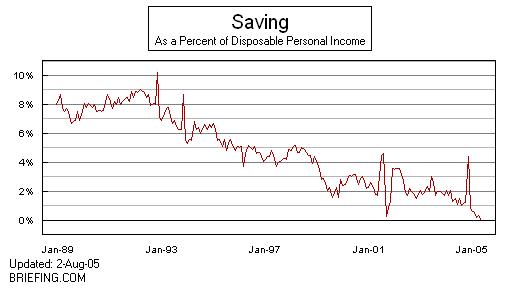
GAP CONTINUES!!
http://briefing.com/Silver/Calendars/EconomicCalendar.htm
Wages up .3% (less than est) Spending....drum roll....up 1% !!!
My goodness, this consumer knows no bounds and shows no fear of debt. Situation before has not sunk I fear, wise guys goosing markets, not reflecting challenges ahead.
WILL the supply of refined petroleum be interupted?
D
Wages up .3% (less than est) Spending....drum roll....up 1% !!!
My goodness, this consumer knows no bounds and shows no fear of debt. Situation before has not sunk I fear, wise guys goosing markets, not reflecting challenges ahead.
WILL the supply of refined petroleum be interupted?
D
Subscribe to:
Posts (Atom)