Thursday, June 08, 2006

MARCH 2001 AND HIGH ALERT CRASH WARNING

http://www.gatech.edu/news-room/archive/news_releases/allvine.html

A Very Likely Scenario Is For Rate Cut To Cause A Short Term Bounce In Stock Market:
In the past the stock market normally advanced quickly on 1st or 2nd cut of rates by the Federal Reserve. If rates are cut on Tuesday, then this will be the 3rd cut. Our expectation is for there to be a market rally for a few days or a couple weeks. Then we expect the market to turn down and move into lower territory. In other words we believe there is a strong likelihood of a Bear Market Rally, but we do not believe this is the end of the Bear Market. Those needing to raise some cash could liquidate some stocks if the advance occurs, but I do not believe this is a time to be increasing commitment to the stock market.

Why Expect Immediate Advance In Stock Market (if it occurs) To Be Short Lived:
There are two fundamental reasons for believing that the Bear Market will continue, and it will take more cuts in the Discount and Federal Funds rate before the bottom is in place. The first problem is that levels of market valuation remain high and are not consistent with market bottoms. For example, the P.E. ratio of the S&P 500 climbed from 16 at beginning of 1995 to 36 (a 50-year record) at the top of the market in March 2000. The P.E. Ratio for the S&P 500 has come down to 22.6 from 36, but is still way above the average of 16.2 P.E. from 1970 to the present (see chart). In addition, as stock prices soared the dividend yield has fallen from 6% in 1980 to a little over 1% a few weeks ago (now 1.36%). In other words, for the market to put in a real bottom we would expect the P.E. Ratio to fall from 22.6 to around 15, or a decline of another 35%.

The NASDAQ Is Even More Overvalued:
The NASDAQ climbed to a P.E. of 200 at the top of the market in early 2000 and has fallen to around 80. The average PE for the NASDAQ is close to 35 times earnings so the NASDAQ could fall by another 50% to bring it down to its historical average.

Other Problems Hanging Over The Stock Market:
We have gone through the longest economic expansion in history that started in March 1991. The almost 10-year long boom has presented great economic times for many Americans. But at the same time there have been some excesses that have come along with the economic boom. To participate in the good times, consumer credit has exploded with credit cards being extensively used to acquire more of the good life. Home equity (% of equity in a home to the value of the home) has fallen sharply as home owners have refinanced their homes and increased their mortgages, while others have taken out secondary mortgages on their home to finance consumption. Huge credit card debt and home mortgage debt is a hangover from the longest expansion in the history of our economy.

Danger In A Near Zero Savings Rate:
The personal savings rate during the 1960s, 1970s, and 1980s ran from 7%-8%, but in the booming carefree 1990s the personal savings rate has fallen to near zero. With the implosion of the stock market and family wealth and job uncertainty (and rising unemployment if economy further tightens), it can be clearly anticipated that the personal savings rate will start to rise. When everything is bright (good jobs, easy credit, and growing retirement and investment portfolios), then people will cut their savings rate (as has occurred during the booming 1990s). If the saving rate were to start climbing from the 0-1% level now back to 7%-8% (the norm), then this could take 2%-3% out of GDP for several years and cause stagnation much like has occurred in Japan. If the black economic clouds grow, then Americans will pull back from their spending ways and start again saving for a rainy day. We could become more like Japan where personal savings has rapidly increased over the last 12 years while the Japanese economy has been in the tank.

Summary:

We expect the Federal Reserve to cut rates when it meets tomorrow and this is in our opinion the appropriate policy. In the past cuts in the Fed Funds and Discount Rate has been very bullish for the stock market. We believe there is a good chance of a Bear Market Rally if the Fed cuts rates on Wednesday. But after a few days or a couple of weeks, we expect the market to move to new lower territory. Primary reasons for this opinion is that levels of market valuation remain fairly high (not what are usual at market bottoms). In addition, there are excesses associated with the record long economic boom that will have to be worked out before the economy can again advance strongly with stock prices climbing.
*****
Flash forward to today!!! (Duratek)

We now have negative saving rate, consumption was NEVER curbed during the 2001 Recession nor anytime during the 2000-2003 Bear Market, only more excesses more piled up, more debt etc. We are LESS prepared then to deal with any economic adversity.

Higher energy costs, inflation in areas of consumer needs not wants make the disposable income scenario much worse, as wages have FAILED to keep up with even basic inflation.

Real estate has begun to deflate, a major driver of economy, and is why I believe the commodity prices have begun to decline, and may be entering a bear market.

Chinese stock market is in bear market and recently plummeted by 5%.

VIX ratio is now in an uptrend and we have experienced TWO 90% DOWN DAYS in stock market in past 30 days, VERY good chance Bear Market is BACK!!!!! The risk is to the downside, and we have enterred the weakest 6 months of stock market returns.

Stock market leadership is nowhere to be found, MANY Dow and SPX stocks near 52 week lows, any near 52 week highs continues to diminish near record levels.

IMHO, with cyclical bull rally in very elder stages, extreme caution is now advised. Consult with your financial professional to see if your portfolio can withstand the return of the Bear Market should that be the reality.

The financial mechanisms are surrounded by GS cronies, let's see what PPT team can do.

Duratek

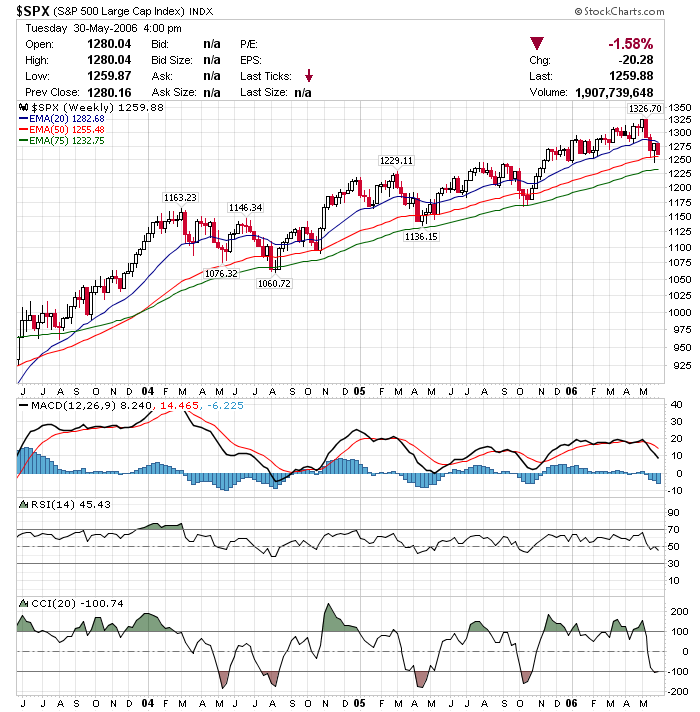
Tuesday, May 30, 2006

SIMPLE IS BETTER

(click to enlarge)
http://stockcharts.com/h-sc/ui?s=$SPX&p=W&b=3&g=0&id=p64235656637

What IS crystal clear to me, is you can even have correction back to 75 WEEK EMA and STILL have a bull mkt! AS long as ????? all 3 of these MA’S are rising stacked on top of each other,

and when the 20 WK slices thru and down, this Bull is officially OVER IMHO, cause when Is the last time that crossover occurred? Back in 2000-2001

And UP again in 2002-2003, I don’t need to know anything more than that.

Duratek (How's my posse doing? or is it one hand clapping?)

Tuesday, May 23, 2006

PEBBLE BED REACTORS

May 23, 2006
Pebble Bed Technology and the Uranium Super Bullby Sol Palha
"Ability hits the mark where presumption overshoots and diffidence falls short." - John Henry Newman 1801-1890, British Religious Leader, Prelate, Writer
China has come up with a new nuclear technology called "pebble bed technology". Essentially power plants built with this technology could only do one thing if something went wrong and that would be to shut down. It would be impossible for these reactors to explode or melt down. The idea is rather simple. Balls of Uranium power these reactors and each ball of uranium is wrapped in an incredibly strong layer of silicon carbide. These spheres have a much higher melting point then the temperature inside the reactor could ever reach. So essentially it would be impossible for the reactor to meltdown or explode. This technology is in the test phase but if it works out as envisioned China will leap frog ahead of the US in this area and then one wonders if they would not export this technology to countries that could help them meet their energy needs. One such country is Iran; in 2003 Iran alone supplied China with over 14% of its oil needs. This figure is definitely substantially higher today. China is desperate for energy and they openly admit to this; when one is desperate for something one is willing to trade almost anything.
"We need every type of energy," says Zhang Zuoyi, head of the institute that helps run the pebblebed test reactor. "We are hungry." China's leaders won't listen to naysayers. They can't afford to.
Another point of interest is that China is about to embark on the biggest nuclear power building plant spree ever undertaken by any nation. Their goal is to derive roughly 4-5% of their Energy needs from Nuclear Power in the next 15 years. While this might sound small when compared to other nations this simple plan means that China will need to build roughly 45 nuclear plants in 15 years or about 3 plants every year. Imagine what effect this will have on uranium prices. Off course in the next few years they could come out with even better technology, which might mean even more nuclear plants. Right now the limiting factor is that no one has thought of coming up with a nuclear power plant assembly line. We are positive that one nation will adopt this idea and when they do installing a new plant will be something that takes months instead of years.
China's new pebble bed technology might be one of the reasons India is not too worried about the nuclear deal falling through with the United States. Not only is this technology superior but also it will most likely cost a lot less and they will not be pushed into a position of having to forcefully take a stance against Iran. Increasingly it appears that more nations are willing to stand up to the US and as the saying goes there is strength in numbers.
China is positioned to leapfrog the world in nuclear power precisely because it entered the race late. Until now, the country has built a hodgepodge of reactors with different technologies and safety features. But recently top leaders decided to build a newer infrastructure virtually from scratch based on the most advanced, and safest, technologies. Although the pebble-bed reactor is not yet ready for prime time, the government is buying equipment and designs that have never been built before. China plans to choose one design of three submitted by Areva of France, Atomstroy export of Russia and Westinghouse Electric for an $8 billion program to build reactors in the eastern province of Zhejiang. (Some industry experts say Areva will probably win, especially since the Chinese government may bristle at the recent takeover bid by Japan's Toshiba on Westinghouse.) The Chinese plan to work closely with the winner to learn how to design and operate the reactors. The goal is to use this technology as the basis for subsequent Chinese plants.
The most likely technology to export, of course, is the pebble bed reactor. All reactors, including the pebble bed, use uranium fuel to produce heat that is used to turn electrical turbines. In conventional so-called light-water reactors, the heat is generated by thousands of fixed metallic rods, which require elaborate cooling systems to keep them from overheating and backup cooling systems in case the primary ones fail. Furthermore, a conventional reactor must be housed in a concrete containment vessel to mitigate damage in case it overheats. In the pebble bed reactor, thousands of tennis-ball-size spheres coated in layers of silicon carbide, ceramic material and graphite each contain thousands of granules of the fuel, uranium dioxide. Because the pebbles dissipate heat so efficiently, say the designers, the fuel inside them couldn't possibly get hot enough to penetrate the graphite casing. The pebble-bed reactor, in fact, doesn't even have a containment vessel. Another advantage of pebble beds is that it's easier to make small plants and put them up quickly, which lends itself to China's plan of spreading plants around the hinterlands. Extracting fuel from pebble bed reactors to use for weapons would be difficult and expensive. Full Story
Conclusion
Even Ukraine which had renounced nuclear technology has decided that they need to build at least 15 plants over the next decade to prevent a repeat of the recent energy crisis when Russia cut of gas supplies to Ukraine. Almost every nation is slowly but surely embracing nuclear energy something that was once shunned. While we have many nations focussing on developing new technologies for nuclear power plants no one is spending the time and money needed to find new supplies of uranium and open up new mines. Current demand far outstrips the available supply and one can only imagine the uranium crunch that will be created in years to come unless a massive program to open up new mines and find new supplies of uranium is undertaken shortly. As usual a crisis that could have easily been prevented will be allowed to develop into a full blown disaster before something meaningful is done. The reasons are always the same; key big players are going to make fortune and the expense and misery of others. When the choice comes to down to money or doing the right thing 9 out of 10 times money wins. Hence make sure that you own the right companies and buy them at the right time as they are many useless so called uranium companies out there. One can also buy a great company at the wrong time. In order to win one has to buy at the right time and also sell at the right time.
"The principle of all successful effort is to try to do not what is absolutely the best, but what is easily within our power, and suited for our temperament and condition." - John Ruskin 1819-1900, British Critic, Social Theorist

Thursday, May 18, 2006

PAUSE THAT WON'T REFRESH

http://www.bloomberg.com/apps/news?pid=10000103&sid=aD_NO5xcEUzQ&refer=us REAL worl evidence of inflation, Fed is bixed in a corner.

Last 8 X Fed discount rate reached 6% (we are there now) there was severe market reaction.

Evidence of 90% or near so down volume yesterday, selling pressure hits a new yearly high.

Vix highest level in 8 months, are the PRO'S getting nervous?

I may be jumping the gun, (meaning getting moving avg confirmation) but stock market action just as we were about to take out OLD bull market highs, making me think Bear market may be back, worst action since cyclical bull began, IMHO

Don't ignore history, are you going to stay fully invested in an aging bull mkt?

Duratek

Saturday, May 13, 2006

REASONS

http://www.prudentbear.com/archive_comm_article.asp?category=Credit+Bubble+Bulletin&content_idx=54398

Doug Noland is THE place to go for raw data, and you WILL get something from this TOUGH read.

D

HOW MARKET TOPS ARE FORMED

Ethanol bull (PEIX) could be starting, remember ALL bulls correct, I think TOO many on board, it has been too easy, so a SHAKEOUT is coming, IMHO not bashing just MHO. certainly this stock has been hot.

BUT, if I am correct, and I am not alone, the top in the cyclical bull could be in.,,,and If I am correct it is very possible the bear rips ALL a new one....bonds MAY do better, but so far havent found bottom, a normal safe haven....gold sure has but WAY overbought will plummet in short order

IMHO A STEEP drop in commodities may signal tougher times ahead,,,,especially SILVER AND COPPER....used in all kinds of products....OIL fell as demand eased?

Utility avg usually tops 6-8 mnths ahead of DOW...it topped last OCT 2005. TRANS new ALL time high, but for 6 years DOW didnt agreee, and withing a snot shot this week it has run away from that new high (maybe it tries again)...NAZ topped months ago....so we dont have a unified market working to new highs together.
And we have VERY few of the Dow 30 close to 52 wk highs....and we have PLENTY of stocks off already by 20% or more....ad that % keeps rising.WHat is wrong with MSFT AMZN YHOO INTC DELL EBAY GOOG IBM GM WMT etc etc...many of these are making 52 wk LOWS Under your nose.
Insider selling is at a frenzy, whats their hurry? and here to http://finance.yahoo.com/q/it?s=PEIX Maybe I am wrong, but if your stocks are acting badly, take them out, shoot them, raise cash ....all IMHO

A BEAR has torn even the bears hide to hide....and hasnt it been easy to be a CRAMER?
Been 3 YEARS!!!! since last 10% correction......VIX is moving up, if that continues the PRO'S are getting nervous...you better too.

OK and dismiss me as a nut case, but remember the day you read this.....in the future.We are in a SECULAR BEAR trend, the FED and BUSH have fought it tooth and nail,,very well.....but it has grossly maladjusted our economy and made our "friends" STRONGER, helped build the Chinese Military too.Yeah, 10's of millions willing to work for $200 or less a MONTH!!! how they gonna afford OUR JUNK? oh yeah on credit?

You will figure out too late I am right, the trend may be changing back to the bear....and you cannot afford to drizzle saliva and let it rip you a new one..or can you?

Duratek

Wednesday, May 10, 2006

GOLD STANDARD, FED IN A BOX

1 M Chinese enter workforce every week (I think right? every day DOH!!?)
avg pay $190 aint gonna make them CONSUMERS instead of savers....as one astute Gov official said...." they need to be more like us!!! and us them!"
Chines official quoted as saying Gov needs to diversify TRILLION $$ reservese doubling maybe QUADUPLING GOLD reserves (reason for recent runup and iran)
State coffers in BLACK, new home buyers TRAPPED with rising costs for everything (cutting consumption or escallating debt or both) as the hidden tax PROPERTY TAX has sky rocketed with HIGHER asessments from housing BUBBLE, you wont see this OVER TAXXING refunded, GOV is OUT OF CONTROL with the taxes

Tarrif could be lifted on Ethanol, IMHO these stocks are VERY vulnerable if so (after speculative fever)

STocks should be near geared up as additive mandated for Summer driving season. Will the increased use of EThanol lead to INFLATION in the raw materials like CORN?

$700 gold? is this the "DATA" Fed is said to be looking at when meeting for rates? HOW does this go unnoticed? wouldnt INFLATION heat up and interest rates RISE sharply is the $$$ is NOT defended.

I think FED is in NO MAN'S LAND, a VICTIM......JAILED by their own hands/policies...NO WAY OUT.

A SEVERE correction at very least is LURKING.....none of us, anyone will see it coming as they stare at CRamer show.......

Up on deck? ATM snafu.......BUSH?repubs want EXTENSION of TAX cuts for RICH....and the AVG JOE gets killed by high energy, levitated Property taxes, and too high mortgages....the ATM tax etc.....etc....the DIV tax cut is for bleep.

Monday, May 08, 2006

"FOLLOW THE MONEY?"

http://www.contraryinvestor.com/moprinter.htm May commentary

When there isn't much to say I take a break, so let's catch up.

In a "floating on a sea of liquidity" and 8,000 hedge funds kind of market, it is not surprising to see a new high for move in Dow, and maybe all time high being less than 2% away, will follow......but all is NOT healthy.

As this rally goes into its 44th month from 2002/2003 lows, it becomes ever more LESS inclusive, and not all indexes have come along.

SPX and NAZ are far off their highs, Transports made new all time highs a year ago, without Dow confirmation, and in SEPT of 2005 the Utility index topped out!!! And can be a fore warning of end of the bull market.

What you must remember, is the rally from 2002 lows is in the context of a SECULAR BEAR MARKET, which will probably last up to the length of the preceding bull market, which means as long as 10- 20 years!

And there will be a few of these strong rallys, until the Bear has done its job and or run its course. Which is to restore ORDER, and the NORMS.

Dividend yields at near 2% is even LOWER than at any previous bull mkt top! At bear mkt bottoms near 6% is typical.

SPX earnings have been propped up from historic energy company profits and HUGE stock buyback programs.

Insiders are selling like mad.

It has been over 3 years since the mkt has corrected 10%.

Bear markets reduce speculation, volume on the BB (penny stocks) is DOUBLE what it was in 2000 !! DEBT has exploded, instead of consumers retrenching. Demand is being satiated, a gluttony, not pent up.

Housing has EXPLODED with excess speculation rampant and now unwinding.

I don't know if THE top is coming, but do feel some kind of important top is near, and we are now IN the dead zone for market, the seasonals nolonger supplying a tailwind.....IMHO caution is warranted.

Next update? when I feel like it.


Duratek

Friday, April 21, 2006

CRASH ALERT!!

not much to say....yeah right. I am on HIGH ALERT, extreme defensive posture taken. Maybe more this weekend.

D

Friday, March 31, 2006

ACCIDENT WAITING TO HAPPEN?

Oil Heads Back Toward $70 a BarrelFriday March 31, 3:05 pm ET By Brad Foss, AP Business Writer
Oil Heads Back Toward $70 a Barrel, With Potenially Grave Consequences for Global Economy
WASHINGTON (AP) -- Oil prices appear headed back toward $70 a barrel, a level not seen since Hurricane Katrina battered the Gulf Coast and sporadic shortages sent gasoline at the pump above $3 a gallon nationwide.
While last summer's price spike triggered outrage in Congress and hurt sport utility vehicle sales, it caused only a hiccup in motor-fuel consumption. And for now, with demand back on the rise, the economy seems capable of absorbing uncomfortably high prices.
Analysts warn, however, that consumers and businesses could be just one major supply disruption away from more serious financial consequences.
Sherry Cooper, chief economist at BMO Nesbitt Burns, said the ramifications of $70 oil and $3-a-gallon gasoline would be "more mild" the second time around "because we're getting kind of used to it."
But while the gas-price sticker shock may be wearing off, Nomura Securities chief economist David Resler fears a more subtle fuel-related angst settling in among consumers.
"There is the pessimistic notion that this is not going to go away and that's going to have a more lasting impact on driving habits and behavior, I suspect, than we've seen so far," Resler said.
In that context, a hypothetical supply disruption that jolts oil prices to $80 or higher and keeps them there for an extended period -- say, three months -- could result in "a substantial falloff in discretionary spending" that snowballs into a serious slowdown.
Perhaps the top threat for the oil market is the standoff between the United Nations and Iran, OPEC's No. 2 producer, over Tehran's nuclear energy ambitions. Iran's foreign minister said Friday his country would not use oil as an economic weapon, and that helped ease prices, but analysts say they remain concerned about supplies from Iraq, Russia, Venezuela and other places.
Unrest in Nigeria has taken more than 500,000 barrels per day of oil off the market, and more than 300,000 barrels per day of Gulf of Mexico output remains shut-in because of damage from last fall's hurricanes.
With global oil demand expected to average 85 million barrels per day in 2006, and excess production capacity limited to 2 million barrels per day, oil analyst Jamal Qureshi of PFC Energy in Washington said prices aren't likely to retreat anytime soon.
"The market is awakening to the scope of the risks," said Antoine Halff, director of global energy Fimat USA in New York.
Yet in spite of all the apprehension about oil supplies -- or maybe because of it -- U.S. inventories of crude are at a seven-year high of roughly 341 million barrels. That does not include the 685,700 barrels in the country's strategic reserve, available in an emergency.
Some analysts point to this buildup of inventories as evidence the market is divorced from reality. IFR Energy Services' Tim Evans sees a "dangerous complacency about the downside potential for prices" -- but many more say it is a reflection of unease about geopolitical uncertainties.
On Friday, light crude for May delivery traded at $65.80 a barrel, down $1.35 on the New York Mercantile Exchange. U.S. retail gasoline prices averaged $2.53 a gallon, or 37 cents higher than last year, according to Oil Price Information Service.
The potential exists for $3-a-gallon gasoline at some point this summer, analysts say, but that assumes out-of-the-ordinary disruptions to refining or distribution, or both. The Energy Department, meanwhile, is forecasting an average summertime price of $2.50.
Economists and oil-market experts say industry and homeowners may not like paying more for fuel but they are adapting, in large part because energy is a tiny piece of overall spending and, thanks to more efficient technology, an even smaller piece than it was during the energy crises of the 1970s.
The burden is most severe on low-income families and fuel-intensive businesses, though truckers, chemical manufacturers and, to a lesser extent, airlines have had success in passing along these costs.
Relatively low interest rates, which have made it easy to borrow money while helping to prop up the stock and housing markets, have reduced the impact of high oil prices on the economy.
Of course, the Federal Reserve has raised short-term rates 15 times since June 2004 to cool off the housing market and keep inflation in check, and this is likely to slow growth irrespective of energy prices.
BMO's Cooper said the Fed probably needs to raise interest rates again in May to slow economic growth because there are signs -- rising airfares among them -- that inflationary pressures are creeping up.
Brian Hicks, co-manager of US Global Investors' Global Resources Fund, a mutual fund heavily invested in energy, said a recession in the U.S. would likely reverberate across emerging-market economies and could quickly depress daily oil demand by 2 million barrels per day.
That dire scenario is not what Hicks or most other financial professionals are anticipating. Hicks forsees oil prices trading in a range of $55 to $65 through the end of the year, with consumption tapering off anywhere above $70 and the Organization of Petroleum Exporting Countries curtailing production at around $50.
James Cordier, president of Liberty Trading in Tampa, Fla., believes oil prices will climb as long as the economies of the U.S., China and India continue to grow and that prices may need to hit $75 before there is any significant demand response.
"We are going to find out at what price level we start rationing demand," Cordier said. "That is what we have to do."

Saturday, March 25, 2006

PICTURE OF THE WEEK


http://www.prudentbear.com/archive_comm_article.asp?category=Credit+Bubble+Bulletin&content_idx=52858 Credit Bubble Report

Even as the Dow sits scant 4% below Jan 2000 bubble highs, the market advance is getting more selecive. when the Dow finally tops, the majority of stocks will already be in bear Markets with 20% losses or more, this is a good time IMHO to examine your holdings and their performance. and maybe a very good time to RAISE cash as MM funds yielding near 4% and 91 day Treasuries more, challenging gains in stock market without risk.

Share volume in CHEAP bulletin board stocks last week ran 2 X previous ever high, the so called lesson of previous Bear Market are all but forgotten. Share volume for little GNBT rose to 89 Million one day last week.

Be careful, be very selective......the top making process continues and the current Bull Cycle is VERY long in the tooth, IMHO in respect to historic means. If you have fallen asleep with your investments, NOW would be a good time to wake up.

My blog for now will only be updated each Sat morning, unless a stock market move of 100 points or more has occured.

Duratek

Monday, March 20, 2006

HEAD BLOODSUCKER SPEAKS

Bernanke: Fed must watch its step
Fed chief says flat yield curve not a sign of economic slowdown, says it isn't clear why long-term bond yields are so low.

March 20, 2006: 9:41 PM EST

NEW YORK, March 20 (Reuters) - Federal Reserve Chairman Ben Bernanke said on Monday it was hard to gauge why long-term interest rates were so low and said the U.S. central bank could not rely on them as its sole guide for policy-making.
"The implications for monetary policy of the recent behavior of long-term yields are not at all clear-cut," Bernanke told the Economic Club of New York.
In his first public foray onto Wall Street since taking over as Fed chairman on Feb. 1, Bernanke ran through several competing explanations for the unusually low level of U.S. bond yields despite a steady ratcheting up of short-term interest rates by the U.S. central bank.
Bernanke revisited a thesis he first laid out a year ago that a "global saving glut" - an excess of savings because of a dearth of enticing investments - could be depressing rates.
If this were the case, he said, then as long as the factors behind it persisted "global equilibrium interest rates - and, consequently, the neutral policy rate - would be lower than they otherwise would be" to keep the economy on an even keel.
But Bernanke laid out a number of other possibilities and concluded: "The bottom line for policy appears ambiguous."
Fed policy-makers have raised benchmark overnight rates to 4.5 percent in a string of 14 steps dating to June 2004 and are widely expected to bump them up another quarter-percentage point at a meeting next Monday and Tuesday.
While overnight rates have risen 3.5 percentage points since mid-2004, the market-set rate on 10-year U.S. government bonds has barely budged.
Bernanke said that if the low level of long-term rates reflected a decline in the compensation investors demanded to cover the risk of losses on long-term holdings, then it could signal stimulative financial conditions that would require higher short-term rates than otherwise to offset.
"But to the extent that long-term rates have been influenced by macroeconomic conditions, including such factors as trends in global saving and investment, the required policy rate will be lower," Bernanke said.
Little slowdown ahead
As he had in congressional testimony last month, Bernanke said he dd not consider the current flat yield curve - with yields on short-term debt close to yields on long-term bonds - as presaging "a significant economic slowdown" as has sometimes been the case in the past.
Indeed, he said other indicators showed markets with few worries on the future. "The fact that actual and implied volatilities of most financial prices remain subdued suggests that market participants do not harbor significant reservations about the economic outlook," he said.
He said, instead, long-term rates could suggest the level of short-term rates consistent with holding the economy at full employment had declined, perhaps reflecting a lasting drag on the economy from high energy costs, slower growth in house prices and the possibility consumers will begin to save more.
But he also noted long-term rates were low around the globe and said "an explanation less centered on the United States might be required."
One other factor that Bernanke raised, but downplayed, was that large official holdings of U.S. Treasury debt accumulated by countries intervening in currency markets was doing much to push U.S. long-term rates down.
"A reasonable conclusion is that the accumulation of dollar reserves abroad has influenced U.S. yields, but reserve accumulation abroad is not the only, or even the dominant, explanation for their recent behavior," he said.
In the end, Bernanke said the Fed would need to monitor bond yields carefully, but also had to take into account a wide array of other signals on the economy's health.
"Policy-makers are well advised to follow two principles familiar to navigators throughout the ages: First, determine your position frequently. Second, use as many guides or landmarks as possible," he said.
"By not tying policy to a small set of forecast indicators, we may sacrifice some degree of simplicity, but we are less likely to be misled when a favored variable behaves in an unusual manner," Bernanke added.

FED RESERVE IS UNCONSTITUTIONAL

http://www.honestmoneyreport.com/archives/2006/0305.php


Article I, Section 8, Clause 5 of the Constitution states: “The Congress shall have Power…To coin Money, regulate the Value thereof, and of foreign Coin, and fix the Standard of Weights and Measures.”

BUT>>>>>>The United States monetary system currently creates, emits, and circulates paper bills of credit known as Federal Reserve Notes. Such acts are not authorized by the Constitution – they are literally prohibited by the Constitution, and should be repealed forthwith.

D...we are losing it people.....

Sunday, March 19, 2006

OUR CHANGING PLANET. follow up to last post

http://pubs.acs.org/subscribe/journals/esthag-w/2005/jun/policy/pt_piltz.html

WAKE UP AMERICA WE ARE BEING BUSHWINKED

http://www.cbsnews.com/stories/2006/03/17/60minutes/main1415985.shtml Bush *&&!!sucker pulled out of Kyoto green house gasses treaty..is now censoring CLIMATE REPORTS!!!!

It is going to be TOO late and no place to hide!! Hate them maybe too , but if a Dem with environmental leanings comes up as candidate.....better vote them in!

Temp at Antarctica is rising 2X as fast as elsewhere, the GOV is censoring your right to know, keeping the TRUTH from you.

If we haven't made drastic changes in 10 years there will be NO reversing this process.

D

Saturday, March 18, 2006

Excerpts from Doug Noland

found @ prudentbear.com

March 14 – Bloomberg (Walden Siew): “Companies are selling floating-rate debt in the U.S. at the fastest pace ever as investors seek securities that will keep their value while the Federal Reserve raises interest rates. Borrowers sold $62.9 billion of floating-rate notes this year and are on track to beat the 2005 record of $302 billion, according to data compiled by Bloomberg.”


Investment grade issuers included GE Capital $3.0 billion, Goldman Sachs $1.75 billion, Wells Fargo $1.5 billion, USB Capital $1.25 billion, Tyson Foods $1.0 billion, Shinsei Finance $700 million, World Savings $600 million, Clear Channel $500 million, HRPT Properties $400 million, Archstone Communities $300 million, Genworth Global $300 million, Compass Bank $275 million and Boston Edison $200 million.

March 14 – Financial Times (Jennifer Hughesin): “Inflows into emerging market equities have set an annual record just 11 weeks into the year as investors continue to chase the higher returns seen in developing markets. In the week to March 8, $20.9bn has been poured into emerging market stock funds breaking last year’s record of $20.3bn, according to Emerging Portfolio Fund Research. Brad Durham, a managing director of EPFR, said: ‘While it is natural to assume that such strong inflows into any asset class are a worrisome sign, there are institutional investors just waiting for corrections in equity and bond markets to plough more money into emerging markets.’”

As I believe we witnessed this week, extraordinarily speculative global financial markets took comforted from inferences of a lack of nerve from the Fed and the Bank of Japan. Global bond markets (generally) abruptly retraced some of recent declines, spurring the resurgence of global equity market speculation (and short covering). Currency markets vacillated, the dollar index was hit for 2%, and the energy and metals complexes rallied back smartly. Middle Eastern equity Bubbles lurched toward collapse then retreated. All in all, it has the look and feel of a major topping process, as players assess and reassess the prospects for a continuation of, or destabilizing interruption to, the Global Credit and Asset Bubbles.

I can imagine that the Fed today takes comfort from its amassed war chest of 450 basis points of reflation ammo. But the enemy is often not as anticipated. There’s a critical issue of which I am left unclear. How does “mopping up” – or perhaps better stated, what is to be “mopped up” - in the middle of a currency crisis?

Tuesday, March 14, 2006

DEVIL IN THE DETAILS

http://briefing.com/Investor/Public/MarketAnalysis/Calendars/EconomicCalendar.htm

Consumer slowing down, gov deficits not. Strain on interest rates to go higher because of huge appetite for debt from all orifices.

Higher rates putting brakes on housing, the engine of WORLD economy. utility rates going up as much as 70% with price controls ending in July.

Cash flush corporations NOT using cash for INVESTMENTS IN SELF OR CAPITOL EQUIP., no they are using it, FED induced super profits to BUYBACK SHARES (insiders love this) to boost earnings as they are actually declining, and fo M and A activity resembling 2000.

Here we are, within 1.5% of Dow bubble highs, yet avg Dow stock off 20% from 52 week highs!!!

Devil in details, cash I am in.

Duratek (surgery last wed, one armed man for now) I hope my readers are hanging in there with me, let me know you want me to continue my blog, and I am doing some good.

Tuesday, March 07, 2006

RECENT COMSTOCK PARTNERS PIECE

Comstock Partners, Inc.

The Derivatives Mess March 02, 2006

Over the past year New York Federal Reserve President Timothy F. Geithner has become increasingly concerned about the use of derivative instruments as outlined in a few of his speeches and a number of largely unnoticed articles buried inside the Wall Street Journal. In a recent speech before the Global Association of Risk Professionals, Geithner stated that the widespread use of derivatives “have not eliminated risk” and “have not eliminated the tendency of markets to occasional periods of mania and panic. They have not eliminated the possibility of failure of a major financial intermediary. And they cannot fully insulate the broader financial system from the effects of such a failure…And there are aspects in the latest changes in financial innovation that could increase systemic risk in some circumstances, by amplifying rather than dampening the movement in asset prices, the reduction in market liquidity and the associated damage to financial institutions.”

Geithner stated that so far the expanded use of derivatives has taken place in a period of generally favorable conditions, but that “we know less about how these markets will function in conditions of stress, and the most sophisticated tools available for measuring potential losses have less to offer than they will with the benefit of experience with adversity.” He pointed out that the gaps in the infrastructure and risk management is most conspicuous in credit derivatives, where the measure of credit risk “may not adequately capture the scale of losses in the event of default in the underlying credits or the consequences of a prolonged disruption to market liquidity. The complexity of many new instruments and the relative immaturity of the various approaches used to measure the risks in those exposures magnify the uncertainty involved.”

As explained by David Wessel in the Wall Street Journal, the problem is that the derivatives market has grown so fast that it has overwhelmed the legal, technical and paper-work handling infrastructure. Under present conditions no firm can be sure who owes what to whom. According to Geithner, “The post-trade processing and settlement infrastructure is still quite weak relative to the significance of these markets…The total stock of unconfirmed trades is large and until recently was growing considerably faster than the total volume of new trades. The time between trade and confirmation is still quite long for a large share of transactions. The share of trades done on the available automated platforms is still substantially short of what is possible…firms were typically assigning trades without the knowledge or consent of the original counterparties. Nostro breaks, which are errors in payments discovered by counterparties at the time of the quarterly flows, rose to a significant share of total trades. Efforts to standardize documentation and provide automated confirmation services has lagged behind product development and growth in volume…the assignment problems create uncertainty about the actual size of exposures to individual counterparties that could exacerbate market liquidity problems in the event of stress.”

To his credit, Geithner began stressing the nature of the problems in late 2004. Former New York Fed president Gerald Corrigan organized an industry group to deal with the problem in early 2005 and the members have met a number of times since then to report on their recommendations, most recently on February 16. Despite reported progress there is still a backlog of thousands of unconfirmed trades, and about 40% of new trades are still not matched electronically. There’s still no centralized means of processing trades.

In our view the derivatives mess described above is another potential time bomb (among many) that could throw the financial markets into a severe crisis. In the last 30 years every period of monetary tightening has eventually led to financial crisis. These included the Penn Central bankruptcy in 1970; the Franklin National Bank failure in 1974; the First Pennsylvania bank failure in 1982; the Continental Illinois bank failure in 1984; the savings & loan crisis in 1990, the Mexican Peso crisis in 1994; the Asian, LTCM and Russian crises in 1998; and the bursting of the Nasdaq bubble in 2000. The derivatives market is a leading candidate to trigger the crisis on this cycle, although there are obviously many other candidates as well.

Saturday, March 04, 2006

MARCH CONTRARY INVESTOR

http://www.contraryinvestor.com/mo.htm

EXCUSES

NEW YORK - Now that America's savings rate has been negative for an entire year, a first since the Great Depression, the question is whether we're a spendthrift nation on its way to the poor house or whether we're looking at the wrong numbers when we calculate savings


http://news.yahoo.com/s/ap/20060304/ap_on_bi_ge/wall___main_1

The personal savings rate used to be 10 percent of disposable income from 1974 to 1984, according to the Bureau of Labor Statistics. It fell to 4.8 percent by 1994, and was negative for all of 2005.

http://www.naftemporiki.gr/markets/quotegraph.asp?id=.BADI&ctime=5Y&cperiodicity=W BDI 5 yr


http://research.stlouisfed.org/publications/usfd/page3.pdf zippity do da adj money


Doug Noland

March 2 – Dow Jones (Christine Richard): “A flood of foreign capital into U.S. dollar-denominated debt has some in the corporate bond market worried that the market's aversion to risk is getting washed away.

February 27 – Bloomberg (Darrell Hassler and Prashant Rao): “U.S. Treasury investors are more complacent about the prospect of an economic shock causing volatility in the $4.2 trillion market than at any time in at least 17 years.”

Broad money supply (M3) surged $54.1 billion to a record $10.335 Trillion (week of Feb. 20). Year-to-date, M3 has expanded at an 8.0% annualized rate. Over 52 weeks, M3 grew 8.5%, with M3-less Money Funds up 8.8%. *(HOLY CRAP!)

D

Wednesday, March 01, 2006

PARTYING LIKE IT'S 1987?

http://www.sandspring.com/charts2006/cdj022206.html

I go in for elbow surgery next Wed, not sure how long it will be before I can post beyond that.

D

Saturday, February 25, 2006

ALL THAT GLITTERS IN LEMMINGLAND

One thing for sure, in a raging bull mkt you see consolidation and buyouts,and now you can add that to rising pressures of price. SO whom would be themost logical candidates for that should be found.

We ALL know the GOV stats are tainted, ACcute OBS piece points some of themout. Glaring and obvious is the reasons behind it all the motivation, SSpayments. The GOV found another way to screw its subjects.If taxes collected are not going to be used properly (SO MUCH GOV waste andCASH MISSING??), and such our GOV has abandoned the COnstitution in itsefforts to be like the ROman Empire, knowing that SS checks would be 70%more if CPI stated properly, I must ask myself why even bother postinganything coming from the BLS? SO if the TAX system is not fair, and usedimproperly, one could argue our income tax system is also unconstitutional.
Listen to this: http://www.epinions.com/content_1886953604If you don't believe me why don't you ask the IRS yourself? That's righthere is a little fun interactive tax game you can play at home, simply callup the IRS Request line at 1-800-829-1040, friendly IRS agents are on handto answer your every tax question so why don't you ask them this simplequestion. "Am I as a resident of the state of [State] obligated by law topay tax on income derived exclusively from wages earned within the 50 statesand if so please site the law or statute which says I am so obligated?" If you get an answer to this question please share it with me at[rampage_1_@yahoo.com].
The IRS never did tell me what law obligates me topay tax on my domestic earnings so if they tell you I would love to hear theanswer.So how did this whole Tax scandal get started? It was caused by war timetaxes such as the Victory Tax that Congress passed to pay for the greatWorld Wars. The Victory Tax was phased out by congress following the war,but nobody seems to have bothered telling that to the IRS who continuallydemands money from US Citizens. And to who does this Federal Income taxmoney go? Many of you think it goes to the Federal Government, well itdoesn't. If you have ever owed Federal Income and have paid for your Taxdebt with a check look to see who cashed your check, it wasn't Uncle Sam itwas the Federal Reserve Bank. The Federal Reserve Bank may have beenempowered by congress to control our money (another unconstitutional act)but only congress has the power to collect and levy taxes, and the FederalReserve is not even a public organization, no audit has ever been done ofthe Federal Reserve, so what does the Federal Reserve do with all of our taxdollars? The lend it to our government and drag the country deeper anddeeper into debt. So what can you do to fight the Fed? Become educated,great websites like www.taxableincome.com and www.taxgate.com are greatresources for any individual who wishes to learn more about how the IRSreally is commiting wholesale fraud against the US People.

http://taxgate.com/ site shut down!!

http://www.quatloos.com/Tax_Protestor_Swan_arrested.htm well is it or isntit?WHO has the right to declare war, did we ever declare war on IRAQ? where2,500 soldies have died?

http://www.pastpeak.com/archives/2005/12/cheney_war_powe.htmWHen did the American public become numb, dumbed down, and beleiveeverything told to them by the LIARS? Where is the public debate?

Thursday, February 23, 2006

WAKE UP LEMMINGS

http://news.yahoo.com/s/ap/20060223/ap_on_go_pr_wh/ports_security WTF is going on here, OR you KNOW what is going on! ANother secret BUSH deal! Spying illegally (against US Constitution) and cutting secret deals, NO BID contracts with BUSH CRONIES, new emminent domain laws, new harsher BAnkruptcy laws, lip service to oil crisis (he wouldn't even mandate better gas milage!!)

My friends, have we lost more than we can ever gain back? The ability for GOV to STEAL your property if you dont pay your property taxes, and the illegality of income taxes in general. We end up the POLICEMAN OF THE WORLD and living in the US POLICE STATE. WHERE are the real leaders hiding?

Living in a bankrupt country is the LEAST of our troubles.

Now while we do a good job f'ing up things here, the world economies meaning Asia (China and JApan mostly) have SAVINGS in which to replace capital equipment and invest for increased productivity to remain the DOMINANT WORLD EXPORTING POWERS.

WHile here in the US, we are back to Depression ERA NEGATIVE SAVINGS RATE, HOCK up to eyeballs with 71% of GDP consumer spending! Could we get any more imbalanced?

ANY cutback in Consumer spending will have DIRE consequences for US economy and that of the worlds. Even though Chinese consumption is rising, it cannot replace that of the US.

THis merry-go-round of ILLUSION of a US fit and healthy could be lifted come end of MArch as US $$$ are NO longer needed for OIL purchases with opening of IRAN OIL Bourus which will ONLY except EURO'S for OIL!!!

AS our stock market of 30 industrials marches higher, it does so without the biggest companies or with broad support as % of companies near 52 week highs falls and those 20% or more below increases!!! JUST as happened as we reached the bull market top in March of 2000.

WILL MARCH mark the top again? You should not run and hide, but would be prudent to raise some CASH just in case we at least see first 10% CORRECTION in OLD cyclical bull.

It is FOGGY here this AM as I post this, I only hope the fog is lifting from your perception of how things really are.

Not only is this country headed in wrong direction, and the GULF between rich and poor growing, but should something happen to pull rug out from under this economy, we are in mcuh worse shape than before to handle it. WHAT, will they CUT interest rates to STIMULATE economy? SURE........maybe we'll have a real estate boom!

Duratek

Wednesday, February 22, 2006

DOSE OF RICHEBACHER

BEST OF KURT RICHEBACHER
February 20, 2006
Since Benjamin Bernanke’s nomination by President Bush to succeed Alan Greenspan at the helm of the Federal Reserve, it has been widely reported that Bernanke had fixed his earlier professional career as a professor of economics upon the study of the cause or causes of the 1930s Great Depression, with the intent to make sure that this will never happen again.
At a conference in 2002 honoring Milton Friedman’s 90th birthday, he expressed contrition on behalf of the Federal Reserve: "Regarding the Great Depression, you are right, we [The Fed] did it. We are very sorry. But thanks to you, we won’t do it again."
Wondering about Mr. Bernanke’s academic research, we took a closer look at his earlier writings and contemporary speeches. We learned that he did "groundbreaking research on how declining asset prices and weakened banks can choke off new lending and economic growth, and how the mistakes of the Federal Reserve compounded the catastrophe."
America’s Great Depression was by far the greatest economic and financial disaster in history. Yet it strikes us that the discussion in the United States has been stuck in the assertion that the Fed’s failure to ease its reins fast enough was key to the savage asset and price deflation that followed during the 1930s.
The question of what may have gone wrong during the prior boom to cause the Depression has always been discarded as beside the point, with the argument that the extraordinary price stability prevailing in the 1920s represented conclusive evidence of the absence of any inflationary influences.
For most American economists, the verdict of Milton Friedman and A.J. Schwartz at the end of their Monetary History of the United States, 1867–1960, published in 1963, about the causes of the Great Depression, is virtual dogma. And so it is for Mr. Bernanke. To quote Friedman:
The stock market boom and the afterglow of concern with World War I inflation have led to a widespread belief that the 1920s were a period of inflation and that the collapse from 1929–1933 were a reaction to that. In fact, the 1920s were, if anything, a time of relative deflation: From 1923–1929 — to compare peak years of business cycles and to avoid distortions from cyclical influences — wholesale prices fell at the rate of 1% per year and the stock of money rose at the annual rate of 4% per year, which is roughly the rate required to match expansion of output. The business cycle expansion from 1927–1929 was the first since 1881–1893 during which wholesale prices fell, even if only a trifle, and there has been none since.
The monetary collapse from 1929–1933 was not an inevitable consequence of what had gone on before. It was the result of the policies followed during those years. As already noted, alternative policies that could have halted the monetary debacle were available throughout those years. Though the Federal Reserve proclaimed that it was following an easy monetary policy, in fact, it followed an exceedingly tight monetary policy.
The 1920s were, indeed, a period of extraordinary price stability. In particular, under the influence of Milton Friedman, it became axiomatic for American policymakers and economists that the Depression must consequently have had its causes in the policies pursued after the stock market crash. One of the consequences of this generally accepted verdict has been a total lack of interest to probe more deeply into the intricacies of the boom phase. As a result, knowledge about eventual abnormalities during this phase is generally abysmal, even among leading American economists.
Actually, the Fed moved quite fast in light of earlier experience, slashing its discount rate from 6% to 2.5% within one year. The first steep fall of stock prices lasted little more than two weeks, from Oct. 24 to Nov. 13, 1929, from where it sharply recovered until April 1930.
After a pretty stable first half of 1930, during which stock prices rallied strongly, the economy suddenly slumped in the second half, even though the broad money supply had barely budged. As the following table shows, this sudden slump occurred across all demand components. To quote Joseph Schumpeter: "Business operations contracted in the midst of a plentiful supply of ‘money.’"
With the euphoria about a "New Era" for the U.S. economy still virulent after the stock market crash, a quick recovery was generally expected. What strikingly differentiated this downturn from all forerunners was the sudden, sharp slump in consumer spending. Yet it was taken for granted that the Fed’s rapid rate cuts would usher in economic revival.
A truly dramatic change in economic activity, and also in expectations, only began with the banking crisis of November–December 1930, acting to reduce the money supply. Escalating bank failures principally had their reason in declining market values of foreign, corporate and real estate bonds ravaging the banks’ capital and lending power. The question is why asset prices fell — because of tight money or due to rising risk premiums as the quality of bonds began to be questioned?
NO "GARDEN-VARIETY" TYPE
It is the great merit of the proponents of Austrian theory to have uncovered and shown that the borrowing and spending excesses driving a boom may, with or without inflation, exert harmful economic and financial effects other than just a rising inflation rate — actually, more harmful effects….
It has always intrigued us how the U.S. economy and its financial system could virtually collapse in the early 1930s if they were in healthy conditions. To explain the rapid collapse with slow rate cuts after 1929 has always struck us as bizarre. For such a collapse to happen, an economy and financial system must have been in terrible shape.
Friedrich Hayek wrote, in Econometrica (April 1934), that the events after 1927 led to the Depression in the United States. The specific events, according to our findings, were the boom-busts of the equity and associated consumption bubbles.
It has been typical of recessions in all industrial countries that consumption has always acted as a stabilizer, while investment and construction turn down. In 1930 and the following years, for the first time, the opposite happened. As the artificial stimulus to consumer spending from the equity boom vanished, slumping consumer spending drastically aggravated the downturn. It is our long-held view that this was one main cause of the Depression’s severity.
The second massive drag came from a highly fragile financial system, which had funded the asset bubble through disproportionately large purchases of corporate bonds, loans on securities and real estate loans.
As asset prices slumped and the economy sharply slowed, the credit pyramid collapsed. It took just three years to wipe out all of the credit inflation of 1922–1929. Total bank loans and the investments of commercial banks at end-1932 stood at a lower figure than during the recession of 1920–21.
WHERE ARE TODAY’S RISKS?
We have recapitulated Japan’s and America’s past disastrous bubble experiences in order to make three things poignantly clear: First, all asset bubbles are the product of credit inflation; second, the two worst bubble experiences in history have developed against the backdrop of virtual price stability; and third, both central banks made their obvious crucial mistake in focusing on low inflation rates and ignoring ongoing credit and asset inflation.
To this, we want finally to add a fourth point: America’s credit inflation since 2000 is the worst in history, as measured by credit growth relative to GDP growth. In essence, the Greenspan Fed replaced the prior bad equity bubble with a much bigger and much worse housing bubble.
The specific effects of credit inflation on the economy and the price system depend on the places where the credit deluge enters the economy. In Japan’s case, it grossly overexpanded construction and business fixed investment. In the U.S. case of the 1920s, it overexpanded consumer spending. Today, the unsustainable excesses are concentrated in consumption and housing.
There is a widespread perception that the U.S. economy under the Greenspan Fed has gained unprecedented steadiness. In actual fact, U.S. economic activity has become dependent as never before on rising house prices facilitating unbridled consumer borrowing. This may temporarily create a semblance of economic stability and strength. The reality is an extremely vulnerable economy and financial system.
For Subscription Information Contact:
THE RICHEBACHER LETTER
808 St. Paul Street
Baltimore, MD 21202
http://www.agora-inc.com/reports/RCH/broke918

CONSUME TO OBLIVION

BEST OF BILL BUCKLER
February 10, 2006
Americans spent $US 42 Billion more than they earned last year. That turned the annual US savings ratio negative, it fell to minus 0.5 per cent last year. This is the first time the US savings ratio has gone negative for an entire year since way back in 1932 and 1933 when the US was struggling to cope with the Great Depression. In December 2005, US consumer spending rose by a bigger-than-expected 0.9 percent while incomes were up by just 0.4 percent. That forced the savings rate down for the month to a negative 0.7 percent. The US national savings rate has been negative in eight of the last nine months. This shows that economically as well as financially, Americans are back in the situation they were in the "dirty thirties". Only the US welfare state, which didn't exist in 1932-33, disguises this fact. What also disguises it is the huge increase in Treasury borrowing. They can't tax, to do so would break the façade….
To "cover" for UNFUNDED promises amounting to $US 51 TRILLION that close to 100 million Americans count on, Congress could raise taxes in the US by that amount over the next 25 years. That is additional taxes piled on top of all the present ones. Were that to happen, it would condemn all younger Americans to being serfs for their retiring elders. It is only the productive who can pay taxes out of their current production. The unproductive leave no present economic goods to tax.
The alternative is piling these unfunded promises on top of what the US Treasury already owes. Having the US Treasury borrow this additional money will make the Federal Government crash under the weight of its debts while leaving unsolved how even the interest payable on this debt can be paid.
The last solution, deep cuts in government expenditures, is the only real economic solution. But that will leave these nearly 100 million older Americans destitute. They will become destitute because they have next to no individual private savings accumulated over a lifetime with which to sustain themselves. An enormous human crisis is on the horizon. The past generations of politicians got away with it. They all retired before this crisis arrived. It is the present day politicians who will have to face the music. The crisis will arrive while they are in office and there is no "magical" solution to the economic problem….
There is an immense crisis over the horizon. It is rolling towards us all, especially towards the USA. We are nearly at the end of the line. The STATE is financially bankrupt and has liabilities it can't cover. If you stand with some property held free and clear of debt and with Gold and Silver coin - you'll make it.
Ó 2006 – The Privateer
http://www.the-privateer.com

Saturday, February 18, 2006

WEEKEND POST

The insurgency has had a devastating impact on Iraq's economy, with the oil industry suffering $6.25 billion in losses in 2005 as a result of sabotage to infrastructure and lost export revenues, Oil Ministry spokesman Assem Jihad said Saturday.

There were 186 attacks on Iraqi oil installations last year, during which insurgents killed 47 oil engineers, technicians and workers, as well as 100 police protecting pipelines and other oil facilities, Jihad said.

Most of the sabotage took place in the northern oil installations, preventing Iraq from exporting around 400,000 barrels a day from its northern oil fields via the Turkish port of Ceyhan.
Iraq produces around 2 million barrels per day from its southern and northern oil fields, down by about 800,000 from levels before the 2003 U.S.-led invasion.

Iraq's crude oil exports — almost all of which are now from the south — run at around 1.4 million barrels per day, also down about 800,000 from prewar levels.

Since Saddam's fall, insurgents have routinely attacked oil infrastructure in a bid to derail American-backed reconstruction efforts.

**Bush's "war for oil" has backfired. Oil before Iraq war was near $20, now near $60 up 3 fold! I knew the guy was a genius.

The laggard (DOW) is now the leader with a flow of funds seeking supposed SAFE MONEY investments in large caps tocks. As reported before the rise is coming with less than stellar buying power and breadth.

DELL another leader fell by the wayside as it slid to new 52 week low after warning of slower growth. INTC sits near 52 wk low also.

As we approach March, month of market top in 2000, it is possible history repeats.

D

Wednesday, February 15, 2006

NOT WHAT IT APPEARS

http://safehaven.com/article-4610.htm

How easy to manipulate 30 stocks? but buying pressure is nowhere near whaty it should be if this move meant anything.

Henry To does a great job describing what divergences exist

D

Saturday, February 11, 2006

MORE OF THE SAME, OR BREAK FROM TRADING RANGE?

My business is doing rather well (office furn) so I have not seen a smidge of trouble at this level. I didn't see it in 2000 top either until a large quote got canceled by e-commerce company.

http://www.prudentbear.com/archive_comm_article.asp?category=Credit+Bubble+Bulletin&content_idx=51451

Broad money supply (M3) dipped $1.8 billion (slowing?) above Credit Bubble Report

We have inversion of yields (most predictable of REcessions)

We have negative savings rate (last seen in Depression)

SLowing consumer credit, topped housing prices, declining cash outs.

1.1 GDP (lowest since last Recession.

We have atypical earnings season with lots of warnings and the LEADERS are dropping like flies GOOG INTC etc.

SPX profits now led by Energy firms, if OIL drops on slowing consumption (why would that be?)

41 month old cyclical bull (stretching it time wise)

Bullish plurality still record unbroken weekly. LOW VIX. LOW cash in mutual funds. 8,000 hedge funds searching for a trade or one to unwind, watch for pick up in volatility.

Leadership in market? which group? some money flowing into Dow 30 big caps.

Yields on 10 yr treasuries at high end of trading range near 4.6%.

Bush LYING about cutting deficits in HALF by 2009 ??? LOL how so? Approaching debt limits allowed.

Investors are not ready for nor do they anticipate any kind of equity accident in 2006, let us hope the overwhelming majority are right.......from a contrarian stand point this is an accident waiting to happen.

D

Sunday, February 05, 2006

FUZZY MATH FUZZY PICTURE? NOT FOR US

http://calculatedrisk.blogspot.com/2005/12/gdp-growth-with-and-without-mortgage.html

Take out MEW (shown above in chart) you gotta see the picture I see. GDP 1.1 as Gov shown, at that manipulated.

First time negative savings since Great Depression, earnings not keeping up with inflation, int rates rising, corporations NOT investing but buying shares back inflating earnings, EARNINGS WARNINGS and MISSES not on the rise.

To this backdrop we have historic bullishness.

We have ingredients that son't guarantee accident but that set the stage for one. 41 months long cyclical bull, generals fading, market rise held by mid cap and small cap issues.

Productivity went NEGATIVE.

30 yr bonds to be reissued will supply cause sharp rise in rates?

D

Saturday, February 04, 2006

HAPPY ENDING? OR SLOPPY SECONDS?

http://research.stlouisfed.org/publications/usfd/page3.pdf

Broad money supply (M3) jumped $20.1 billion (week of Jan. 23) to a record $10.274 Trillion. Over the past 36 weeks, M3 has inflated $649 billion, or 9.7% annualized. Over 52 weeks, M3 has expanded 8.0%, with M3-less Money Funds up 8.4%.

(doug noland http://www.prudentbear.com/archive_comm_article.asp?category=Credit+Bubble+Bulletin&content_idx=51224)

Earnings disappointments and higher rates…

The Mortgage Bankers Association Purchase Applications Index dropped 8.0% last week. Purchase Applications were down 2.3% from one year ago, with dollar volume up 2.6%. Refi applications fell 1.5%. The average new Purchase mortgage rose modestly to $230,600, while the average ARM slipped to $335,500.

The spread between 2 and 10-year yields moved 7 bps to an inverted 5 bps.

Slumping productivity and rising wage costs…

January 31 – Bloomberg (Alison Fitzgerald): “The U.S. government plans to borrow $188 billion from January to March, the most ever for a single quarter, as the Treasury sells 30-year bonds for the first time since 2001 to meet demand for longer-term debt.”

Bubble Economy Watch:

December Average Hourly Earnings were up 3.3% from the year ago period, the strongest y-o-y increase since February 2003.

February 2 – EconoPlay.com (Gary Rosenberger): “Recruiters are reporting a pop on the job front in January as companies squeezed the hiring trigger following a cautious December, with anecdotal accounts covering a range from modest, steady growth to “fun times are back.” Taken together, the comments suggest January job formation took something beyond a modest bounce higher, with all recruiters interviewed reporting increases in permanent placement. In some high-skill categories, like accounting, employers are running into a tight labor pool and increasing wage pressures…” (Gary Rosenberger’s new econoplay.com provides his excellent work on a subscription basis)

Under Greenspan’s stewardship of the world’s reserve currency and dominant Credit system, global imbalances went to unparalleled and unmanageable extremes. Nonetheless, The Crowd today showers Alan Greenspan with praise and glorifies his accomplishments.

I don’t believe Credit cycles should or can be prolonged indefinitely, so I naturally scoff at notions of Greenspan’s greatness. To nurture a system of unrestrained Credit and speculation is to jeopardize the market pricing mechanism. To abrogate the business cycle is to undermine a capitalistic system. To accommodate and prolong Credit booms is to ensure a problematic evolution of risk assessment and Embracement, not to mention deep structural economic impairment. To actively reduce uncertainty is to inflate expectations, and to guarantee liquidity is to promote market excess. From Main Street to wall street, there is too much faith in the capabilities - and too little appreciation of the limitations - of monetary policy. From the corporate board room to the Halls of Congress, there is a mistaken belief that recessions can and should now be avoided.

Never have so many had their expectations rise to lofty levels – the type of elevated expectations that leads to disappointment and disillusionment. For now, we have global competitors for limited energy and commodity resources liquefied like never before.

The Essence of the Ongoing Greenspan Era is one of an historic Credit Bubble. His legacy should be based upon future circumstances and developments with respect to this Bubble and not how things appeared the afternoon he paraded out the door.

D

Friday, February 03, 2006

HOUSTON, WE HAVE A PROBLEM

http://news.yahoo.com/s/csm/20060203/ts_csm/apocket \

Economists aren't expecting a recession. But since consumers account for more than two-thirds of the nation's economic output, the health of American wage earners is a central question mark hanging over this year's economy.
Other parts of the economy may help pick up the slack. With the world economy expanding, exports should contribute solidly to gross domestic product (
GDP' name=c1>SEARCHNews News Photos Images Web' name=c3>
GDP). And many economists expect to see businesses invest more of their record profits in new equipment and facilities.


**THOSE record profits have instead been used to buyback stock

BE CAREFUL WHAT YOU WISH FOR AM DATA

http://briefing.com/Investor/Public/MarketAnalysis/Calendars/EconomicCalendar.htm

UNemployment drops to 4.7%, no change in workweek, wages up .4% (spending much higher so net loss) employee costs rising (inflationary) with no advance in workweek, did people just drop out of job search?

4.7% might make big Ben keep raising rates to at least 5% INFLATIONARY pressures building no matter what CNBC idiots say. KUDLOW LEESMAN perma bulls love the data, even though job creation fell short of expected 250K

GOOG back under $400 and AMZN reeling this AM the generals continue to falter, with 4 years under its belt, this cyclical bull is just about out of steam IMHO.

Has oil topped? has gold topped? or what is $570 gold saying?

2 days in last week or so we had triple digit down days, with generals falling down I fell when you look back you will say "gee why didnt I heed these early warnings?"

The bed is neither too soft nor hard, and it isn't just right.

D

Wednesday, February 01, 2006

FUZZY MATH

Fallen Generals, way OFF their 52 week highs.

MSFT, INTC, DELL, GE, GM GOOG WMT AND a host of others. MIsses by C, DD and Alcoa.

In the god old days, such a scenario would seem to abet hysterical selling, but on the day after GOOG'S 60 pt AH drop and miss, market ignored, guess it liked BUsh speach?

We have influx of money beginning of each month....and plenty who still see only blue skies and every drop is buying binge, as the VIX TRIN CPC dither to a wilt....showing no weakness or fear, all is good. SO it appears.

But with the leaders, the GEnerals lagging we are led by the enlisted men and this my friends along with only 15% of stocks within 2% of their highs has some more to go, but as I watch rates continue to climb and fell they will go higher, I DO NOT LIKE the end of the road picture I see.

D

Monday, January 30, 2006

WAKE UP CALL. TIME RUNNING OUT

Were it not for stock buybacks SPX earnings would be negative, is reason also for 1% GDP. Energy stocks playing Atlas. PLUMETING cash out home equity doesnt support spending, and if spending outstrips wages and savings plunging savings rate to 1933 LOWS neg .5% the market even outdated following of 30 industrials will follow.

D

Friday, January 27, 2006

http://briefing.com/Investor/Public/MarketAnalysis/Calendars/EconomicCalendar.htm (new home sales at 10)

YET juicing are they the futures, doesnt mean HEAVY GREEN early trading. IMHO they already GOOSE the GDP....we know that and still an economy gone FLAT, and if the jiggyness here is for the END of FED tightening? SO SAD it is not to realize what is really going on

NOT THE SAME OLD PAPPA BEAR

"Spx earnings rose 11.5% last qtr" (impressive right?) "WHat is corp America DOING with ALL its cash? Investing in Asia and buying back their shares. (quotations from and paraphrased PRIVATEER)

But we like when shares are bought right? That increases demand for the stock right? It amounted to "US $160 B.....and without this? "US EPS would have FALLEN by 7.8%.....a DRASTIC FALL in earnings" *(we also have massive non-confirmations in various indexes)

WHen CASH is re-invested in the company to upgrade software (you see SEBL and many others languishing?) buy new hardware (Dell languishing) and invest in Capitol equipment (CAT OFFSHORE SALES) the US core health is deintegrating before our very eyes.

The COVER up which I believe GOLD is doing its best to "RAT OUT", is REAL INFLATION is soaring in everything except CHINESE IMPORTS.

How could not RECORD OIL and demand for paper and wood etc, and the transport of all these goods (RECORD HIGH TRANNY AVG) not be filtering down into US goods? We know the CPI and PPI go UNDER REPORTED. OIL remains near $70.

HOUSING IS SLOWING, make no bones about it, Houston we have a trend, this comes first before the FALLING of prices.

'FED reported that in 2004 $600 B was EXTRACTED from household equity" which accounted for 40% of the GDP GROWTH!" THIS is not there for the future, and we already know household DEBT has risen to 121% of disposable income, and that REAL WAGES have fallen, there is margin for error.

I believe we are set up for a NASTY ACCIDENT, see how foolishly they run back to market only days after 200 PT crash?

VIX and CPC remained LOW during this decline.

We know how the FED and BUSH have hoodwinked and used smoke screens to hide the reality of our situation, hey "it's all good".

60% of mortgages now "interest only"? HUGE amounts of SPECULATORS holding investment property in the MOST ILLIQUID market.

It ALL comes together this March again is my guess. We have IRAN and the EURO ONLY OIL BOURUS, we have FED hiding their dirty work with M3, we have new FED Chief at helm, we have Anniversary of 2000 top, we have OLD bull market cycle.

Early buying held up by those who maxxed out contributions mid last year and retirement contributions coming in up to end of March, and I DO believe there is much trouble ahead after that if it even waits.

Consumers in debt to eyeballs, 70% already in homes, WHAT be the driver for the economy? with cash hordes going to make earnings look good instead of investment.....what be the driver? Are recent upswing in yields telling us Foreign buyers of our debt are balking?

When the 20 week EMA crosses down the 50 WK and they both begin to decline, is when I go FULL bearish with leverage as the trend will be obvious to those of us who even bother to look for it.

Til then, I will continue to look for long opps when they appear, with itchy trigger finger. The margin for error (SNDK OFF $10 last night) is going going gone. (INTC at 52 wk low)

Duratek

Tuesday, January 24, 2006

Researching a HYdrogen Economy

http://www.hydrogen.co.uk/h2/hydrogen.htm PRO
http://www.fromthewilderness.com/free/ww3/081803_hydrogen_answers.html DEFINATELy CON !
http://www.energycooperation.org/hydrogeneconomy.htm
http://www.calpoly.edu/~sjoplin/hydrogen_economy.html
Since hydrogen is not an abundant fuel, it must be produced using energy from other sources, preferably renewable ones. Hydrogen is not a solution to a growing demand for energy but rather a better means of utilising it. Before the hydrogen economy becomes feasible, better methods for storing hydrogen must be developed.

Saturday, January 21, 2006

BURN FIAT BURN

Runaway inflation? NO WAY ?

WE have tons of excess capacity and a need to keep consumers buying, will higher prices do that?

I buy Chinese desks and chairs and have had NO price increases or gas surcharges. BDI has been declining sharply

Are we getting to the preverbial "you can lead a horse to water, but Cant make him drink?" they can keep printing money but the velocity of such and demand is falling....consumer loans have declined near first time in how many years 2 months in row.

However as I Just post this I went here http://research.stlouisfed.org/publications/usfd/page3.pdf SOB!!!!!! what a HUGE LEAP from last week OMG!!! This is crisis proportions my friends

From Noland (prudentbear.com)

January 15 – Market News International: “China’s foreign exchange reserves rose 34% to $818.9 bln last year, as massive amounts of foreign direct investment, export earnings and ‘hot money’ chasing currency appreciation continued to pour into the country.

January 18 – Associated Press (Scott Sonner): “‘Right now, the rest of the world owns $3 trillion more of us than we own of them,’ (Warren) Buffett told business students and faculty Tuesday at the University of Nevada, Reno. “In my view, it will create political turmoil at some point. ... Pretty soon, I think there will be a big adjustment…’

Broad money supply (M3) declined $23.2 billion (week of Jan. 9) to $10.244 Trillion. Over the past 34 weeks, M3 has inflated $619 billion, or 9.8% annualized. (SO money supply is a TRICKY definition to understand as we compare M3 with VELOCITY (MZM) and ADJ base

Noland feels demand for Chinese product will grow as consumers pick up spending and Katrina spending.

WILL OUTCRY from GOV spending and waste LEAD to CUTBACKS in such which cancel out Katrina spending? Maybe so.

AS gold and OIL have risen so have stocks….ASSET inflation along with housing……..if housing declines maybe so will all kinds of related SPENDING depressing demand for all kinds of things.

ANY SHARP fall in gold I will take as a VERY bad sign and expect other commodities and assets to follow.

Fri was opex fri, so strange things happen, like 200 pt whiff. I thing major damage done, let's see how mkt acts next week

D

Wednesday, January 18, 2006

COWBOYS WEAR WHITE HATS

http://www.atimes.com/atimes/Global_Economy/FJ30Dj01.html

ABove written in OCT 2004. JAW dropping, not much bang for buck when you see chart of what we got GDP-wise for each $$ printed.

AMD saves day, expect potential upside THURS. even though AAPL much more important laid an egg AH GOOG will probably delight.

1275 SPX defended for now, will this launch new attack on 11K??

Could get pop from NIKK tonight, though they CLOSED markets early last night to STOP the selling.

After March things could get more dicey. My buddy P1 got a pop AH from DVAX!! Take a look. Chart was UGLY,$4 stock pops $2 plus, nice, not always about the charts huh?

Can't pedict when news will come or if good.

D

Tuesday, January 17, 2006

RUBBER CHICKEN MEETS THE ROAD??

http://www.schaeffersresearch.com/commentary/observations.aspx?ID=15008 SCHAEFFER ON CHARTS TALKING comp AND nikk

WArnings ignored earlier PD, DD ALCOA. NOW more YHOO and INTC misses and take GOOG down with it.Bullishness nary wavers.

I can see COMP at 2,500 and I can see it at 1,500.

Mad dash for yield, how safe are yields?

11K touted on every talking head show, whoopie, it's a round number that hasn't held since besting it, rather odd? But it's 11K man!! come on!!!pause that refreshes?

Consumers are cutting back. Prfoit projections are too high, IMHO

BDI shows a slowing CHinese economy. OIL surging on speculation? Does HIGH oil force FED to continue raising rates?

Bonds have outperformed stocks last 5 years.

A leak of air just now, stay tuned. 4 years bull OLD BULL, 4 years with no 10% correction....greedy or asleep Lemings beware.

Readers are you still out there, I am trying to keep this blog going....

D

Thursday, January 12, 2006

BLACK HOLE

http://www.econindicators.com/em-cgi/charter.exe/var/vel-gdp-per-m3

Can't shake feeling we are working up to something. NO 10% correction in 4 years. DD, ALCOA, PD warning. Consumer spending slowing. BDI already blown apart showing diminishing demand for raw materials. And velocity barely budging in face of historic FED pumping.

Duratek

RANDOM THOUGHTS OF GLOOM/DOOM

BDI swooned, CHina slowing, demand for commodities slowing, prices receding to follow. Consumer spending collapsing. Ability to fund consumption from rising home values vanishing. Speculators stuck with inventory they cant sell. 70% already own.CNBC jackles sputter "we are becoming more competitive.....businesses will spend (tech) to increase productivity which is booming". cyclical bull 41 months old. deficits out of control, if Bernanke does as many think, the US $$ will be decimated, assets will plummet, int rates will sky rocket (why I wont touch high yields nor treasuries). RATES have been HELD low below inflation and mkt by manipulation. CHinese already stopped buying. Iran OIL/EURO will CURB demand for US $$$ IS THIS WHY M3 EXPLODING? CAN FED PRINT AT WILL??? setting up dollar tsunami. BDI shipping rates swooning is DIRECT result of lessening in demand.PERIOD.

RECORD bullish readings near 70% for 3 week mkt vane (EWT) 18 yr high.Home equity was 40% of 2004 GDP (Privateer)

$50 Trillion unfunded liabilities means NO NEW TAXES to pay for this, who then how?

DURATEK, DAY OF RECKONING APPROACHING

Wednesday, January 11, 2006

ALICE IN WONDERLAND

http://www.geocities.com/northstarzone/FED.html

AND SO 11k IS HERE WHOOPIE, could stay jiggy til MArch, ride the tiger, have finger on trigger.

D

Saturday, January 07, 2006

MUST READ Doug Noland

http://www.prudentbear.com/archive_comm_article.asp?category=Credit+Bubble+Bulletin&content_idx=50242

(excerpts from above)

The now global U.S. Credit Bubble will be sustained only by enormous ongoing Credit and speculative excess. And it is also the case that Credit booms turn most fragile when they appear most powerful. Seemingly endless liquidity can vanish as quickly as a speculator’s nerve.

Energy insecurity and the determination to rectify it will certainly be a major global theme going forward. As such, I fully expect the fanciful notion of the “win-win” Bretton Wood’s II (stable dollar claims recycling) monetary regime will loose sway to the “zero-sum game” proposition of excess dollar claims as purchasing power to procure increasingly constrained crude oil and industrial metals supplies. The trend toward energy investment and precious metals holdings as a preferred store of value (to inflating quantities of specious financial claims) will only gain momentum. Indeed, the dilemma posed by the volatile interplay between accelerating energy and hard commodity shortages and the Global Liquidity Glut could easily unfold as A Critical Issue of 2006.

The energy boom will continue to support economic expansion, as will the booming export sector and hurricane rebuilding. All indications are for continued Service sector expansion.

I will be surprised if there is much of a consumer pull-back in the near-term. And if financial markets cooperate, the economic surprise for 2006 could very well be the re-emergence of the technology investment boom/Bubble. It is a fundamental tenet of Macro Credit Theory that if the Financial Sphere is determined to expand Credit and sustain abundant marketplace liquidity – create purchasing power – the Economic Sphere will gladly find ways to spend it. It’s guaranteed! Barring market tumult, I see a significant probability that economic growth initially surprises on the upside.

It is the nature of economic Bubbles to advance to a fateful state of exuberance; for market Bubbles to conclude with a destabilizing terminal “blow-off” phase. Distressingly, we are today faced with the reality that the norm would consummate the worst-case scenario for both the U.S. financial system and economy. As an analyst of Bubble Processes and Dynamics – as well as a student of financial history - I fear the worst-case is anything but a low-probability proposition. I never believed the tech Bubble was The Bubble. It is now clear that it was but a harbinger of things to come – a forewarning recklessly disregarded. More importantly, the technology Bubble served as a prerequisite for the policymaking, financial and economic backdrops capable of fomenting History’s Greatest Bubble.

I hope the “optimists” are right, but they won’t be. There are too many ways things can go wrong. The Bubble economy is unstable and will likely boom until it busts.

CONCLUSION:

Euphoria, greed, confidence, and marketplace liquidity are notoriously flaky and fleeting things. You certainly would never wager the world on them. I have warned repeatedly of the great dangers associated with leveraged speculation evolving into the key source of liquidity for the financial markets and economy. Well, this dynamic has enveloped the globe – the entire world! Our policymakers have done the unthinkable; they’ve kept betting over and over - double-or-nothings - until they bet – yes – the entire world. What a stunning, extraordinary and distressing development. It’s going to be a wild, exciting and, likely, historic 2006. To my loyal readers, I promise to do my best when following, analyzing and commenting on developments. As a Macro Credit and Bubble analyst, I am a kid in a candy store and more than willing to live with stomach aches and a mouthful of cavities.

Duratek's take:

We will FLY to new heights...until we don't......and instead of a little correction, when 2nd Phase of Bear comes back it will wreck havoc WORLD WIDE!! Those f'ers at the FED have gone TOO far this time. I think we are near a BLOW OFF stage....

I SMELL BLOOD IN THE WATER

We have a FED gone wild, we have bullishness gone wild (HUGE gap in RYdex bear and bull funds!!), we have margin debt gone wild, little cash to cover (4% Mutual funds cash levels).
**DEC CROSSCURRENTS.

If economy is on SOUND FOOTING, why is the FED pumping in $40 B a week?

Every time (with NO exception) oil/gas prices such as we have (been near $60 for a yr) led to Recession.

Inverted yield curve....led to recession, yet at same time Fed says "it's different this time" they plan to in March STOP reporting M3. Same time Iran opens Euro's for oil. Near weaker 6 months of market. near ANniversary of 2000 top. Every day adds to OLD 40 month cyclical bull.

Rally NOT being disputed with LOW VIX LOW TRIN LOW CPC/CPCE

Cramer getting face time, has legion of groupies.

ALL moves (like FED int rates) assumed telegraphed.

Margin debt near records set during 2000 bull run, is the action JUST hedgies running after same which is hot (GOOG SNDK GOLD) with little LEMMINGS piling on.....with "free" money the LONG side of trades is like a one-sided Titanic.As MUCH of trading is programmed (up to 70% !!!!) and on MARGIN!!!! imagine the move in REVERSE? forget any stops.

Consumer now has credit card doubled minimum payments, higher adj mortgages, weak wage increases, and an explosion coming in AMT taxes. Real world energy prices and real world inflation on things we must have also crimping cash flow. With slow or end to property value rise, much harder to pull cash out of home.

It seems to me, too many Hedge Funds, hardly regulated, buying on leverage, most on SAME SIDE of trade.....set up similar to 2000 top is in place NOW.

11K almost a sure thing to be broken, then what? A BLOW OFF TOP? rise to NEW HIGHS IN DOW? BUT my friends, when a market exhibits behaviour more like 2000 than 1982, what do you do?

The downside protection being given away, and most bears gone and shorts covered, and all eyes on Dow 11K, eyes have been removed from the dangers, the underlying falsity of the move, of the fundamentals.

An accident is waiting to happen, and I won't be on the roads when it happens. As Newman professes "all he lessons of the mania offere have been ignored"

Duratek (I have turned EXTREMELY bearish because most are not)

Friday, January 06, 2006

Random Thoughts

Bonds not reacting to weak jobs......yet
High yield funds rebounding from end of yr selling..today as well
End of rates rising now strongly telegraphed.....high yield funds given present?
Everyone already knew fed agenda, 2PM rally Tuesday transparent reaction to...what
70% program trading.....no reality in mkts
MARCH screams of no return deadline.
Weakest recovery still per wage and work week advance
40 month bull MUST be near last leg
RYDEX funds show GULF of bullishness per flow of funds
http://research.stlouisfed.org/publications/usfd/page3.pdf WOW, but peak from Sept still stands