http://stockcharts.com/h-sc/ui?s=$NDX&p=W&yr=2&mn=0&dy=0&id=p01607842149 (After PLEASE look at my weekly chart, you tell me why I should be looking to go long? On the weekly even more convincing we have JUST BEGUN)
http://stockcharts.com/h-sc/ui?s=$NDX&p=M&yr=10&mn=0&dy=0&id=p58304240138 (Then this monthly, look after over a decade of seperation, these Monthly MA'S have all converged JUST above current prices, and MACD is below zero for first time SINCE 2000!!)
Even my daily chart will show you what I see, and is a downtrend until it isnt, IMHO
http://stockcharts.com/h-sc/ui?s=$NDX&p=D&yr=0&mn=6&dy=0&id=p34930657201&a=82314172
D
Friday, August 11, 2006


Thursday, August 10, 2006
ANTI-TRUST CASE AGAINST INTEL and MORNING COMMENTARY
http://money.cnn.com/magazines/fortune/fortune_archive/2006/08/21/8383598/index.htm
AMD suing over monopolistic practices at INTC, mainly in JAPAN.
The GENERALS, DELL; INTC;YHOO;EBAY;AMZN;GOOG;AMD; and a SLEW of others have been captured and hanged. You dont win military action without any generals, NAZ off 15% this year already.
General market leadership? Beaten down recent leaders.....CAT;MMM;DD;.......how many of the DOW 30 are near their 52 week highs?
Transports: Off nearly 20% from its "double top" all time highs. It is never good to have ONE INDEX going one way with the other/s going another way.
I believe the Transports are blowing a TUBA sized alarm, that ALL IS NOT WELL.
How is Housing doing? Largest UNSOLD inventory in at least 40 years? with prices still TOO HIGH?? DO you think weakness here will affect the employment scene? hasnt shown up yet has it?
Now the FED is pausing, watch LONGER term rates, will they defy logic and rise??????
Rest of world is TIGHTENING!!! OIL prices refuse to come down. Inflationary prices are now being PASSED ON and will filter into economy, FED sees this but can do nothing?
I am getting 6% price increases from most companies, got a 20% increase from one Canadian company.
REFI activity has EVAPORATED, this money WAS consumer spending backbone.
EMPLOYER employeee costs are RISING just as PRODUCTIVITY is FALLING!!!
I believe we have PASSED the PEAK in earnings........stock prices will fall IMHO.
Many indexes made their highs in typical fashion last MArch, it is my opinion and I am going to wait for a tradable bottom to appear in its traditional time frame SEPT/OCT and run with it thru DEC and cash out!
The FED pushed the envelope TOO HARD in housing to get us out of our deflationary bubble bursting spiral, but now it appears the HOUSING BUBBLE has been pierced.....and my friends, that can't be good.
Yesterdays reversal after a hoot n ninny open based on LOL CSCO!!!! WOOOOOOOOO was incinerated, cant be leaving bullsih traders with a warm fuzzy.
Duratek.....who you going to come to for the REAL STORY??
AMD suing over monopolistic practices at INTC, mainly in JAPAN.
The GENERALS, DELL; INTC;YHOO;EBAY;AMZN;GOOG;AMD; and a SLEW of others have been captured and hanged. You dont win military action without any generals, NAZ off 15% this year already.
General market leadership? Beaten down recent leaders.....CAT;MMM;DD;.......how many of the DOW 30 are near their 52 week highs?
Transports: Off nearly 20% from its "double top" all time highs. It is never good to have ONE INDEX going one way with the other/s going another way.
I believe the Transports are blowing a TUBA sized alarm, that ALL IS NOT WELL.
How is Housing doing? Largest UNSOLD inventory in at least 40 years? with prices still TOO HIGH?? DO you think weakness here will affect the employment scene? hasnt shown up yet has it?
Now the FED is pausing, watch LONGER term rates, will they defy logic and rise??????
Rest of world is TIGHTENING!!! OIL prices refuse to come down. Inflationary prices are now being PASSED ON and will filter into economy, FED sees this but can do nothing?
I am getting 6% price increases from most companies, got a 20% increase from one Canadian company.
REFI activity has EVAPORATED, this money WAS consumer spending backbone.
EMPLOYER employeee costs are RISING just as PRODUCTIVITY is FALLING!!!
I believe we have PASSED the PEAK in earnings........stock prices will fall IMHO.
Many indexes made their highs in typical fashion last MArch, it is my opinion and I am going to wait for a tradable bottom to appear in its traditional time frame SEPT/OCT and run with it thru DEC and cash out!
The FED pushed the envelope TOO HARD in housing to get us out of our deflationary bubble bursting spiral, but now it appears the HOUSING BUBBLE has been pierced.....and my friends, that can't be good.
Yesterdays reversal after a hoot n ninny open based on LOL CSCO!!!! WOOOOOOOOO was incinerated, cant be leaving bullsih traders with a warm fuzzy.
Duratek.....who you going to come to for the REAL STORY??
Wednesday, August 09, 2006
"OVERSUPPLY SLUMP WORST IN 40 YEARS!"
http://money.cnn.com/2006/08/09/news/companies/aig.reut/index.htm (also AIG earnings PLUNGE 29%)
Builder: Oversupply slump worst in 40 years
Toll Brothers slashes outlook on new homes as orders plunge and revenue misses forecasts.
August 9 2006: 4:15 PM EDT
NEW YORK (CNNMoney.com) -- Homebuilder Toll Brothers said the current slump in residential construction is unlike any it has seen in 40 years as it became the latest to warn of a glut in new homes for sale and a slowdown in the closely watched real estate market.
The builder of luxury homes also reported weaker than expected preliminary results for the just completed quarter and cut its outlook for the homes it will sell in the current period. Toll Brothers (Charts) shares fell 4 percent in premarket trading.
The housing and homebuilding markets have helped drive the national economy during the past few years. Any downturns in these critical sectors could add to the problems of an already unsteady situation.
In a statement, company chairman Robert Toll warned there is a glut of supply of homes for sale in the market, as the building boom of recent years seems to be turning into a bust.
The slowdown "is the first downturn in the forty years since we entered the business that was not precipitated by high interest rates, a weak economy, job losses or other macroeconomic factors," Toll said in his statement.
"Instead, it seems to be the result of an oversupply of inventory and a decline in confidence," he added. "Speculative buyers who spurred demand in 2004 and 2005 are now sellers; builders that built speculative homes must now move their specs; and nervous buyers are canceling contracts for homes already under construction."
Markets where the company recorded big increases in cancellation rates included Orlando, Northern California, Palm Springs, Las Vegas and Phoenix.
The company's reported homebuilding revenues were approximately $1.53 billion in the quarter ending July 31, compared to the record of $1.54 billion a year earlier. Analysts surveyed by earnings tracker First Call had been forecasting a 7 percent increase in overall revenue at the company.
The Pennsylvania-based builder said it expects to deliver 2,500 to 2,800 homes in the current quarter, a cut of at least 14 percent from its previous guidance of 2,900 to 3,300. And the company announced signed contracts in the just completed quarter plunged 45 percent to $1.05 billion from a record of $1.92 billion a year earlier.
The company said it is not under as much pressure as many builders to cut prices because it builds relatively few homes on spec. But Toll said that much of the supply of finished and near-finished product is being marketed using advertised price reductions and increased sales incentives, which in turn is leading many potential buyers to delay their purchase decisions as they wonder about the direction of home prices.
But Toll said the company believes that, as there is a cutback in supply by builders, the housing market should be able get back on the growth track of recent years.
"With many potential buyers on the sidelines right now, we believe there is growing pent-up demand that will come into the market once buyer sentiment improves."
Toll said on a conference call Wednesday afternoon that he expects the slump to last at least through the end of the year, however, adding it could drag on for another two.
"But the market isn't dead," Toll said. "It's concerned with the direction of home prices and if it has reached the bottom. You might argue that this is the best time to buy a home, with comparatively low mortgage rates and incentives. It's very hard to pick a bottom and anyone who tries will probably have a problem."
Toll named some once previously hot markets as underperformers lately.
Florida has been fair or poor, for the most part, not an unexpected assessment during the summertime. Other down markets were Las Vegas and Reno, Chicago, Minnesota and the Maryland shore.
Stronger markets he named were Hoboken, Delaware, Colorado and Phoenix.
Builder: Oversupply slump worst in 40 years
Toll Brothers slashes outlook on new homes as orders plunge and revenue misses forecasts.
August 9 2006: 4:15 PM EDT
NEW YORK (CNNMoney.com) -- Homebuilder Toll Brothers said the current slump in residential construction is unlike any it has seen in 40 years as it became the latest to warn of a glut in new homes for sale and a slowdown in the closely watched real estate market.
The builder of luxury homes also reported weaker than expected preliminary results for the just completed quarter and cut its outlook for the homes it will sell in the current period. Toll Brothers (Charts) shares fell 4 percent in premarket trading.
The housing and homebuilding markets have helped drive the national economy during the past few years. Any downturns in these critical sectors could add to the problems of an already unsteady situation.
In a statement, company chairman Robert Toll warned there is a glut of supply of homes for sale in the market, as the building boom of recent years seems to be turning into a bust.
The slowdown "is the first downturn in the forty years since we entered the business that was not precipitated by high interest rates, a weak economy, job losses or other macroeconomic factors," Toll said in his statement.
"Instead, it seems to be the result of an oversupply of inventory and a decline in confidence," he added. "Speculative buyers who spurred demand in 2004 and 2005 are now sellers; builders that built speculative homes must now move their specs; and nervous buyers are canceling contracts for homes already under construction."
Markets where the company recorded big increases in cancellation rates included Orlando, Northern California, Palm Springs, Las Vegas and Phoenix.
The company's reported homebuilding revenues were approximately $1.53 billion in the quarter ending July 31, compared to the record of $1.54 billion a year earlier. Analysts surveyed by earnings tracker First Call had been forecasting a 7 percent increase in overall revenue at the company.
The Pennsylvania-based builder said it expects to deliver 2,500 to 2,800 homes in the current quarter, a cut of at least 14 percent from its previous guidance of 2,900 to 3,300. And the company announced signed contracts in the just completed quarter plunged 45 percent to $1.05 billion from a record of $1.92 billion a year earlier.
The company said it is not under as much pressure as many builders to cut prices because it builds relatively few homes on spec. But Toll said that much of the supply of finished and near-finished product is being marketed using advertised price reductions and increased sales incentives, which in turn is leading many potential buyers to delay their purchase decisions as they wonder about the direction of home prices.
But Toll said the company believes that, as there is a cutback in supply by builders, the housing market should be able get back on the growth track of recent years.
"With many potential buyers on the sidelines right now, we believe there is growing pent-up demand that will come into the market once buyer sentiment improves."
Toll said on a conference call Wednesday afternoon that he expects the slump to last at least through the end of the year, however, adding it could drag on for another two.
"But the market isn't dead," Toll said. "It's concerned with the direction of home prices and if it has reached the bottom. You might argue that this is the best time to buy a home, with comparatively low mortgage rates and incentives. It's very hard to pick a bottom and anyone who tries will probably have a problem."
Toll named some once previously hot markets as underperformers lately.
Florida has been fair or poor, for the most part, not an unexpected assessment during the summertime. Other down markets were Las Vegas and Reno, Chicago, Minnesota and the Maryland shore.
Stronger markets he named were Hoboken, Delaware, Colorado and Phoenix.
MARKET ACTION ALERT
http://stockcharts.com/h-sc/ui?s=$TRAN&p=D&yr=1&mn=0&dy=0&id=p82466192234 CHART OF TRANSPORTS DAILY.
Just made a new LOW for move and is RED for the day, non confirmations can be deadly,
D
Just made a new LOW for move and is RED for the day, non confirmations can be deadly,
D
Tuesday, August 08, 2006
HISTORY OF STOCK MARKET PERFORMANCE WHEN THE FED IS DONE?
http://answers.google.com/answers/threadview?id=740006
**In my searching this is best info I could gather, and I bet it isnt what you expected.
Duratek
Subject: Re: stock market Answered By: wonko-ga on 27 Jun 2006 14:15 PDT
Despite experts recommending large cap stocks as good investments at
the end of a Fed rate tightening cycle, recent studies suggest that
both the S&P 500 and the Dow Jones Industrials have tended to trend
lower for the following 6 and 12 month periods. History does not
appear to support the popular thesis that the end of a tightening
cycle is uniformly good for stocks in general. However, financials,
health care, real estate, technology, and utilities have historically
performed well at the conclusion of a Fed rate tightening cycle.
Sincerely,
Wonko
Sources:
"Ironically enough, even in the unlikely event that the Fed is
finished raising rates, history has shown that alone is not enough to
boost stock prices. In fact, according to statistics gathered by Jason
Goepfert of SentimentTrader.com, since 1950, the average return in the
Dow Jones Industrials in the six months that follow the end of a rate
hike cycle is –2.7%. Basically, stocks generally move lower when the
Fed stops raising rates. Not the other way around. The idea that the
end of a rate hike cycle is bullish for stocks is not supported by the
market’s historical performance."
"INDEX INTELLIGENCE: Don’t Bet on the Fed" By Frederic Ruffy,
Optionetics.com (5/9/2006)
http://www.optionetics.com/articles/article_full.asp?idNo=14816
"But what the bulls see as an all-clear signal is far from a sure
thing. "There's quite a bit of talk about the market doing better once
the Fed (stops)," says Ed Clissold, senior global analyst at Ned Davis
Research (NDR). "However, more often than not the market has struggled
after the last rate hike."
Going back to 1929, the Standard & Poor's 500 was actually lower six
months after the last rate increase 71% of the time and down 64% of
the time 12 months later, according to data that NDR compiled for USA
TODAY."
"Odds are that stocks will drop once rate-rising stops" By Adam Shell,
USA TODAY (January 29, 2006)
http://www.usatoday.com/money/markets/us/2006-01-29-fed-stops-usat_x.htm
"Stock investors typically welcome the end of Fed tightening with open
arms, although the picture can be mixed for equities. The S&P 500 has
posted an average advance of about 8% in the year after the end of Fed
tightening, even as the economy loses serious momentum. This is
despite the fact that stocks have posted double-digit declines in two
of the cycles (after 2000 and 1981)—both times because the economy
slipped into outright recession. However, the good news is that
equities have normally posted even stronger gains (averaging almost
20%) in the second year after the Fed finishes tightening. The only
exception was the 2000 episode, when stocks were still melting from
extremely overvalued levels. Just as that cycle appears to be an
outlier, so too does the huge rally after the end of the 1995
tightening cycle, when stocks jumped 35% in the first year. Overall,
it seems that stocks are less beholden to the Fed rate cycle in recent
years (Chart 1)."
"When the Fed Stops" by Douglas Porter, Focus (June 9, 2006)
http://www.bmonesbittburns.com/economics/focus/20060609/
Experts are favoring large-cap stocks. Financial stocks are mentioned
by multiple experts, and five sectors have been shown to typically
perform better at the end of a rate tightening cycle.
"The financial sector historically benefits after the Fed stops raising rates."
"Capital Market Outlook" by Lynn Reaser, Harvey B. Hirschhorn, and
Joseph P. Quinlan, Banc of America Investment Advisers (June 12, 2006)
http://institutional.columbiamanagement.com/NR/rdonlyres/B1200E17-A2E0-4C93-B398-14DD747182BA/0/CMO_061206.pdf
"Q: How would an end to the Fed’s tightening cycle affect large-caps and the Fund?
A: First, we have to consider why the Fed would stop raising
interest rates. The consensus is that we’re going to see one or two
more Fed hikes in this cycle. However, we expect a very strong GDP
(gross domestic product) number for the first quarter of 2006, which
could persuade the Fed to continue to raise rates until they see some
compelling reason to stop. Reasons could include a major economic
slowdown, evidence that the inflation environment has become benign,
or a financial or geopolitical catastrophe like we’ve seen in the
past—though I’d put a low probability on the last example. Once they
feel enough inflation has been wrung out of the system and enough of a
slowdown has occurred, they may move to the sideline. Quality
large-cap growth names have historically done well in those
environments, and we believe we have built a portfolio that could
benefit in such a scenario.
Despite the slowing we are seeing, the U.S. consumer has remained
remarkably resilient. That has a lot to do with employment, which is
another important factor to consider. In our view, as long as
unemployment remains low, consumers are going to feel confident about
spending. Should there be a significant drop in the level of
employment, or should the consumer begin to really feel the effects of
higher energy costs and higher rates, that confidence and the
resulting economic activity could slow. Once again, in such an
environment, we would expect large-cap growth to outperform."
"Poised for a Rotation Back to Large-Cap Growth" A Conversation with
RCM’s Raphael Edelman, Allianz Global Investors (March 30, 2006)
http://www.allianzinvestors.com/commentary/mkt_insight_ts03302006.jsp
"Though were coming off of a low base in this example, stock markets
have still performed well in anticipation of the end of a
rate-tightening cycle, according to Sam Stovall, chief investment
strategist at Standard & Poor's. Stovall says that since the early
1970s, the S&P 500 advanced an average of 3% in the three-month period
preceding the last rate increase of a tightening period."
"Size may also play a role in stock selection during periods of rising
rates. "When interest rates move up, economic growth slows down," says
Rosanne Pane, mutual fund strategist at Standard & Poor's. "Investors
are attracted to companies with high-quality and consistent growth. We
believe this tends to favor the large-cap companies. On the other
hand, small-cap stocks, which usually exhibit higher growth rates,
tend to perform better when the economy is rebounding, as we saw in
2003."
Historical data show that after a period of credit-tightening ceases,
certain key sectors have performed very well over the next 12-month
period. For example, on Feb. 1, 1995, the Fed completed a year-long
tightening campaign that saw interest rates double, to 6.00% from
3.00%. For the one-year period ending Feb. 1, 1996, the average sector
fund in five key sectors -- financials, health care, real estate,
technology, and utilities -- delivered powerful gains."
"What Rising Rates Mean for Stocks" by Palash R. Ghosh, Business Week
(December 2, 2005) http://www.businessweek.com/investor/content/dec2005/pi2005121_5966_pi015.htm?campaign_id=search
Search terms: fed stock rate cycle sector large small cap; fed stock
rate cycle sector; fed stock rate cycle; History stock performance
Federal Reserve stops raising rates
**In my searching this is best info I could gather, and I bet it isnt what you expected.
Duratek
Subject: Re: stock market Answered By: wonko-ga on 27 Jun 2006 14:15 PDT
Despite experts recommending large cap stocks as good investments at
the end of a Fed rate tightening cycle, recent studies suggest that
both the S&P 500 and the Dow Jones Industrials have tended to trend
lower for the following 6 and 12 month periods. History does not
appear to support the popular thesis that the end of a tightening
cycle is uniformly good for stocks in general. However, financials,
health care, real estate, technology, and utilities have historically
performed well at the conclusion of a Fed rate tightening cycle.
Sincerely,
Wonko
Sources:
"Ironically enough, even in the unlikely event that the Fed is
finished raising rates, history has shown that alone is not enough to
boost stock prices. In fact, according to statistics gathered by Jason
Goepfert of SentimentTrader.com, since 1950, the average return in the
Dow Jones Industrials in the six months that follow the end of a rate
hike cycle is –2.7%. Basically, stocks generally move lower when the
Fed stops raising rates. Not the other way around. The idea that the
end of a rate hike cycle is bullish for stocks is not supported by the
market’s historical performance."
"INDEX INTELLIGENCE: Don’t Bet on the Fed" By Frederic Ruffy,
Optionetics.com (5/9/2006)
http://www.optionetics.com/articles/article_full.asp?idNo=14816
"But what the bulls see as an all-clear signal is far from a sure
thing. "There's quite a bit of talk about the market doing better once
the Fed (stops)," says Ed Clissold, senior global analyst at Ned Davis
Research (NDR). "However, more often than not the market has struggled
after the last rate hike."
Going back to 1929, the Standard & Poor's 500 was actually lower six
months after the last rate increase 71% of the time and down 64% of
the time 12 months later, according to data that NDR compiled for USA
TODAY."
"Odds are that stocks will drop once rate-rising stops" By Adam Shell,
USA TODAY (January 29, 2006)
http://www.usatoday.com/money/markets/us/2006-01-29-fed-stops-usat_x.htm
"Stock investors typically welcome the end of Fed tightening with open
arms, although the picture can be mixed for equities. The S&P 500 has
posted an average advance of about 8% in the year after the end of Fed
tightening, even as the economy loses serious momentum. This is
despite the fact that stocks have posted double-digit declines in two
of the cycles (after 2000 and 1981)—both times because the economy
slipped into outright recession. However, the good news is that
equities have normally posted even stronger gains (averaging almost
20%) in the second year after the Fed finishes tightening. The only
exception was the 2000 episode, when stocks were still melting from
extremely overvalued levels. Just as that cycle appears to be an
outlier, so too does the huge rally after the end of the 1995
tightening cycle, when stocks jumped 35% in the first year. Overall,
it seems that stocks are less beholden to the Fed rate cycle in recent
years (Chart 1)."
"When the Fed Stops" by Douglas Porter, Focus (June 9, 2006)
http://www.bmonesbittburns.com/economics/focus/20060609/
Experts are favoring large-cap stocks. Financial stocks are mentioned
by multiple experts, and five sectors have been shown to typically
perform better at the end of a rate tightening cycle.
"The financial sector historically benefits after the Fed stops raising rates."
"Capital Market Outlook" by Lynn Reaser, Harvey B. Hirschhorn, and
Joseph P. Quinlan, Banc of America Investment Advisers (June 12, 2006)
http://institutional.columbiamanagement.com/NR/rdonlyres/B1200E17-A2E0-4C93-B398-14DD747182BA/0/CMO_061206.pdf
"Q: How would an end to the Fed’s tightening cycle affect large-caps and the Fund?
A: First, we have to consider why the Fed would stop raising
interest rates. The consensus is that we’re going to see one or two
more Fed hikes in this cycle. However, we expect a very strong GDP
(gross domestic product) number for the first quarter of 2006, which
could persuade the Fed to continue to raise rates until they see some
compelling reason to stop. Reasons could include a major economic
slowdown, evidence that the inflation environment has become benign,
or a financial or geopolitical catastrophe like we’ve seen in the
past—though I’d put a low probability on the last example. Once they
feel enough inflation has been wrung out of the system and enough of a
slowdown has occurred, they may move to the sideline. Quality
large-cap growth names have historically done well in those
environments, and we believe we have built a portfolio that could
benefit in such a scenario.
Despite the slowing we are seeing, the U.S. consumer has remained
remarkably resilient. That has a lot to do with employment, which is
another important factor to consider. In our view, as long as
unemployment remains low, consumers are going to feel confident about
spending. Should there be a significant drop in the level of
employment, or should the consumer begin to really feel the effects of
higher energy costs and higher rates, that confidence and the
resulting economic activity could slow. Once again, in such an
environment, we would expect large-cap growth to outperform."
"Poised for a Rotation Back to Large-Cap Growth" A Conversation with
RCM’s Raphael Edelman, Allianz Global Investors (March 30, 2006)
http://www.allianzinvestors.com/commentary/mkt_insight_ts03302006.jsp
"Though were coming off of a low base in this example, stock markets
have still performed well in anticipation of the end of a
rate-tightening cycle, according to Sam Stovall, chief investment
strategist at Standard & Poor's. Stovall says that since the early
1970s, the S&P 500 advanced an average of 3% in the three-month period
preceding the last rate increase of a tightening period."
"Size may also play a role in stock selection during periods of rising
rates. "When interest rates move up, economic growth slows down," says
Rosanne Pane, mutual fund strategist at Standard & Poor's. "Investors
are attracted to companies with high-quality and consistent growth. We
believe this tends to favor the large-cap companies. On the other
hand, small-cap stocks, which usually exhibit higher growth rates,
tend to perform better when the economy is rebounding, as we saw in
2003."
Historical data show that after a period of credit-tightening ceases,
certain key sectors have performed very well over the next 12-month
period. For example, on Feb. 1, 1995, the Fed completed a year-long
tightening campaign that saw interest rates double, to 6.00% from
3.00%. For the one-year period ending Feb. 1, 1996, the average sector
fund in five key sectors -- financials, health care, real estate,
technology, and utilities -- delivered powerful gains."
"What Rising Rates Mean for Stocks" by Palash R. Ghosh, Business Week
(December 2, 2005) http://www.businessweek.com/investor/content/dec2005/pi2005121_5966_pi015.htm?campaign_id=search
Search terms: fed stock rate cycle sector large small cap; fed stock
rate cycle sector; fed stock rate cycle; History stock performance
Federal Reserve stops raising rates
A SOCIALISTS'S VIEW OF THE WTO TALKS BREAKDOWN
http://www.pslweb.org/site/News2?JServSessionIdr005=2lctbx1qv1.app1b&page=NewsArticle&id=5465&news_iv_ctrl=1261
Does it makes for the US to subsidize ETHANOL by 50 cents a gallon while putting a huge TARRIF on any IMPORTS? The US taxpayers, you and me FOOT that subsidy bill!
WE could near import ALL our ETHANOL needs at a MUCH LOWER cost with this action.
D
Does it makes for the US to subsidize ETHANOL by 50 cents a gallon while putting a huge TARRIF on any IMPORTS? The US taxpayers, you and me FOOT that subsidy bill!
WE could near import ALL our ETHANOL needs at a MUCH LOWER cost with this action.
D
Saturday, August 05, 2006
SEND A MESSAGE COME NOVEMBER!

(page 47 from book) Scowcroft, then Nat'l security advisor to 1st Bush. taken from interview in 2002 with Russert on Face The Nation
Scowcroft warned that A U.S. invasion of Iraq..."could turn the whole region into a cauldron, and thus destroy the war on terriorism." He went on to say in WSJ piece " If we reject a comprhensive perspective, however, we put at risk our campaign against terrorism as well as stability and security in a vital region of the world." (you are seeing proof of that now, Middle East violence,civil war in Iraq, protests in Iraq FOR Hezbola, against US)
How great is our Foreign Policy when we refuse to talk DIRECTLY to IRAN, N.Korea, etc etc.
WE can see "ticks on a dog" from our satelites in space, but all those shots shown to us supposedly PROOF we knew "exactly" where the WMD were, all turned out to be duds?
The American people sit quiet, while their rights are being stolen (Patriot Act) and while the Constitution is reinterpreted to fit the needs of our worst American President in history. And he isnt even that bright to begin with, he is a puppet.
Our policies are helping to build China as not only a world power in manufacturing, but as a world military super power. Their military buildup is in super nova high gear.
Friends? Russia and CHina both supply IRAN with military hardware.
Iran, Russia, Venezuala control world energy. And now CHina is on the move to secure its needs.
WE have NO energy policy. Bush is bought and paid for by the energy consortium.
Last 2 elections have been STOLEN from the people and the Democrats. Electronic voting machines can be easily tampered with.
I believe a LOUD and CLEAR drum will be beat come November, and even if you can't stand them, the Democratic candidates will win by landslides.....paving way for Democratic victory come 2008. I only pray it's not Hilary.
Other than Gore, I don't see now who else would be worthy of consideration, and am not sure he can win.
D
WILL THIS "PAUSE" REFRESH?
In my opinion, the relative calm created by the long, slow, and utterly predictable series of ¼ point rate hikes over the past two year has lent primary support for the U.S. dollar and the bond market. Once this prop is removed by a Fed pause, despite a knee-jerk bond rally, I expect both bonds and the dollar to be sold. But what the Fed giveth on the short end, the market will likely taketh away on the long end. Ironically, when the Fed finally stops notching up short-term rates, the market will likely start pushing up long-term rates. This will frustrate the Fed and Wall Street bulls who had hoped that a pause would breathe life into the stagnating economy.
http://safehaven.com/article-5658.htm
http://safehaven.com/article-5658.htm
IN A NUTSHELL WHAT IS BEFORE THE FED
Central Bank Watch: http://safehaven.com/article-5662.htm
August 4 - Financial Times (Chris Giles & Gerrit Wiesmann): "Interest rates rose across Europe on Thursday as the European Central Bank increased rates by an expected quarter point to 3 per cent, while the Bank of England surprised markets with an equivalent rise of its main interest rate to 4.75 per cent. The world's leading central bankers are now as one in tightening monetary policy. Thursday's European rate rises followed swiftly on the Bank of Japan's move to end its long-standing zero interest rate policy and the Federal Reserve's quarter-point rate rise to 5.25 per cent late last month. Australia this week also raised its key rate by 25 basis points to 6 per cent. Central bankers believe that four years of rapid global economic growth, high energy prices and historically low interest rates have led to mounting inflationary pressure worldwide."
August 4 - Financial Times (Chris Giles & Gerrit Wiesmann): "Interest rates rose across Europe on Thursday as the European Central Bank increased rates by an expected quarter point to 3 per cent, while the Bank of England surprised markets with an equivalent rise of its main interest rate to 4.75 per cent. The world's leading central bankers are now as one in tightening monetary policy. Thursday's European rate rises followed swiftly on the Bank of Japan's move to end its long-standing zero interest rate policy and the Federal Reserve's quarter-point rate rise to 5.25 per cent late last month. Australia this week also raised its key rate by 25 basis points to 6 per cent. Central bankers believe that four years of rapid global economic growth, high energy prices and historically low interest rates have led to mounting inflationary pressure worldwide."
WHO WILL PROTECT US?
t r u t h o u t 08.04
Go directly to our issues page: http://www.truthout.org/issues.shtml
John Conyers The Constitution in Crisis http://www.truthout.org/docs_2006/080406R.shtml
Congressman John Conyers released the final version of his report today, the "Constitution in Crisis." The report, which is some 350 pages in length and is supported by more than 1,400 footnotes, compiles the accumulated evidence that the Bush administration has thumbed its nose at our nation's laws, and the Constitution itself.
Go directly to our issues page: http://www.truthout.org/issues.shtml
John Conyers The Constitution in Crisis http://www.truthout.org/docs_2006/080406R.shtml
Congressman John Conyers released the final version of his report today, the "Constitution in Crisis." The report, which is some 350 pages in length and is supported by more than 1,400 footnotes, compiles the accumulated evidence that the Bush administration has thumbed its nose at our nation's laws, and the Constitution itself.
TNX CHART UPDATED, UP CHANNEL INTACT SO FAR

Click to enlarge, click 4 arrow image in right lower corner to enlarge again.
Thursday, August 03, 2006
THE LANDING PAD
http://www.contraryinvestor.com/mo.htm MORE ON HOUSING, MUST READ.
I have done my research, and the market consistantly bottoms in OCT, 2003 it was AUG because of end of bear. AUG-OCT historically have been the WORST times to be IN the market.
LOTS of EMPHASIS is being placed on FRI employment report (a STRONG report will roil markets IMHO) as being THE data point the FED will make their decision on rates next week.
MANY are calling for the end of rate hikes then, and that it will PROPEL mkt into stratosphere.
I think we go sideways until that day 2:15 you know what they know. The report tomorrow could set the tone, tune in 8:30 AM briefing.com
D
I have done my research, and the market consistantly bottoms in OCT, 2003 it was AUG because of end of bear. AUG-OCT historically have been the WORST times to be IN the market.
LOTS of EMPHASIS is being placed on FRI employment report (a STRONG report will roil markets IMHO) as being THE data point the FED will make their decision on rates next week.
MANY are calling for the end of rate hikes then, and that it will PROPEL mkt into stratosphere.
I think we go sideways until that day 2:15 you know what they know. The report tomorrow could set the tone, tune in 8:30 AM briefing.com
D
GOING NOWHERE SLOW
Generals raise fears of Iraq civil war AP - 1 hour, 49 minutes ago
WASHINGTON - The top U.S. military commander in the Middle East told Congress on Thursday that " Iraq could move toward civil war" if the raging sectarian violence in Baghdad is not stopped. "I believe that the sectarian violence is probably as bad as I have seen it," Gen. John Abizaid, the commander of U.S. Central Command, told the Senate Armed Services Committee.
**NOT enought boots on the ground, Iraqi's not ready to take over for US Troops, didn't start with a sound plan and we have made an unstable region more so, not what was intended in the "Master Plan".
Nope, it was WORLD PEACE, place another Democracy in Middle East and watch it spread (but terrorism spread), watch OIL prices decline as US gains control of 2nd richest KNOWN reserves and pumps like mad (OIL has TRIPLED!)
Best laid plans go astray, bad plans go bust!
D
Tuesday, August 01, 2006
REASONS TO IMPEACH?
http://www.talkingpointsmemo.com/docs/conyers-report/?resultpage=1&
Is there a Congressman in office that is awake?
Read FIASCO, pretty scarey if someone like WOlfowitz could influence a President to go to war.
D
Is there a Congressman in office that is awake?
Read FIASCO, pretty scarey if someone like WOlfowitz could influence a President to go to war.
D

Monday, July 31, 2006
GET INFORMED BEFORE NEXT ELECTION
 BuzzFlash.com's Review (excerpt)
From Penguin Books, the Publisher, About "Fiasco":"Many officers have shared their anger with renowned military reporter Thomas E. Ricks, and in Fiasco, Ricks combines these astonishing on-the-record military accounts with his own extraordinary on-the-ground reportage to create a spellbinding account of an epic disaster.
As many in the military publicly acknowledge here for the first time, the guerrilla insurgency that exploded several months after Saddam's fall was not foreordained. In fact, to a shocking degree, it was created by the folly of the war's architects. But the officers who did raise their voices against the miscalculations, shortsightedness, and general failure of the war effort were generally crushed, their careers often ended.
A willful blindness gripped political and military leaders, and dissent was not tolerated.There are a number of heroes in Fiasco—inspiring leaders from the highest levels of the Army and Marine hierarchies to the men and women whose skill and bravery led to battlefield success in towns from Fallujah to Tall Afar—but again and again, strategic incoherence rendered tactical success meaningless.
There was never any question that the U.S. military would topple Saddam Hussein, but as Fiasco shows there was also never any real thought about what would come next. This blindness has ensured the Iraq war a place in history as nothing less than a fiasco. Fair, vivid, and devastating, Fiasco is a book whose tragic verdict feels definitive."
Friday, July 28, 2006
FRI AM DATA ALERT
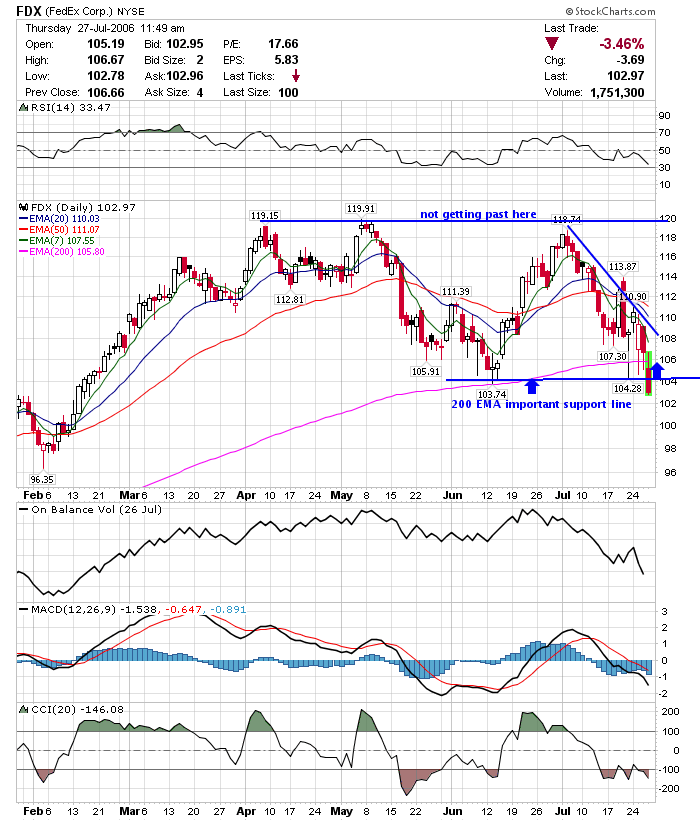
GDP CAME IN AT 2.5, EMPLOYEE COST INDEX UP .9% AND HAS BEEN RISING STEADILY.
SO WE HAVE A SLOWING ECONOMY, COSTS OF KEEPING EMPLOYEES RISING SHARPLY, AND INFLATION IS IN THE AIR!
WHAT IS MORE IMPORTANT THAN THE DATA, IS TRADER REACTION. WITH THE TRANSPORT INDEX BREAKING DOWN BADLY, CAUTION IS ADVISED
SO WE HAVE A SLOWING ECONOMY, COSTS OF KEEPING EMPLOYEES RISING SHARPLY, AND INFLATION IS IN THE AIR!
WHAT IS MORE IMPORTANT THAN THE DATA, IS TRADER REACTION. WITH THE TRANSPORT INDEX BREAKING DOWN BADLY, CAUTION IS ADVISED

Thursday, July 27, 2006
ON THE WINGS OF A BUTTERFLY
ON THE WINGS OF A BUTTERFLY, I AM FREE
I AM FREE OF THE WORLD’S TROUBLES
I AM FREE TO FLY ABOVE ALL THE WORRIES
I AM FREE TO LEAVE THIS WORLD AND ENTER
A NEW ONE
A NEW WOLRD FREE OF STRIFE AND TURMOIL
FREE OF HATE AND INJUSTICE
FREE OF CRIME AND INPATIENCE
FREE OF THE HANDS OF TIME
ON THE WINGS OF A BUTTERFLY, I AM FREE
I AM FREE TO GO WHERE I WANT
I AM FREE OF ALL PAIN
I AM LIGHT AS A FEATHER AND HAVE NO WORRIES
ON THE WINGS OF A BUTTERFLY
I HAVE ONLY ONE REGRET IN LEAVING THIS WORLD
AND THAT IS THAT I CANNOT BE WITH YOU ANYMORE
YOU HAVE BROUGHT ME SO MUCH JOY IN MY LIFE
I HOPE YOU KNOW HOW MUCH I LOVED YOU
ON THE WINGS OF A BUTTERFLY I AM FREE,
BUT I CANNOT HAVE YOU
BUT WHAT I DO HAVE, AS DO YOU IS A LIFETIME OF MEMORIES
OF HAPPY TIMES AND OF LOVE AND JOY
I KNOW WHAT WE MEANT TO EACH OTHER
THE SADNESS AND EMPTYNESS WILL LIFT
ON THE WINGS OF A BUTTERFLY I AM LIFTED FROM MY SORROW
AND AM UPLIFTED WHEN I THINK OF YOU, OUR LIFE TOGETHER
I WILL BE THAT BUTTERFLY SOMEDAY,
AND I AM SURE WE WILL MEET AGAIN
HIGH ABOVE THE WORLD
WITHOUT A CARE, IN TOTAL PEACE
AND TOGETHER AGAIN.
IN LOVING MEMORY AND EVERLASTING PEACE. RUTH, MAY YOUR MOM REST IN PEACE.
DURATEK
I AM FREE OF THE WORLD’S TROUBLES
I AM FREE TO FLY ABOVE ALL THE WORRIES
I AM FREE TO LEAVE THIS WORLD AND ENTER
A NEW ONE
A NEW WOLRD FREE OF STRIFE AND TURMOIL
FREE OF HATE AND INJUSTICE
FREE OF CRIME AND INPATIENCE
FREE OF THE HANDS OF TIME
ON THE WINGS OF A BUTTERFLY, I AM FREE
I AM FREE TO GO WHERE I WANT
I AM FREE OF ALL PAIN
I AM LIGHT AS A FEATHER AND HAVE NO WORRIES
ON THE WINGS OF A BUTTERFLY
I HAVE ONLY ONE REGRET IN LEAVING THIS WORLD
AND THAT IS THAT I CANNOT BE WITH YOU ANYMORE
YOU HAVE BROUGHT ME SO MUCH JOY IN MY LIFE
I HOPE YOU KNOW HOW MUCH I LOVED YOU
ON THE WINGS OF A BUTTERFLY I AM FREE,
BUT I CANNOT HAVE YOU
BUT WHAT I DO HAVE, AS DO YOU IS A LIFETIME OF MEMORIES
OF HAPPY TIMES AND OF LOVE AND JOY
I KNOW WHAT WE MEANT TO EACH OTHER
THE SADNESS AND EMPTYNESS WILL LIFT
ON THE WINGS OF A BUTTERFLY I AM LIFTED FROM MY SORROW
AND AM UPLIFTED WHEN I THINK OF YOU, OUR LIFE TOGETHER
I WILL BE THAT BUTTERFLY SOMEDAY,
AND I AM SURE WE WILL MEET AGAIN
HIGH ABOVE THE WORLD
WITHOUT A CARE, IN TOTAL PEACE
AND TOGETHER AGAIN.
IN LOVING MEMORY AND EVERLASTING PEACE. RUTH, MAY YOUR MOM REST IN PEACE.
DURATEK
Tuesday, July 25, 2006
ACTIVE SPX CHART UPDATED
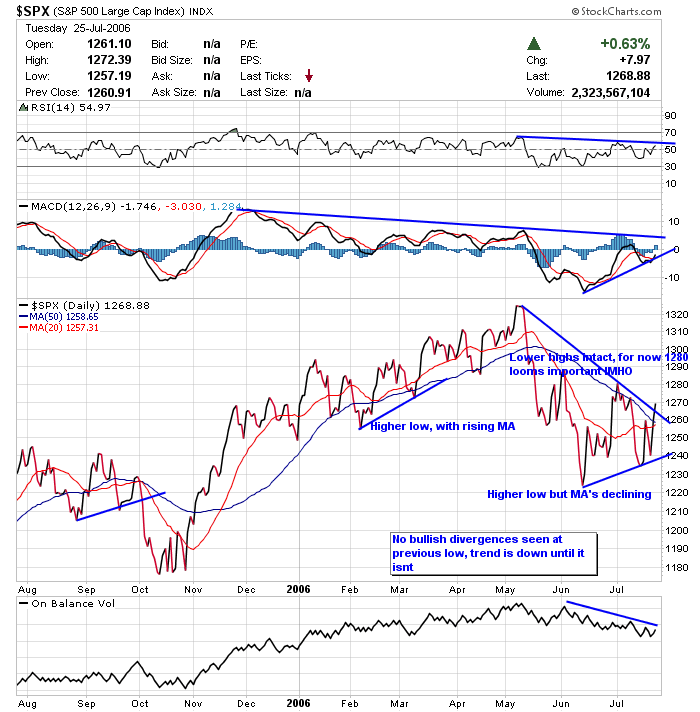 Comments on chart are valid, higher lows DID lead to price rise, above short term downtrend line as drawn. Will be interesting to see how this all plays out.
Click to enlarge.
D
To one of my readers
lastch,
appreciate you comments. I have been studying technical analysis for over 8 years now and have been implimenting a system for identifying TRENDS.
It is not quite perfected as to signal exit points, but is very accurate and will be something I will use to trade over any other method. Trend Followers are the MOST succesful traders, so this is what I choose to emmulate.
Maybe I underestimated how I would fell posting to the thin air, not knowing how I was reaching or effecting people vs the email replies and phone conversations with my trading friends, all of whom are extremely saavy and knowledgable.
My reasoning was to have my blog so I could share what I was learning, and I am never short of an opinion.
IMHO, this US market is setting up to put a real hurting on as many as it can lure in.
Looks like it may run to 1280-ish on the SPX, the NAZ is still way underperforming, it led the way to 2000, it led the way in 2003 recovery, it is only group that has signalled the BEAR is BACK using my TA I developed.
Today is strong mkt it looked? YET TRANSPORTS were off near 2% !
Wasn't it the Trannies which led this mkt up? and hit NEW all time highs this year? Yes it was, now their path is diverging....ominous IMHO. UPS key transport missed earnings...so did DUpont.
EBAY INTC DELL AMZN YHOO MSFT all languish near 52 week lows or worse...what's going on?
90% up days then 80 and 90% down days...all in same month? MOST volatile mkt in 55 years, most dont see it...they see what CNBC is peddling.
For you my friend, have helped me realize why I loved my blog....to help open the minds and make people think about what is really going on.
One must not take what is handed them as the truth.
Check back in from time to time, I will do my best to put something of value on my blog as best I can.
Duratek
appreciate you comments. I have been studying technical analysis for over 8 years now and have been implimenting a system for identifying TRENDS.
It is not quite perfected as to signal exit points, but is very accurate and will be something I will use to trade over any other method. Trend Followers are the MOST succesful traders, so this is what I choose to emmulate.
Maybe I underestimated how I would fell posting to the thin air, not knowing how I was reaching or effecting people vs the email replies and phone conversations with my trading friends, all of whom are extremely saavy and knowledgable.
My reasoning was to have my blog so I could share what I was learning, and I am never short of an opinion.
IMHO, this US market is setting up to put a real hurting on as many as it can lure in.
Looks like it may run to 1280-ish on the SPX, the NAZ is still way underperforming, it led the way to 2000, it led the way in 2003 recovery, it is only group that has signalled the BEAR is BACK using my TA I developed.
Today is strong mkt it looked? YET TRANSPORTS were off near 2% !
Wasn't it the Trannies which led this mkt up? and hit NEW all time highs this year? Yes it was, now their path is diverging....ominous IMHO. UPS key transport missed earnings...so did DUpont.
EBAY INTC DELL AMZN YHOO MSFT all languish near 52 week lows or worse...what's going on?
90% up days then 80 and 90% down days...all in same month? MOST volatile mkt in 55 years, most dont see it...they see what CNBC is peddling.
For you my friend, have helped me realize why I loved my blog....to help open the minds and make people think about what is really going on.
One must not take what is handed them as the truth.
Check back in from time to time, I will do my best to put something of value on my blog as best I can.
Duratek
Monday, July 17, 2006
PICTURE OF THE DAY

I don't think a tradable bottom is in place, sufficient demand at current prices has not shown up IMHO. It may not be until normal cyclical lows made in Sept/Oct time frame. This I might ride into Dec and then skeedaddle until MArch.
Think about the action in the Dow, has it been bullish? higher highs? lows?
With extreme prices being paid in energy, and NO relief that can be seen, inflation is more than on our doorstep. And higher oil trickles down into almost everything we buy or need.
Dollar is soaring today, news reports say it's because of middle east unrest, imagine that the US $$$ as safe haven...LOL gues they do not care about the $trillions in debt and unfudned liabilities? Gold off in reaction.
So, we have an engine, in ASIA some have called CHINDIA (complete investor) that is gaining spedd and horsepower and is insatiable in its growing deamnd to feed....consume natural resources, this may be unstoppable unavoidable and the result could be a doubling in energy consumption in 10 years! HOW is this demand going to be met?
We are ill prepared and not moving FAST enough to deal with these andmany other issues. We have a puppet at the helm we only get lip service from.
Ford comes out with 500 HP Mustang, neat huh? SUV'S roam the land, Hummers on every street, it isnt that they can't afford the gas, it is the rate of consumption that is the problem, gas mileage MUST increase, conservation, more diesel engines, new fuels and technology.
Lots of talk about ETAHNOL, but it is nt very efficient, and it takes lots of POWER to produce, pesticides etc, sugar cane is more reasonable source, of which the US has none. INstead we put tarrif on incoming Ethanol and add a SUBSIDY you and I pay for towards US produced Ethanol, Ethanol cannot stand on its own without 50 Cent gal subsidy, again you and I pay.
My moving average work tells me NAZ is in bear market again, with the DOW and SPX VERY close, but no signal yet. But one thing seems very clear to me, the demand for stocks is dwindling while supply increases, this is setting us up for a big mistake. And we just had 3 staright triple digit losses.
Lemmings are staying put for now, and I still expect a nice rally from lows in Fall into year end, but that will only be a temporary lull before more increased selling action returns.
It seems like a NO BRAINER to invest in oil and energy related stocks here, you see it on every magazine cover, Peak OIL stories abound, "we are running out of oil"....WHO doesn't think oil is just going to keep going up?
And that is what bothers me, contrarian as I am, it seems too easy. TOO many people think this is true.
I agree no new oil discoveries of significance have been found in last 10 years. Demand from China and India is growing exponentially, these are all real situations.
My gut tells me a correction is coming and if I was wanting to add for start positions, this is what I might look for. Gold and OIL charts look like bull markets, so good chance of higher highes down the road.....but you always get bull corrections too.
When wanting a position in something, it is sometimes a good idea to ease into it, 1/3 a 1/3 and if trend is solid all in the amount you have decided you can risk, and an exit strategy.
Not every trade will be a winner, even if based on sound theory, so it is key to keep your losses small. It is NOT so important to be stubborn and be proven right. The best make mistakes all the time, it is just when they ARE right it is in big way.
COULD HIGH ENERGY prices, inflation, weak hosuing market, and FED rate increases all conspire to cause a Recession?
I think so, and wouldn't a world slowdown, weaken demand for oil? With lots of supply meeting current demand, if demand slackens, won't prices tumble?at least temporarily?
Things are getting VERY interesting, and troubling, stay tuned.
Duratek
Friday, July 14, 2006
BOJ BUSTS A MOVE
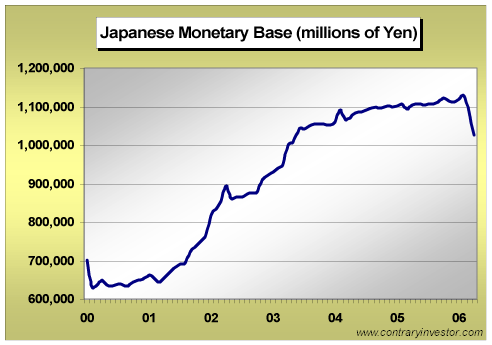
BoJ ends zero interest rate policy
Peter Alford, Tokyo correspondent 15 jul 06T
HE Bank of Japan has terminated its zero interest rate policy, marking the country's emergence from a twilight zone where bank accounts pay 0.001 per cent, a standard home mortgage rate is 2.5 per cent and apartments are worth 70 per cent less now than 20 years ago.Yesterday's decision to move the overnight call rate target, the so-called policy rate, from "effective zero" to 0.25 per cent for the first time since March 2001 underscores the central bank's confidence that Japan's long struggle with deflation is finally won.
Major retail banks greeted the news with an immediate interest lift for ordinary at-call savings bank deposits from 0.001 per cent to a princely 0.1 per cent.
Dai Ichi Life Research cautioned, however, that tangible benefits would only be felt by the rich and the debt-free elderly - the 12 per cent of households who control more than half Japan's Y728 trillion ($8.37 trillion) of bank savings and deposits.
Dai Ichi estimated the interest rate shift would add about Y557 billion annually to household incomes and cost home mortgagees an additional Y135 billion.
The yen, bond prices and the Tokyo stock market dropped yesterday and a senior analyst, Credit Suisse Securities chief economist Hiromichi Shirakawa, warned the combined effect of the Japanese tightening and US inflation news next week could roil world markets.
"We share (the BoJ's) concern, which is mainly a further downturn of equity markets globally," Mr Shirakawa said.
"Next week could be when we again see downward pressure on equity markets."
Two other uncertainties worry the Japanese markets; the timing of further rate rises and the future of BoJ governor Toshihiko Fukui, widely regarded as an important factor in Japan's stabilisation following a decade of BoJ policy failure.
"We have no intention to carry out consecutive rate rises," Mr Fukui told journalists last night. "We will adjust interest rates gradually while carefully checking the economy and prices."
However, Mr Fukui's gradualist language does not impress analysts such as Macquarie Securities Japan chief economist Richard Jerram who noted this week that so far this year the BoJ had tightened monetary conditions at the earliest opportunity and quickly. Some Tokyo market economists said yesterday the BoJ still planned to get to 1.5 per cent by March 2008 when 71-year-old Mr Fukui's term ends.
Others, such as Mr Shirakawa believe political conditions - the governing Liberal Democrat Party elects a new prime minister on September 20 - followed by worsening international conditions and a sharp downturn in the Japanese corporate profit cycle will prevent the BoJ from tightening again before mid-2007. On the second question, Mr Fukui indicated he intended to stay at the post. "I caused a fuss and worried many people, but I still have a duty to fulfil," he said. "There is no change in my intention."
The governor has been wildly assailed over his investment seven years ago in the now-notorious Murakami fund. Mr Fukui has been cleared of any illegality or conflict by a BoJ examination, but the association with alleged inside-trader Yoshiaki Murakami has made him bitterly unpopular - 72 per cent of respondents to a newspaper poll released yesterday said he should resign.
Peter Alford, Tokyo correspondent 15 jul 06T
HE Bank of Japan has terminated its zero interest rate policy, marking the country's emergence from a twilight zone where bank accounts pay 0.001 per cent, a standard home mortgage rate is 2.5 per cent and apartments are worth 70 per cent less now than 20 years ago.Yesterday's decision to move the overnight call rate target, the so-called policy rate, from "effective zero" to 0.25 per cent for the first time since March 2001 underscores the central bank's confidence that Japan's long struggle with deflation is finally won.
Major retail banks greeted the news with an immediate interest lift for ordinary at-call savings bank deposits from 0.001 per cent to a princely 0.1 per cent.
Dai Ichi Life Research cautioned, however, that tangible benefits would only be felt by the rich and the debt-free elderly - the 12 per cent of households who control more than half Japan's Y728 trillion ($8.37 trillion) of bank savings and deposits.
Dai Ichi estimated the interest rate shift would add about Y557 billion annually to household incomes and cost home mortgagees an additional Y135 billion.
The yen, bond prices and the Tokyo stock market dropped yesterday and a senior analyst, Credit Suisse Securities chief economist Hiromichi Shirakawa, warned the combined effect of the Japanese tightening and US inflation news next week could roil world markets.
"We share (the BoJ's) concern, which is mainly a further downturn of equity markets globally," Mr Shirakawa said.
"Next week could be when we again see downward pressure on equity markets."
Two other uncertainties worry the Japanese markets; the timing of further rate rises and the future of BoJ governor Toshihiko Fukui, widely regarded as an important factor in Japan's stabilisation following a decade of BoJ policy failure.
"We have no intention to carry out consecutive rate rises," Mr Fukui told journalists last night. "We will adjust interest rates gradually while carefully checking the economy and prices."
However, Mr Fukui's gradualist language does not impress analysts such as Macquarie Securities Japan chief economist Richard Jerram who noted this week that so far this year the BoJ had tightened monetary conditions at the earliest opportunity and quickly. Some Tokyo market economists said yesterday the BoJ still planned to get to 1.5 per cent by March 2008 when 71-year-old Mr Fukui's term ends.
Others, such as Mr Shirakawa believe political conditions - the governing Liberal Democrat Party elects a new prime minister on September 20 - followed by worsening international conditions and a sharp downturn in the Japanese corporate profit cycle will prevent the BoJ from tightening again before mid-2007. On the second question, Mr Fukui indicated he intended to stay at the post. "I caused a fuss and worried many people, but I still have a duty to fulfil," he said. "There is no change in my intention."
The governor has been wildly assailed over his investment seven years ago in the now-notorious Murakami fund. Mr Fukui has been cleared of any illegality or conflict by a BoJ examination, but the association with alleged inside-trader Yoshiaki Murakami has made him bitterly unpopular - 72 per cent of respondents to a newspaper poll released yesterday said he should resign.
Monday, June 26, 2006
Sunday, June 25, 2006
HOSTILE AND YOUR MONEY
Because I am HOME ALONE for a few days, I use this time to reflect, and to watch bad movies. So last night I chose HOSTILE and Underworld 2
Now Hostile started out great, great looking woman taking their clothes off, party time in Amsterdam for the 3 friends, until they find out the hard way they been had....."I make money on you, that makes you my bitch" says the beautiful vixen. As it turns out, unsuspecting people are being sold for torture, and you could pony up $50K and pick one to mame and kill as you like.....what fun!!!!! Underworld? well who wouldn't love a classic battle against werewolves and vampires?
We are at a crossroads, right here, right now! WHat to do?
Summer rally could be nigh, and it would make sense to come next Wed/Thur around the next Fed meeting on interest rates. 2 more hikes according to futures bets seem clear, MOST think 50 more basis points and DONE....some even think 50 comes next week signaling the FED IS DONE FOR NOW!!!!!
Isn't that what everyone is waiting for? Isn't that reason to PARTY ON DUDE?
Let's think about that. What would the END OF HIKES MEAN FOR US? It would mean SHOR TERM rates halt their rise, but longer term rates are controlled by market forces, and if they DROP, they would INVERT again (already are) signalling RECESSION ahead is likely.
Wouldn't the market like a potential CUT in interest rates by FED? but after such a historic rise in home prices and building activity, lowering rates would NOT, IMHO lead to another leg up in housing.
The US DOLLAR has been in rally mode, and as EWT calls for a 100 index move for dollar, so many feel it impossible to happen, majority long the Euro, that is Hedge Fund buying. A crowded trade is not where I want to be.
Long term rates have broken out, and is causing much pain in economy, higher credit card rates, double minimum payments not to mention a coming rise to all those in adjustable mortgages.
Consider that REAL INFLATION is present in economy, even in manipulated government data, the hawkish tone of FED might mean they overcompensate for these inflation possibilities, as they often overshoot. I mean what would you call keeping rates at 1% for a year when rates fell?
I was just in Fla., and I saw MUCHO for sale signs, prices are easing, inventory rising, speculators may be caught with hand in cookie jar. Speculators fueled the unwanted rise in prices, not NORMAL demand, and it also has unwanted side effect of raising everyone's property taxes!!!
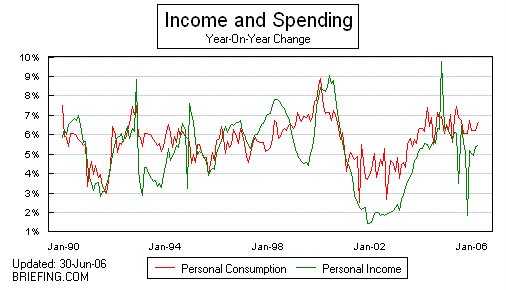
I have read the negative savings rate doesn't matter, that as long as Consumer's keep spending we'll be fine, or if they begin to lighten up, Business Spending will cover the slack. But a recent CEO POLL showed 41% CUTTING SPENDING!!!!!!!
"FORTUNE TELLERS LIVE IN THE FUTURE. SO DO PEOPLE WHO WANT TO PUT THINGS OFF. SO DO FUNDAMETALISTS" ED SEYKOTA
"PROFIT TARGETS IMPLY A TRADER CAN PREDICT THE FUTURE. PROFIT TARGETS ARE PROFIT-LIMITING. TREND FOLLOWERS STAY IN THE MOMENT OF NOW, AVOID PROGNOSTICATION, AND LET THE MARKETS RUN AS FAR AS THEY GO." STUDENT OF ED SEYKOTA
"CONFIDENCE COMES FROM SUCCESS, TO BE SURE, BUT IT CAN ALSO COME FROM RECOGNIZING THAT A LOT OF CAREFULLY EXAMINED FAILURES ARE THEMSELVES ONE PATH TO SUCCESS." DENISE SHEKERJIAN
Friends, the markets will tell us, price action will dictate our course, and there is NO reason trying to predict what no one can.
Duratek
Now Hostile started out great, great looking woman taking their clothes off, party time in Amsterdam for the 3 friends, until they find out the hard way they been had....."I make money on you, that makes you my bitch" says the beautiful vixen. As it turns out, unsuspecting people are being sold for torture, and you could pony up $50K and pick one to mame and kill as you like.....what fun!!!!! Underworld? well who wouldn't love a classic battle against werewolves and vampires?
We are at a crossroads, right here, right now! WHat to do?
Summer rally could be nigh, and it would make sense to come next Wed/Thur around the next Fed meeting on interest rates. 2 more hikes according to futures bets seem clear, MOST think 50 more basis points and DONE....some even think 50 comes next week signaling the FED IS DONE FOR NOW!!!!!
Isn't that what everyone is waiting for? Isn't that reason to PARTY ON DUDE?
Let's think about that. What would the END OF HIKES MEAN FOR US? It would mean SHOR TERM rates halt their rise, but longer term rates are controlled by market forces, and if they DROP, they would INVERT again (already are) signalling RECESSION ahead is likely.
Wouldn't the market like a potential CUT in interest rates by FED? but after such a historic rise in home prices and building activity, lowering rates would NOT, IMHO lead to another leg up in housing.
The US DOLLAR has been in rally mode, and as EWT calls for a 100 index move for dollar, so many feel it impossible to happen, majority long the Euro, that is Hedge Fund buying. A crowded trade is not where I want to be.
Long term rates have broken out, and is causing much pain in economy, higher credit card rates, double minimum payments not to mention a coming rise to all those in adjustable mortgages.
Consider that REAL INFLATION is present in economy, even in manipulated government data, the hawkish tone of FED might mean they overcompensate for these inflation possibilities, as they often overshoot. I mean what would you call keeping rates at 1% for a year when rates fell?
I was just in Fla., and I saw MUCHO for sale signs, prices are easing, inventory rising, speculators may be caught with hand in cookie jar. Speculators fueled the unwanted rise in prices, not NORMAL demand, and it also has unwanted side effect of raising everyone's property taxes!!!
I have read the negative savings rate doesn't matter, that as long as Consumer's keep spending we'll be fine, or if they begin to lighten up, Business Spending will cover the slack. But a recent CEO POLL showed 41% CUTTING SPENDING!!!!!!!
"FORTUNE TELLERS LIVE IN THE FUTURE. SO DO PEOPLE WHO WANT TO PUT THINGS OFF. SO DO FUNDAMETALISTS" ED SEYKOTA
"PROFIT TARGETS IMPLY A TRADER CAN PREDICT THE FUTURE. PROFIT TARGETS ARE PROFIT-LIMITING. TREND FOLLOWERS STAY IN THE MOMENT OF NOW, AVOID PROGNOSTICATION, AND LET THE MARKETS RUN AS FAR AS THEY GO." STUDENT OF ED SEYKOTA
"CONFIDENCE COMES FROM SUCCESS, TO BE SURE, BUT IT CAN ALSO COME FROM RECOGNIZING THAT A LOT OF CAREFULLY EXAMINED FAILURES ARE THEMSELVES ONE PATH TO SUCCESS." DENISE SHEKERJIAN
Friends, the markets will tell us, price action will dictate our course, and there is NO reason trying to predict what no one can.
Duratek
ABRAMOFF : FOLLOW THE MONEY
E-Mails Reveal Abramoff Requests, Contacts
By JOHN SOLOMON, Associated Press Writer
document.write(getElapsed("20060625T133227Z"));
39 minutes agoUPDATED 12 MINUTES AGO
Jack Abramoff leaves Federal Court in Washington, Jan. ...
WASHINGTON - Wanted: Face time with President Bush or top adviser Karl Rove. Suggested donation: $100,000. The middleman: lobbyist Jack Abramoff. Blunt e-mails that connect money and access in Washington show that prominent Republican activist Grover Norquist facilitated some administration contacts for Abramoff's clients while the lobbyist simultaneously solicited those clients for large donations to Norquist's tax-exempt group.
Those who were solicited or landed administration introductions included foreign figures and American Indian tribes, according to e-mails gathered by Senate investigators and federal prosecutors or obtained independently by The Associated Press.
"Can the tribes contribute $100,000 for the effort to bring state legislatures and those tribal leaders who have passed Bush resolutions to Washington?" Norquist wrote Abramoff in one such e-mail in July 2002.
"When I have funding, I will ask Karl Rove for a date with the president. Karl has already said 'yes' in principle and knows you organized this last time and hope to this year," Norquist wrote in the e-mail.
A Senate committee that investigated Abramoff previously aired evidence showing Bush met briefly in 2001 at the White House with some of Abramoff's tribal clients after they donated money to Norquist's group.
The 2002 e-mail about a second White House meeting and donations, however, was not disclosed. The AP obtained the text from people with access to the document.
The tribes got to meet Bush at the White House in 2002 again and then donated to Norquist's Americans for Tax Reform, or ATR.
Though Norquist's own e-mail connects the $100,000 donation and the White House visit, ATR spokesman John Kartch said Norquist never offered to arrange meetings in exchange for money.
Instead, Norquist simply wanted Abramoff's tribes to help pay for a conference where lawmakers and tribal leaders passed resolutions supporting the Bush agenda, ultimately securing a brief encounter with Bush, Kartch said.
"No one from Americans for Tax Reform ever assisted Jack Abramoff in getting meetings or introductions with the White House or congressional leaders in exchange for contributions," Kartch said, suggesting some of the e-mails might be misleading.
"If you look at some of Abramoff's e-mails to third parties, they might be misread to suggest that he was misrepresenting or confusing support for a project with a specific meeting," Kartch said. "This could have been deliberate or just unclear."
Kartch said: "People were invited to ATR's conference and to the White House only if they worked on pro-tax-cut resolutions. Nobody was invited because they made a contribution to ATR."
Lawyers for Abramoff declined comment.
The White House said Rove was unaware that Norquist solicited any money in connection with ATR events in both 2001 and 2002 that brought Abramoff's tribal clients and others to the White House.
"We do not solicit donations in exchange for meetings or events at the White House, and we don't have any knowledge of this activity taking place," said a White House spokeswoman, Erin Healy.
After the tribes' 2002 event with Bush, Norquist pressed Abramoff anew for tribal donations _ this time for a political action committee. "Jack, a few months ago you said you could get each of your Indian tribes to make a contribution. ... Is this still possible?" Norquist asked in an October 2002 e-mail.
Abramoff responded that "everyone is tapped out having given directly to the campaigns. After the election, we'll be able to get this moving."
The e-mails show Abramoff delivered on his original promise to get tribal money for the event that included the Bush visit, sending one check from the Mississippi Choctaw tribe in October and one in November from the Saginaw Chippewa of Michigan. Kartch said Abramoff didn't deliver on PAC contributions.
Norquist and Abramoff were longtime associates who went back decades to their days in the Young Republicans movement. Norquist founded ATR to advocate lower taxes and less government. He built it into a major force in the Republican Party as the GOP seized control of Congress and the White House.
Abramoff became one of Washington's rainmaker lobbyists before allegations that he defrauded Indian tribes led to his downfall and a prison sentence. He is cooperating with prosecutors.
At the time ATR dealt with Abramoff, Kartch said, "he was a longtime and respected Republican activist in Washington. There was no reason to suspect any of the problems that later came up."
The e-mails show Abramoff, on multiple occasions, asked clients for large donations to Norquist's group while Norquist invited them to ATR events that brought them face to face with top administration officials.
For instance, several months after donating $25,000 to Norquist's group, Saginaw officials attended a reception in the summer of 2003 at Norquist's home. They posed for a photo with Norquist and Labor Secretary Elaine Chao.
A few weeks earlier, then-Saginaw tribal chief Maynard Kahgegab Jr. had been appointed by Chao to a federal commission, according Labor Department and tribal documents obtained by the AP.
The Saginaw used the Chao photo, the commission appointment and photos they took with Bush at the White House to boast on their internal Web site about the high-level Washington access that Abramoff's team had won.
Labor officials confirmed that Chao attended the reception at Norquist's home. But they said they do not know who recommended Kahgegab to be appointed in May 2003 to the U.S. Native American Employment and Training Council. The department sought to remove the chief a year later after he lost a tribal election, documents show.
"This is one of hundreds of advisory appointments that are sent forward by agencies within the department for front office signoff," said a department spokesman, David James.
ATR's Kartch suggested Chao's contact with the Saginaw at Norquist's home was incidental. "ATR does many receptions for supporters. There were dozens of people in attendance that evening. This event was not organized specifically for any person, but was rather a widely attended general event," he said.
Norquist did make a special effort _ at Abramoff's request _ to introduce a British businessman and an African dignitary to Rove at another ATR event in summer 2002.
Abramoff bluntly told Norquist he was asking the African dignitary for a $100,000 donation to ATR and suggested the introduction to Rove might help secure the money.
"I have asked them for $100K for ATR," Abramoff wrote Norquist in July 2002. "If they come I'll think we'll get it. If he is there, please go up to him (he'll be African) and welcome him."
Norquist obliged.
"I am assuming this is very important and therefore we are making it happen," the GOP activist wrote back, promising to introduce the two foreigners as well as a Saginaw tribal official to Rove that night.
A day later, an ecstatic Abramoff sent an e-mail thanking Norquist for "accommodating" the introductions. "I spoke with the ambassador today and he is moving my ATR request forward," the lobbyist wrote, referring to the donation.
Kartch confirmed Norquist invited the foreigners to the ATR event, but Kartch said the group never asked for, expected or received the $100,000.
It was not the first time that Abramoff sought ATR donations in connection with lobbying business. E-mails dating to 1995 show Abramoff solicited donations from clients to Norquist's group as part of lobbying efforts.
"I spoke this evening with Grover," Abramoff wrote in an October 1995 e-mail outlining how Norquist and his group could help a client on a matter before Congress.
Abramoff wrote that the lobbying help he was seeking from Norquist's group was "perfectly consistent" with ATR's position but that Norquist nonetheless wanted a donation to be made.
"He said that if they want the taxpayer movement, including him, involved on this issue and anything else which will come over the course of the year or so, they need to become a major player with ATR. He recommended that they make a $50,000 contribution to ATR," the lobbyist wrote.
Abramoff cautioned one of his colleagues that the donation needed to be "kept discreet."
"We don't want opponents to think that we are trying buy the taxpayer movement," he said.
Kartch denied that anyone at ATR asked Abramoff for the money. "ATR is not responsible for comments by Jack Abramoff to third parties," he said.
Copyright 2006 The Associated Press
By JOHN SOLOMON, Associated Press Writer
document.write(getElapsed("20060625T133227Z"));
39 minutes agoUPDATED 12 MINUTES AGO
Jack Abramoff leaves Federal Court in Washington, Jan. ...
WASHINGTON - Wanted: Face time with President Bush or top adviser Karl Rove. Suggested donation: $100,000. The middleman: lobbyist Jack Abramoff. Blunt e-mails that connect money and access in Washington show that prominent Republican activist Grover Norquist facilitated some administration contacts for Abramoff's clients while the lobbyist simultaneously solicited those clients for large donations to Norquist's tax-exempt group.
Those who were solicited or landed administration introductions included foreign figures and American Indian tribes, according to e-mails gathered by Senate investigators and federal prosecutors or obtained independently by The Associated Press.
"Can the tribes contribute $100,000 for the effort to bring state legislatures and those tribal leaders who have passed Bush resolutions to Washington?" Norquist wrote Abramoff in one such e-mail in July 2002.
"When I have funding, I will ask Karl Rove for a date with the president. Karl has already said 'yes' in principle and knows you organized this last time and hope to this year," Norquist wrote in the e-mail.
A Senate committee that investigated Abramoff previously aired evidence showing Bush met briefly in 2001 at the White House with some of Abramoff's tribal clients after they donated money to Norquist's group.
The 2002 e-mail about a second White House meeting and donations, however, was not disclosed. The AP obtained the text from people with access to the document.
The tribes got to meet Bush at the White House in 2002 again and then donated to Norquist's Americans for Tax Reform, or ATR.
Though Norquist's own e-mail connects the $100,000 donation and the White House visit, ATR spokesman John Kartch said Norquist never offered to arrange meetings in exchange for money.
Instead, Norquist simply wanted Abramoff's tribes to help pay for a conference where lawmakers and tribal leaders passed resolutions supporting the Bush agenda, ultimately securing a brief encounter with Bush, Kartch said.
"No one from Americans for Tax Reform ever assisted Jack Abramoff in getting meetings or introductions with the White House or congressional leaders in exchange for contributions," Kartch said, suggesting some of the e-mails might be misleading.
"If you look at some of Abramoff's e-mails to third parties, they might be misread to suggest that he was misrepresenting or confusing support for a project with a specific meeting," Kartch said. "This could have been deliberate or just unclear."
Kartch said: "People were invited to ATR's conference and to the White House only if they worked on pro-tax-cut resolutions. Nobody was invited because they made a contribution to ATR."
Lawyers for Abramoff declined comment.
The White House said Rove was unaware that Norquist solicited any money in connection with ATR events in both 2001 and 2002 that brought Abramoff's tribal clients and others to the White House.
"We do not solicit donations in exchange for meetings or events at the White House, and we don't have any knowledge of this activity taking place," said a White House spokeswoman, Erin Healy.
After the tribes' 2002 event with Bush, Norquist pressed Abramoff anew for tribal donations _ this time for a political action committee. "Jack, a few months ago you said you could get each of your Indian tribes to make a contribution. ... Is this still possible?" Norquist asked in an October 2002 e-mail.
Abramoff responded that "everyone is tapped out having given directly to the campaigns. After the election, we'll be able to get this moving."
The e-mails show Abramoff delivered on his original promise to get tribal money for the event that included the Bush visit, sending one check from the Mississippi Choctaw tribe in October and one in November from the Saginaw Chippewa of Michigan. Kartch said Abramoff didn't deliver on PAC contributions.
Norquist and Abramoff were longtime associates who went back decades to their days in the Young Republicans movement. Norquist founded ATR to advocate lower taxes and less government. He built it into a major force in the Republican Party as the GOP seized control of Congress and the White House.
Abramoff became one of Washington's rainmaker lobbyists before allegations that he defrauded Indian tribes led to his downfall and a prison sentence. He is cooperating with prosecutors.
At the time ATR dealt with Abramoff, Kartch said, "he was a longtime and respected Republican activist in Washington. There was no reason to suspect any of the problems that later came up."
The e-mails show Abramoff, on multiple occasions, asked clients for large donations to Norquist's group while Norquist invited them to ATR events that brought them face to face with top administration officials.
For instance, several months after donating $25,000 to Norquist's group, Saginaw officials attended a reception in the summer of 2003 at Norquist's home. They posed for a photo with Norquist and Labor Secretary Elaine Chao.
A few weeks earlier, then-Saginaw tribal chief Maynard Kahgegab Jr. had been appointed by Chao to a federal commission, according Labor Department and tribal documents obtained by the AP.
The Saginaw used the Chao photo, the commission appointment and photos they took with Bush at the White House to boast on their internal Web site about the high-level Washington access that Abramoff's team had won.
Labor officials confirmed that Chao attended the reception at Norquist's home. But they said they do not know who recommended Kahgegab to be appointed in May 2003 to the U.S. Native American Employment and Training Council. The department sought to remove the chief a year later after he lost a tribal election, documents show.
"This is one of hundreds of advisory appointments that are sent forward by agencies within the department for front office signoff," said a department spokesman, David James.
ATR's Kartch suggested Chao's contact with the Saginaw at Norquist's home was incidental. "ATR does many receptions for supporters. There were dozens of people in attendance that evening. This event was not organized specifically for any person, but was rather a widely attended general event," he said.
Norquist did make a special effort _ at Abramoff's request _ to introduce a British businessman and an African dignitary to Rove at another ATR event in summer 2002.
Abramoff bluntly told Norquist he was asking the African dignitary for a $100,000 donation to ATR and suggested the introduction to Rove might help secure the money.
"I have asked them for $100K for ATR," Abramoff wrote Norquist in July 2002. "If they come I'll think we'll get it. If he is there, please go up to him (he'll be African) and welcome him."
Norquist obliged.
"I am assuming this is very important and therefore we are making it happen," the GOP activist wrote back, promising to introduce the two foreigners as well as a Saginaw tribal official to Rove that night.
A day later, an ecstatic Abramoff sent an e-mail thanking Norquist for "accommodating" the introductions. "I spoke with the ambassador today and he is moving my ATR request forward," the lobbyist wrote, referring to the donation.
Kartch confirmed Norquist invited the foreigners to the ATR event, but Kartch said the group never asked for, expected or received the $100,000.
It was not the first time that Abramoff sought ATR donations in connection with lobbying business. E-mails dating to 1995 show Abramoff solicited donations from clients to Norquist's group as part of lobbying efforts.
"I spoke this evening with Grover," Abramoff wrote in an October 1995 e-mail outlining how Norquist and his group could help a client on a matter before Congress.
Abramoff wrote that the lobbying help he was seeking from Norquist's group was "perfectly consistent" with ATR's position but that Norquist nonetheless wanted a donation to be made.
"He said that if they want the taxpayer movement, including him, involved on this issue and anything else which will come over the course of the year or so, they need to become a major player with ATR. He recommended that they make a $50,000 contribution to ATR," the lobbyist wrote.
Abramoff cautioned one of his colleagues that the donation needed to be "kept discreet."
"We don't want opponents to think that we are trying buy the taxpayer movement," he said.
Kartch denied that anyone at ATR asked Abramoff for the money. "ATR is not responsible for comments by Jack Abramoff to third parties," he said.
Copyright 2006 The Associated Press
Thursday, June 08, 2006
MARCH 2001 AND HIGH ALERT CRASH WARNING
http://www.gatech.edu/news-room/archive/news_releases/allvine.html
A Very Likely Scenario Is For Rate Cut To Cause A Short Term Bounce In Stock Market:
In the past the stock market normally advanced quickly on 1st or 2nd cut of rates by the Federal Reserve. If rates are cut on Tuesday, then this will be the 3rd cut. Our expectation is for there to be a market rally for a few days or a couple weeks. Then we expect the market to turn down and move into lower territory. In other words we believe there is a strong likelihood of a Bear Market Rally, but we do not believe this is the end of the Bear Market. Those needing to raise some cash could liquidate some stocks if the advance occurs, but I do not believe this is a time to be increasing commitment to the stock market.
Why Expect Immediate Advance In Stock Market (if it occurs) To Be Short Lived:
There are two fundamental reasons for believing that the Bear Market will continue, and it will take more cuts in the Discount and Federal Funds rate before the bottom is in place. The first problem is that levels of market valuation remain high and are not consistent with market bottoms. For example, the P.E. ratio of the S&P 500 climbed from 16 at beginning of 1995 to 36 (a 50-year record) at the top of the market in March 2000. The P.E. Ratio for the S&P 500 has come down to 22.6 from 36, but is still way above the average of 16.2 P.E. from 1970 to the present (see chart). In addition, as stock prices soared the dividend yield has fallen from 6% in 1980 to a little over 1% a few weeks ago (now 1.36%). In other words, for the market to put in a real bottom we would expect the P.E. Ratio to fall from 22.6 to around 15, or a decline of another 35%.
The NASDAQ Is Even More Overvalued:
The NASDAQ climbed to a P.E. of 200 at the top of the market in early 2000 and has fallen to around 80. The average PE for the NASDAQ is close to 35 times earnings so the NASDAQ could fall by another 50% to bring it down to its historical average.
Other Problems Hanging Over The Stock Market:
We have gone through the longest economic expansion in history that started in March 1991. The almost 10-year long boom has presented great economic times for many Americans. But at the same time there have been some excesses that have come along with the economic boom. To participate in the good times, consumer credit has exploded with credit cards being extensively used to acquire more of the good life. Home equity (% of equity in a home to the value of the home) has fallen sharply as home owners have refinanced their homes and increased their mortgages, while others have taken out secondary mortgages on their home to finance consumption. Huge credit card debt and home mortgage debt is a hangover from the longest expansion in the history of our economy.
Danger In A Near Zero Savings Rate:
The personal savings rate during the 1960s, 1970s, and 1980s ran from 7%-8%, but in the booming carefree 1990s the personal savings rate has fallen to near zero. With the implosion of the stock market and family wealth and job uncertainty (and rising unemployment if economy further tightens), it can be clearly anticipated that the personal savings rate will start to rise. When everything is bright (good jobs, easy credit, and growing retirement and investment portfolios), then people will cut their savings rate (as has occurred during the booming 1990s). If the saving rate were to start climbing from the 0-1% level now back to 7%-8% (the norm), then this could take 2%-3% out of GDP for several years and cause stagnation much like has occurred in Japan. If the black economic clouds grow, then Americans will pull back from their spending ways and start again saving for a rainy day. We could become more like Japan where personal savings has rapidly increased over the last 12 years while the Japanese economy has been in the tank.
Summary:
We expect the Federal Reserve to cut rates when it meets tomorrow and this is in our opinion the appropriate policy. In the past cuts in the Fed Funds and Discount Rate has been very bullish for the stock market. We believe there is a good chance of a Bear Market Rally if the Fed cuts rates on Wednesday. But after a few days or a couple of weeks, we expect the market to move to new lower territory. Primary reasons for this opinion is that levels of market valuation remain fairly high (not what are usual at market bottoms). In addition, there are excesses associated with the record long economic boom that will have to be worked out before the economy can again advance strongly with stock prices climbing.
*****
Flash forward to today!!! (Duratek)
We now have negative saving rate, consumption was NEVER curbed during the 2001 Recession nor anytime during the 2000-2003 Bear Market, only more excesses more piled up, more debt etc. We are LESS prepared then to deal with any economic adversity.
Higher energy costs, inflation in areas of consumer needs not wants make the disposable income scenario much worse, as wages have FAILED to keep up with even basic inflation.
Real estate has begun to deflate, a major driver of economy, and is why I believe the commodity prices have begun to decline, and may be entering a bear market.
Chinese stock market is in bear market and recently plummeted by 5%.
VIX ratio is now in an uptrend and we have experienced TWO 90% DOWN DAYS in stock market in past 30 days, VERY good chance Bear Market is BACK!!!!! The risk is to the downside, and we have enterred the weakest 6 months of stock market returns.
Stock market leadership is nowhere to be found, MANY Dow and SPX stocks near 52 week lows, any near 52 week highs continues to diminish near record levels.
IMHO, with cyclical bull rally in very elder stages, extreme caution is now advised. Consult with your financial professional to see if your portfolio can withstand the return of the Bear Market should that be the reality.
The financial mechanisms are surrounded by GS cronies, let's see what PPT team can do.
A Very Likely Scenario Is For Rate Cut To Cause A Short Term Bounce In Stock Market:
In the past the stock market normally advanced quickly on 1st or 2nd cut of rates by the Federal Reserve. If rates are cut on Tuesday, then this will be the 3rd cut. Our expectation is for there to be a market rally for a few days or a couple weeks. Then we expect the market to turn down and move into lower territory. In other words we believe there is a strong likelihood of a Bear Market Rally, but we do not believe this is the end of the Bear Market. Those needing to raise some cash could liquidate some stocks if the advance occurs, but I do not believe this is a time to be increasing commitment to the stock market.
Why Expect Immediate Advance In Stock Market (if it occurs) To Be Short Lived:
There are two fundamental reasons for believing that the Bear Market will continue, and it will take more cuts in the Discount and Federal Funds rate before the bottom is in place. The first problem is that levels of market valuation remain high and are not consistent with market bottoms. For example, the P.E. ratio of the S&P 500 climbed from 16 at beginning of 1995 to 36 (a 50-year record) at the top of the market in March 2000. The P.E. Ratio for the S&P 500 has come down to 22.6 from 36, but is still way above the average of 16.2 P.E. from 1970 to the present (see chart). In addition, as stock prices soared the dividend yield has fallen from 6% in 1980 to a little over 1% a few weeks ago (now 1.36%). In other words, for the market to put in a real bottom we would expect the P.E. Ratio to fall from 22.6 to around 15, or a decline of another 35%.
The NASDAQ Is Even More Overvalued:
The NASDAQ climbed to a P.E. of 200 at the top of the market in early 2000 and has fallen to around 80. The average PE for the NASDAQ is close to 35 times earnings so the NASDAQ could fall by another 50% to bring it down to its historical average.
Other Problems Hanging Over The Stock Market:
We have gone through the longest economic expansion in history that started in March 1991. The almost 10-year long boom has presented great economic times for many Americans. But at the same time there have been some excesses that have come along with the economic boom. To participate in the good times, consumer credit has exploded with credit cards being extensively used to acquire more of the good life. Home equity (% of equity in a home to the value of the home) has fallen sharply as home owners have refinanced their homes and increased their mortgages, while others have taken out secondary mortgages on their home to finance consumption. Huge credit card debt and home mortgage debt is a hangover from the longest expansion in the history of our economy.
Danger In A Near Zero Savings Rate:
The personal savings rate during the 1960s, 1970s, and 1980s ran from 7%-8%, but in the booming carefree 1990s the personal savings rate has fallen to near zero. With the implosion of the stock market and family wealth and job uncertainty (and rising unemployment if economy further tightens), it can be clearly anticipated that the personal savings rate will start to rise. When everything is bright (good jobs, easy credit, and growing retirement and investment portfolios), then people will cut their savings rate (as has occurred during the booming 1990s). If the saving rate were to start climbing from the 0-1% level now back to 7%-8% (the norm), then this could take 2%-3% out of GDP for several years and cause stagnation much like has occurred in Japan. If the black economic clouds grow, then Americans will pull back from their spending ways and start again saving for a rainy day. We could become more like Japan where personal savings has rapidly increased over the last 12 years while the Japanese economy has been in the tank.
Summary:
We expect the Federal Reserve to cut rates when it meets tomorrow and this is in our opinion the appropriate policy. In the past cuts in the Fed Funds and Discount Rate has been very bullish for the stock market. We believe there is a good chance of a Bear Market Rally if the Fed cuts rates on Wednesday. But after a few days or a couple of weeks, we expect the market to move to new lower territory. Primary reasons for this opinion is that levels of market valuation remain fairly high (not what are usual at market bottoms). In addition, there are excesses associated with the record long economic boom that will have to be worked out before the economy can again advance strongly with stock prices climbing.
*****
Flash forward to today!!! (Duratek)
We now have negative saving rate, consumption was NEVER curbed during the 2001 Recession nor anytime during the 2000-2003 Bear Market, only more excesses more piled up, more debt etc. We are LESS prepared then to deal with any economic adversity.
Higher energy costs, inflation in areas of consumer needs not wants make the disposable income scenario much worse, as wages have FAILED to keep up with even basic inflation.
Real estate has begun to deflate, a major driver of economy, and is why I believe the commodity prices have begun to decline, and may be entering a bear market.
Chinese stock market is in bear market and recently plummeted by 5%.
VIX ratio is now in an uptrend and we have experienced TWO 90% DOWN DAYS in stock market in past 30 days, VERY good chance Bear Market is BACK!!!!! The risk is to the downside, and we have enterred the weakest 6 months of stock market returns.
Stock market leadership is nowhere to be found, MANY Dow and SPX stocks near 52 week lows, any near 52 week highs continues to diminish near record levels.
IMHO, with cyclical bull rally in very elder stages, extreme caution is now advised. Consult with your financial professional to see if your portfolio can withstand the return of the Bear Market should that be the reality.
The financial mechanisms are surrounded by GS cronies, let's see what PPT team can do.
Duratek
Tuesday, May 30, 2006
SIMPLE IS BETTER
(click to enlarge)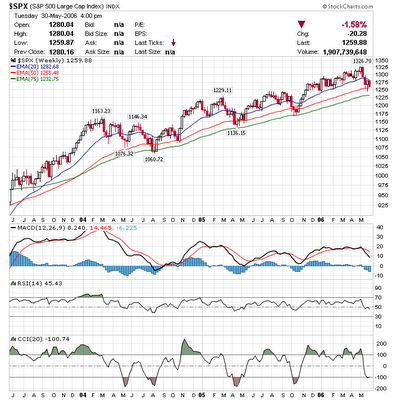
http://stockcharts.com/h-sc/ui?s=$SPX&p=W&b=3&g=0&id=p64235656637
What IS crystal clear to me, is you can even have correction back to 75 WEEK EMA and STILL have a bull mkt! AS long as ????? all 3 of these MA’S are rising stacked on top of each other,
and when the 20 WK slices thru and down, this Bull is officially OVER IMHO, cause when Is the last time that crossover occurred? Back in 2000-2001
And UP again in 2002-2003, I don’t need to know anything more than that.
Duratek (How's my posse doing? or is it one hand clapping?)
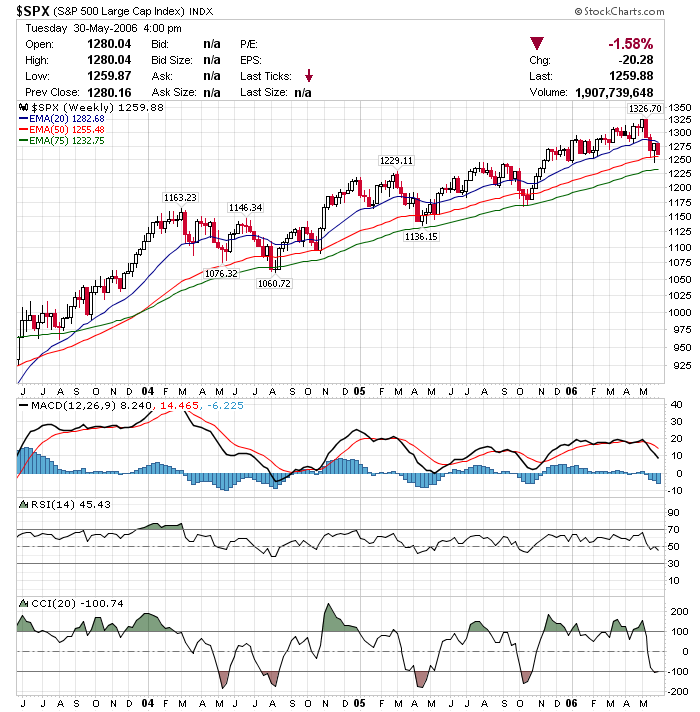
http://stockcharts.com/h-sc/ui?s=$SPX&p=W&b=3&g=0&id=p64235656637
What IS crystal clear to me, is you can even have correction back to 75 WEEK EMA and STILL have a bull mkt! AS long as ????? all 3 of these MA’S are rising stacked on top of each other,
and when the 20 WK slices thru and down, this Bull is officially OVER IMHO, cause when Is the last time that crossover occurred? Back in 2000-2001
And UP again in 2002-2003, I don’t need to know anything more than that.
Duratek (How's my posse doing? or is it one hand clapping?)
Tuesday, May 23, 2006
PEBBLE BED REACTORS
May 23, 2006
Pebble Bed Technology and the Uranium Super Bullby Sol Palha
"Ability hits the mark where presumption overshoots and diffidence falls short." - John Henry Newman 1801-1890, British Religious Leader, Prelate, Writer
China has come up with a new nuclear technology called "pebble bed technology". Essentially power plants built with this technology could only do one thing if something went wrong and that would be to shut down. It would be impossible for these reactors to explode or melt down. The idea is rather simple. Balls of Uranium power these reactors and each ball of uranium is wrapped in an incredibly strong layer of silicon carbide. These spheres have a much higher melting point then the temperature inside the reactor could ever reach. So essentially it would be impossible for the reactor to meltdown or explode. This technology is in the test phase but if it works out as envisioned China will leap frog ahead of the US in this area and then one wonders if they would not export this technology to countries that could help them meet their energy needs. One such country is Iran; in 2003 Iran alone supplied China with over 14% of its oil needs. This figure is definitely substantially higher today. China is desperate for energy and they openly admit to this; when one is desperate for something one is willing to trade almost anything.
"We need every type of energy," says Zhang Zuoyi, head of the institute that helps run the pebblebed test reactor. "We are hungry." China's leaders won't listen to naysayers. They can't afford to.
Another point of interest is that China is about to embark on the biggest nuclear power building plant spree ever undertaken by any nation. Their goal is to derive roughly 4-5% of their Energy needs from Nuclear Power in the next 15 years. While this might sound small when compared to other nations this simple plan means that China will need to build roughly 45 nuclear plants in 15 years or about 3 plants every year. Imagine what effect this will have on uranium prices. Off course in the next few years they could come out with even better technology, which might mean even more nuclear plants. Right now the limiting factor is that no one has thought of coming up with a nuclear power plant assembly line. We are positive that one nation will adopt this idea and when they do installing a new plant will be something that takes months instead of years.
China's new pebble bed technology might be one of the reasons India is not too worried about the nuclear deal falling through with the United States. Not only is this technology superior but also it will most likely cost a lot less and they will not be pushed into a position of having to forcefully take a stance against Iran. Increasingly it appears that more nations are willing to stand up to the US and as the saying goes there is strength in numbers.
China is positioned to leapfrog the world in nuclear power precisely because it entered the race late. Until now, the country has built a hodgepodge of reactors with different technologies and safety features. But recently top leaders decided to build a newer infrastructure virtually from scratch based on the most advanced, and safest, technologies. Although the pebble-bed reactor is not yet ready for prime time, the government is buying equipment and designs that have never been built before. China plans to choose one design of three submitted by Areva of France, Atomstroy export of Russia and Westinghouse Electric for an $8 billion program to build reactors in the eastern province of Zhejiang. (Some industry experts say Areva will probably win, especially since the Chinese government may bristle at the recent takeover bid by Japan's Toshiba on Westinghouse.) The Chinese plan to work closely with the winner to learn how to design and operate the reactors. The goal is to use this technology as the basis for subsequent Chinese plants.
The most likely technology to export, of course, is the pebble bed reactor. All reactors, including the pebble bed, use uranium fuel to produce heat that is used to turn electrical turbines. In conventional so-called light-water reactors, the heat is generated by thousands of fixed metallic rods, which require elaborate cooling systems to keep them from overheating and backup cooling systems in case the primary ones fail. Furthermore, a conventional reactor must be housed in a concrete containment vessel to mitigate damage in case it overheats. In the pebble bed reactor, thousands of tennis-ball-size spheres coated in layers of silicon carbide, ceramic material and graphite each contain thousands of granules of the fuel, uranium dioxide. Because the pebbles dissipate heat so efficiently, say the designers, the fuel inside them couldn't possibly get hot enough to penetrate the graphite casing. The pebble-bed reactor, in fact, doesn't even have a containment vessel. Another advantage of pebble beds is that it's easier to make small plants and put them up quickly, which lends itself to China's plan of spreading plants around the hinterlands. Extracting fuel from pebble bed reactors to use for weapons would be difficult and expensive. Full Story
Conclusion
Even Ukraine which had renounced nuclear technology has decided that they need to build at least 15 plants over the next decade to prevent a repeat of the recent energy crisis when Russia cut of gas supplies to Ukraine. Almost every nation is slowly but surely embracing nuclear energy something that was once shunned. While we have many nations focussing on developing new technologies for nuclear power plants no one is spending the time and money needed to find new supplies of uranium and open up new mines. Current demand far outstrips the available supply and one can only imagine the uranium crunch that will be created in years to come unless a massive program to open up new mines and find new supplies of uranium is undertaken shortly. As usual a crisis that could have easily been prevented will be allowed to develop into a full blown disaster before something meaningful is done. The reasons are always the same; key big players are going to make fortune and the expense and misery of others. When the choice comes to down to money or doing the right thing 9 out of 10 times money wins. Hence make sure that you own the right companies and buy them at the right time as they are many useless so called uranium companies out there. One can also buy a great company at the wrong time. In order to win one has to buy at the right time and also sell at the right time.
"The principle of all successful effort is to try to do not what is absolutely the best, but what is easily within our power, and suited for our temperament and condition." - John Ruskin 1819-1900, British Critic, Social Theorist
Pebble Bed Technology and the Uranium Super Bullby Sol Palha
"Ability hits the mark where presumption overshoots and diffidence falls short." - John Henry Newman 1801-1890, British Religious Leader, Prelate, Writer
China has come up with a new nuclear technology called "pebble bed technology". Essentially power plants built with this technology could only do one thing if something went wrong and that would be to shut down. It would be impossible for these reactors to explode or melt down. The idea is rather simple. Balls of Uranium power these reactors and each ball of uranium is wrapped in an incredibly strong layer of silicon carbide. These spheres have a much higher melting point then the temperature inside the reactor could ever reach. So essentially it would be impossible for the reactor to meltdown or explode. This technology is in the test phase but if it works out as envisioned China will leap frog ahead of the US in this area and then one wonders if they would not export this technology to countries that could help them meet their energy needs. One such country is Iran; in 2003 Iran alone supplied China with over 14% of its oil needs. This figure is definitely substantially higher today. China is desperate for energy and they openly admit to this; when one is desperate for something one is willing to trade almost anything.
"We need every type of energy," says Zhang Zuoyi, head of the institute that helps run the pebblebed test reactor. "We are hungry." China's leaders won't listen to naysayers. They can't afford to.
Another point of interest is that China is about to embark on the biggest nuclear power building plant spree ever undertaken by any nation. Their goal is to derive roughly 4-5% of their Energy needs from Nuclear Power in the next 15 years. While this might sound small when compared to other nations this simple plan means that China will need to build roughly 45 nuclear plants in 15 years or about 3 plants every year. Imagine what effect this will have on uranium prices. Off course in the next few years they could come out with even better technology, which might mean even more nuclear plants. Right now the limiting factor is that no one has thought of coming up with a nuclear power plant assembly line. We are positive that one nation will adopt this idea and when they do installing a new plant will be something that takes months instead of years.
China's new pebble bed technology might be one of the reasons India is not too worried about the nuclear deal falling through with the United States. Not only is this technology superior but also it will most likely cost a lot less and they will not be pushed into a position of having to forcefully take a stance against Iran. Increasingly it appears that more nations are willing to stand up to the US and as the saying goes there is strength in numbers.
China is positioned to leapfrog the world in nuclear power precisely because it entered the race late. Until now, the country has built a hodgepodge of reactors with different technologies and safety features. But recently top leaders decided to build a newer infrastructure virtually from scratch based on the most advanced, and safest, technologies. Although the pebble-bed reactor is not yet ready for prime time, the government is buying equipment and designs that have never been built before. China plans to choose one design of three submitted by Areva of France, Atomstroy export of Russia and Westinghouse Electric for an $8 billion program to build reactors in the eastern province of Zhejiang. (Some industry experts say Areva will probably win, especially since the Chinese government may bristle at the recent takeover bid by Japan's Toshiba on Westinghouse.) The Chinese plan to work closely with the winner to learn how to design and operate the reactors. The goal is to use this technology as the basis for subsequent Chinese plants.
The most likely technology to export, of course, is the pebble bed reactor. All reactors, including the pebble bed, use uranium fuel to produce heat that is used to turn electrical turbines. In conventional so-called light-water reactors, the heat is generated by thousands of fixed metallic rods, which require elaborate cooling systems to keep them from overheating and backup cooling systems in case the primary ones fail. Furthermore, a conventional reactor must be housed in a concrete containment vessel to mitigate damage in case it overheats. In the pebble bed reactor, thousands of tennis-ball-size spheres coated in layers of silicon carbide, ceramic material and graphite each contain thousands of granules of the fuel, uranium dioxide. Because the pebbles dissipate heat so efficiently, say the designers, the fuel inside them couldn't possibly get hot enough to penetrate the graphite casing. The pebble-bed reactor, in fact, doesn't even have a containment vessel. Another advantage of pebble beds is that it's easier to make small plants and put them up quickly, which lends itself to China's plan of spreading plants around the hinterlands. Extracting fuel from pebble bed reactors to use for weapons would be difficult and expensive. Full Story
Conclusion
Even Ukraine which had renounced nuclear technology has decided that they need to build at least 15 plants over the next decade to prevent a repeat of the recent energy crisis when Russia cut of gas supplies to Ukraine. Almost every nation is slowly but surely embracing nuclear energy something that was once shunned. While we have many nations focussing on developing new technologies for nuclear power plants no one is spending the time and money needed to find new supplies of uranium and open up new mines. Current demand far outstrips the available supply and one can only imagine the uranium crunch that will be created in years to come unless a massive program to open up new mines and find new supplies of uranium is undertaken shortly. As usual a crisis that could have easily been prevented will be allowed to develop into a full blown disaster before something meaningful is done. The reasons are always the same; key big players are going to make fortune and the expense and misery of others. When the choice comes to down to money or doing the right thing 9 out of 10 times money wins. Hence make sure that you own the right companies and buy them at the right time as they are many useless so called uranium companies out there. One can also buy a great company at the wrong time. In order to win one has to buy at the right time and also sell at the right time.
"The principle of all successful effort is to try to do not what is absolutely the best, but what is easily within our power, and suited for our temperament and condition." - John Ruskin 1819-1900, British Critic, Social Theorist
Thursday, May 18, 2006
PAUSE THAT WON'T REFRESH
http://www.bloomberg.com/apps/news?pid=10000103&sid=aD_NO5xcEUzQ&refer=us REAL worl evidence of inflation, Fed is bixed in a corner.
Last 8 X Fed discount rate reached 6% (we are there now) there was severe market reaction.
Evidence of 90% or near so down volume yesterday, selling pressure hits a new yearly high.
Vix highest level in 8 months, are the PRO'S getting nervous?
I may be jumping the gun, (meaning getting moving avg confirmation) but stock market action just as we were about to take out OLD bull market highs, making me think Bear market may be back, worst action since cyclical bull began, IMHO
Don't ignore history, are you going to stay fully invested in an aging bull mkt?
Duratek
Last 8 X Fed discount rate reached 6% (we are there now) there was severe market reaction.
Evidence of 90% or near so down volume yesterday, selling pressure hits a new yearly high.
Vix highest level in 8 months, are the PRO'S getting nervous?
I may be jumping the gun, (meaning getting moving avg confirmation) but stock market action just as we were about to take out OLD bull market highs, making me think Bear market may be back, worst action since cyclical bull began, IMHO
Don't ignore history, are you going to stay fully invested in an aging bull mkt?
Duratek
Saturday, May 13, 2006
REASONS
http://www.prudentbear.com/archive_comm_article.asp?category=Credit+Bubble+Bulletin&content_idx=54398
Doug Noland is THE place to go for raw data, and you WILL get something from this TOUGH read.
D
Doug Noland is THE place to go for raw data, and you WILL get something from this TOUGH read.
D
HOW MARKET TOPS ARE FORMED
Ethanol bull (PEIX) could be starting, remember ALL bulls correct, I think TOO many on board, it has been too easy, so a SHAKEOUT is coming, IMHO not bashing just MHO. certainly this stock has been hot.
BUT, if I am correct, and I am not alone, the top in the cyclical bull could be in.,,,and If I am correct it is very possible the bear rips ALL a new one....bonds MAY do better, but so far havent found bottom, a normal safe haven....gold sure has but WAY overbought will plummet in short order
IMHO A STEEP drop in commodities may signal tougher times ahead,,,,especially SILVER AND COPPER....used in all kinds of products....OIL fell as demand eased?
Utility avg usually tops 6-8 mnths ahead of DOW...it topped last OCT 2005. TRANS new ALL time high, but for 6 years DOW didnt agreee, and withing a snot shot this week it has run away from that new high (maybe it tries again)...NAZ topped months ago....so we dont have a unified market working to new highs together.
And we have VERY few of the Dow 30 close to 52 wk highs....and we have PLENTY of stocks off already by 20% or more....ad that % keeps rising.WHat is wrong with MSFT AMZN YHOO INTC DELL EBAY GOOG IBM GM WMT etc etc...many of these are making 52 wk LOWS Under your nose.
Insider selling is at a frenzy, whats their hurry? and here to http://finance.yahoo.com/q/it?s=PEIX Maybe I am wrong, but if your stocks are acting badly, take them out, shoot them, raise cash ....all IMHO
A BEAR has torn even the bears hide to hide....and hasnt it been easy to be a CRAMER?
Been 3 YEARS!!!! since last 10% correction......VIX is moving up, if that continues the PRO'S are getting nervous...you better too.
OK and dismiss me as a nut case, but remember the day you read this.....in the future.We are in a SECULAR BEAR trend, the FED and BUSH have fought it tooth and nail,,very well.....but it has grossly maladjusted our economy and made our "friends" STRONGER, helped build the Chinese Military too.Yeah, 10's of millions willing to work for $200 or less a MONTH!!! how they gonna afford OUR JUNK? oh yeah on credit?
You will figure out too late I am right, the trend may be changing back to the bear....and you cannot afford to drizzle saliva and let it rip you a new one..or can you?
Duratek
BUT, if I am correct, and I am not alone, the top in the cyclical bull could be in.,,,and If I am correct it is very possible the bear rips ALL a new one....bonds MAY do better, but so far havent found bottom, a normal safe haven....gold sure has but WAY overbought will plummet in short order
IMHO A STEEP drop in commodities may signal tougher times ahead,,,,especially SILVER AND COPPER....used in all kinds of products....OIL fell as demand eased?
Utility avg usually tops 6-8 mnths ahead of DOW...it topped last OCT 2005. TRANS new ALL time high, but for 6 years DOW didnt agreee, and withing a snot shot this week it has run away from that new high (maybe it tries again)...NAZ topped months ago....so we dont have a unified market working to new highs together.
And we have VERY few of the Dow 30 close to 52 wk highs....and we have PLENTY of stocks off already by 20% or more....ad that % keeps rising.WHat is wrong with MSFT AMZN YHOO INTC DELL EBAY GOOG IBM GM WMT etc etc...many of these are making 52 wk LOWS Under your nose.
Insider selling is at a frenzy, whats their hurry? and here to http://finance.yahoo.com/q/it?s=PEIX Maybe I am wrong, but if your stocks are acting badly, take them out, shoot them, raise cash ....all IMHO
A BEAR has torn even the bears hide to hide....and hasnt it been easy to be a CRAMER?
Been 3 YEARS!!!! since last 10% correction......VIX is moving up, if that continues the PRO'S are getting nervous...you better too.
OK and dismiss me as a nut case, but remember the day you read this.....in the future.We are in a SECULAR BEAR trend, the FED and BUSH have fought it tooth and nail,,very well.....but it has grossly maladjusted our economy and made our "friends" STRONGER, helped build the Chinese Military too.Yeah, 10's of millions willing to work for $200 or less a MONTH!!! how they gonna afford OUR JUNK? oh yeah on credit?
You will figure out too late I am right, the trend may be changing back to the bear....and you cannot afford to drizzle saliva and let it rip you a new one..or can you?
Duratek
Wednesday, May 10, 2006
GOLD STANDARD, FED IN A BOX
1 M Chinese enter workforce every week (I think right? every day DOH!!?)
avg pay $190 aint gonna make them CONSUMERS instead of savers....as one astute Gov official said...." they need to be more like us!!! and us them!"
Chines official quoted as saying Gov needs to diversify TRILLION $$ reservese doubling maybe QUADUPLING GOLD reserves (reason for recent runup and iran)
State coffers in BLACK, new home buyers TRAPPED with rising costs for everything (cutting consumption or escallating debt or both) as the hidden tax PROPERTY TAX has sky rocketed with HIGHER asessments from housing BUBBLE, you wont see this OVER TAXXING refunded, GOV is OUT OF CONTROL with the taxes
Tarrif could be lifted on Ethanol, IMHO these stocks are VERY vulnerable if so (after speculative fever)
STocks should be near geared up as additive mandated for Summer driving season. Will the increased use of EThanol lead to INFLATION in the raw materials like CORN?
$700 gold? is this the "DATA" Fed is said to be looking at when meeting for rates? HOW does this go unnoticed? wouldnt INFLATION heat up and interest rates RISE sharply is the $$$ is NOT defended.
I think FED is in NO MAN'S LAND, a VICTIM......JAILED by their own hands/policies...NO WAY OUT.
A SEVERE correction at very least is LURKING.....none of us, anyone will see it coming as they stare at CRamer show.......
Up on deck? ATM snafu.......BUSH?repubs want EXTENSION of TAX cuts for RICH....and the AVG JOE gets killed by high energy, levitated Property taxes, and too high mortgages....the ATM tax etc.....etc....the DIV tax cut is for bleep.
avg pay $190 aint gonna make them CONSUMERS instead of savers....as one astute Gov official said...." they need to be more like us!!! and us them!"
Chines official quoted as saying Gov needs to diversify TRILLION $$ reservese doubling maybe QUADUPLING GOLD reserves (reason for recent runup and iran)
State coffers in BLACK, new home buyers TRAPPED with rising costs for everything (cutting consumption or escallating debt or both) as the hidden tax PROPERTY TAX has sky rocketed with HIGHER asessments from housing BUBBLE, you wont see this OVER TAXXING refunded, GOV is OUT OF CONTROL with the taxes
Tarrif could be lifted on Ethanol, IMHO these stocks are VERY vulnerable if so (after speculative fever)
STocks should be near geared up as additive mandated for Summer driving season. Will the increased use of EThanol lead to INFLATION in the raw materials like CORN?
$700 gold? is this the "DATA" Fed is said to be looking at when meeting for rates? HOW does this go unnoticed? wouldnt INFLATION heat up and interest rates RISE sharply is the $$$ is NOT defended.
I think FED is in NO MAN'S LAND, a VICTIM......JAILED by their own hands/policies...NO WAY OUT.
A SEVERE correction at very least is LURKING.....none of us, anyone will see it coming as they stare at CRamer show.......
Up on deck? ATM snafu.......BUSH?repubs want EXTENSION of TAX cuts for RICH....and the AVG JOE gets killed by high energy, levitated Property taxes, and too high mortgages....the ATM tax etc.....etc....the DIV tax cut is for bleep.
Monday, May 08, 2006
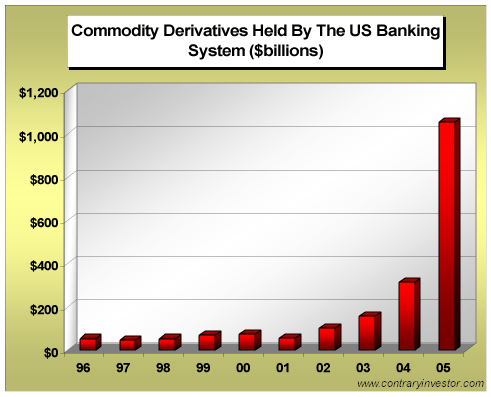
http://www.contraryinvestor.com/moprinter.htm May commentary
When there isn't much to say I take a break, so let's catch up.
In a "floating on a sea of liquidity" and 8,000 hedge funds kind of market, it is not surprising to see a new high for move in Dow, and maybe all time high being less than 2% away, will follow......but all is NOT healthy.
As this rally goes into its 44th month from 2002/2003 lows, it becomes ever more LESS inclusive, and not all indexes have come along.
SPX and NAZ are far off their highs, Transports made new all time highs a year ago, without Dow confirmation, and in SEPT of 2005 the Utility index topped out!!! And can be a fore warning of end of the bull market.
What you must remember, is the rally from 2002 lows is in the context of a SECULAR BEAR MARKET, which will probably last up to the length of the preceding bull market, which means as long as 10- 20 years!
And there will be a few of these strong rallys, until the Bear has done its job and or run its course. Which is to restore ORDER, and the NORMS.
Dividend yields at near 2% is even LOWER than at any previous bull mkt top! At bear mkt bottoms near 6% is typical.
SPX earnings have been propped up from historic energy company profits and HUGE stock buyback programs.
Insiders are selling like mad.
It has been over 3 years since the mkt has corrected 10%.
Bear markets reduce speculation, volume on the BB (penny stocks) is DOUBLE what it was in 2000 !! DEBT has exploded, instead of consumers retrenching. Demand is being satiated, a gluttony, not pent up.
Housing has EXPLODED with excess speculation rampant and now unwinding.
I don't know if THE top is coming, but do feel some kind of important top is near, and we are now IN the dead zone for market, the seasonals nolonger supplying a tailwind.....IMHO caution is warranted.
Next update? when I feel like it.
Duratek
When there isn't much to say I take a break, so let's catch up.
In a "floating on a sea of liquidity" and 8,000 hedge funds kind of market, it is not surprising to see a new high for move in Dow, and maybe all time high being less than 2% away, will follow......but all is NOT healthy.
As this rally goes into its 44th month from 2002/2003 lows, it becomes ever more LESS inclusive, and not all indexes have come along.
SPX and NAZ are far off their highs, Transports made new all time highs a year ago, without Dow confirmation, and in SEPT of 2005 the Utility index topped out!!! And can be a fore warning of end of the bull market.
What you must remember, is the rally from 2002 lows is in the context of a SECULAR BEAR MARKET, which will probably last up to the length of the preceding bull market, which means as long as 10- 20 years!
And there will be a few of these strong rallys, until the Bear has done its job and or run its course. Which is to restore ORDER, and the NORMS.
Dividend yields at near 2% is even LOWER than at any previous bull mkt top! At bear mkt bottoms near 6% is typical.
SPX earnings have been propped up from historic energy company profits and HUGE stock buyback programs.
Insiders are selling like mad.
It has been over 3 years since the mkt has corrected 10%.
Bear markets reduce speculation, volume on the BB (penny stocks) is DOUBLE what it was in 2000 !! DEBT has exploded, instead of consumers retrenching. Demand is being satiated, a gluttony, not pent up.
Housing has EXPLODED with excess speculation rampant and now unwinding.
I don't know if THE top is coming, but do feel some kind of important top is near, and we are now IN the dead zone for market, the seasonals nolonger supplying a tailwind.....IMHO caution is warranted.
Next update? when I feel like it.
Duratek
Friday, April 21, 2006
CRASH ALERT!!
not much to say....yeah right. I am on HIGH ALERT, extreme defensive posture taken. Maybe more this weekend.
D
D
Friday, March 31, 2006
ACCIDENT WAITING TO HAPPEN?
Oil Heads Back Toward $70 a BarrelFriday March 31, 3:05 pm ET By Brad Foss, AP Business Writer
Oil Heads Back Toward $70 a Barrel, With Potenially Grave Consequences for Global Economy
WASHINGTON (AP) -- Oil prices appear headed back toward $70 a barrel, a level not seen since Hurricane Katrina battered the Gulf Coast and sporadic shortages sent gasoline at the pump above $3 a gallon nationwide.
While last summer's price spike triggered outrage in Congress and hurt sport utility vehicle sales, it caused only a hiccup in motor-fuel consumption. And for now, with demand back on the rise, the economy seems capable of absorbing uncomfortably high prices.
Analysts warn, however, that consumers and businesses could be just one major supply disruption away from more serious financial consequences.
Sherry Cooper, chief economist at BMO Nesbitt Burns, said the ramifications of $70 oil and $3-a-gallon gasoline would be "more mild" the second time around "because we're getting kind of used to it."
But while the gas-price sticker shock may be wearing off, Nomura Securities chief economist David Resler fears a more subtle fuel-related angst settling in among consumers.
"There is the pessimistic notion that this is not going to go away and that's going to have a more lasting impact on driving habits and behavior, I suspect, than we've seen so far," Resler said.
In that context, a hypothetical supply disruption that jolts oil prices to $80 or higher and keeps them there for an extended period -- say, three months -- could result in "a substantial falloff in discretionary spending" that snowballs into a serious slowdown.
Perhaps the top threat for the oil market is the standoff between the United Nations and Iran, OPEC's No. 2 producer, over Tehran's nuclear energy ambitions. Iran's foreign minister said Friday his country would not use oil as an economic weapon, and that helped ease prices, but analysts say they remain concerned about supplies from Iraq, Russia, Venezuela and other places.
Unrest in Nigeria has taken more than 500,000 barrels per day of oil off the market, and more than 300,000 barrels per day of Gulf of Mexico output remains shut-in because of damage from last fall's hurricanes.
With global oil demand expected to average 85 million barrels per day in 2006, and excess production capacity limited to 2 million barrels per day, oil analyst Jamal Qureshi of PFC Energy in Washington said prices aren't likely to retreat anytime soon.
"The market is awakening to the scope of the risks," said Antoine Halff, director of global energy Fimat USA in New York.
Yet in spite of all the apprehension about oil supplies -- or maybe because of it -- U.S. inventories of crude are at a seven-year high of roughly 341 million barrels. That does not include the 685,700 barrels in the country's strategic reserve, available in an emergency.
Some analysts point to this buildup of inventories as evidence the market is divorced from reality. IFR Energy Services' Tim Evans sees a "dangerous complacency about the downside potential for prices" -- but many more say it is a reflection of unease about geopolitical uncertainties.
On Friday, light crude for May delivery traded at $65.80 a barrel, down $1.35 on the New York Mercantile Exchange. U.S. retail gasoline prices averaged $2.53 a gallon, or 37 cents higher than last year, according to Oil Price Information Service.
The potential exists for $3-a-gallon gasoline at some point this summer, analysts say, but that assumes out-of-the-ordinary disruptions to refining or distribution, or both. The Energy Department, meanwhile, is forecasting an average summertime price of $2.50.
Economists and oil-market experts say industry and homeowners may not like paying more for fuel but they are adapting, in large part because energy is a tiny piece of overall spending and, thanks to more efficient technology, an even smaller piece than it was during the energy crises of the 1970s.
The burden is most severe on low-income families and fuel-intensive businesses, though truckers, chemical manufacturers and, to a lesser extent, airlines have had success in passing along these costs.
Relatively low interest rates, which have made it easy to borrow money while helping to prop up the stock and housing markets, have reduced the impact of high oil prices on the economy.
Of course, the Federal Reserve has raised short-term rates 15 times since June 2004 to cool off the housing market and keep inflation in check, and this is likely to slow growth irrespective of energy prices.
BMO's Cooper said the Fed probably needs to raise interest rates again in May to slow economic growth because there are signs -- rising airfares among them -- that inflationary pressures are creeping up.
Brian Hicks, co-manager of US Global Investors' Global Resources Fund, a mutual fund heavily invested in energy, said a recession in the U.S. would likely reverberate across emerging-market economies and could quickly depress daily oil demand by 2 million barrels per day.
That dire scenario is not what Hicks or most other financial professionals are anticipating. Hicks forsees oil prices trading in a range of $55 to $65 through the end of the year, with consumption tapering off anywhere above $70 and the Organization of Petroleum Exporting Countries curtailing production at around $50.
James Cordier, president of Liberty Trading in Tampa, Fla., believes oil prices will climb as long as the economies of the U.S., China and India continue to grow and that prices may need to hit $75 before there is any significant demand response.
"We are going to find out at what price level we start rationing demand," Cordier said. "That is what we have to do."
Oil Heads Back Toward $70 a Barrel, With Potenially Grave Consequences for Global Economy
WASHINGTON (AP) -- Oil prices appear headed back toward $70 a barrel, a level not seen since Hurricane Katrina battered the Gulf Coast and sporadic shortages sent gasoline at the pump above $3 a gallon nationwide.
While last summer's price spike triggered outrage in Congress and hurt sport utility vehicle sales, it caused only a hiccup in motor-fuel consumption. And for now, with demand back on the rise, the economy seems capable of absorbing uncomfortably high prices.
Analysts warn, however, that consumers and businesses could be just one major supply disruption away from more serious financial consequences.
Sherry Cooper, chief economist at BMO Nesbitt Burns, said the ramifications of $70 oil and $3-a-gallon gasoline would be "more mild" the second time around "because we're getting kind of used to it."
But while the gas-price sticker shock may be wearing off, Nomura Securities chief economist David Resler fears a more subtle fuel-related angst settling in among consumers.
"There is the pessimistic notion that this is not going to go away and that's going to have a more lasting impact on driving habits and behavior, I suspect, than we've seen so far," Resler said.
In that context, a hypothetical supply disruption that jolts oil prices to $80 or higher and keeps them there for an extended period -- say, three months -- could result in "a substantial falloff in discretionary spending" that snowballs into a serious slowdown.
Perhaps the top threat for the oil market is the standoff between the United Nations and Iran, OPEC's No. 2 producer, over Tehran's nuclear energy ambitions. Iran's foreign minister said Friday his country would not use oil as an economic weapon, and that helped ease prices, but analysts say they remain concerned about supplies from Iraq, Russia, Venezuela and other places.
Unrest in Nigeria has taken more than 500,000 barrels per day of oil off the market, and more than 300,000 barrels per day of Gulf of Mexico output remains shut-in because of damage from last fall's hurricanes.
With global oil demand expected to average 85 million barrels per day in 2006, and excess production capacity limited to 2 million barrels per day, oil analyst Jamal Qureshi of PFC Energy in Washington said prices aren't likely to retreat anytime soon.
"The market is awakening to the scope of the risks," said Antoine Halff, director of global energy Fimat USA in New York.
Yet in spite of all the apprehension about oil supplies -- or maybe because of it -- U.S. inventories of crude are at a seven-year high of roughly 341 million barrels. That does not include the 685,700 barrels in the country's strategic reserve, available in an emergency.
Some analysts point to this buildup of inventories as evidence the market is divorced from reality. IFR Energy Services' Tim Evans sees a "dangerous complacency about the downside potential for prices" -- but many more say it is a reflection of unease about geopolitical uncertainties.
On Friday, light crude for May delivery traded at $65.80 a barrel, down $1.35 on the New York Mercantile Exchange. U.S. retail gasoline prices averaged $2.53 a gallon, or 37 cents higher than last year, according to Oil Price Information Service.
The potential exists for $3-a-gallon gasoline at some point this summer, analysts say, but that assumes out-of-the-ordinary disruptions to refining or distribution, or both. The Energy Department, meanwhile, is forecasting an average summertime price of $2.50.
Economists and oil-market experts say industry and homeowners may not like paying more for fuel but they are adapting, in large part because energy is a tiny piece of overall spending and, thanks to more efficient technology, an even smaller piece than it was during the energy crises of the 1970s.
The burden is most severe on low-income families and fuel-intensive businesses, though truckers, chemical manufacturers and, to a lesser extent, airlines have had success in passing along these costs.
Relatively low interest rates, which have made it easy to borrow money while helping to prop up the stock and housing markets, have reduced the impact of high oil prices on the economy.
Of course, the Federal Reserve has raised short-term rates 15 times since June 2004 to cool off the housing market and keep inflation in check, and this is likely to slow growth irrespective of energy prices.
BMO's Cooper said the Fed probably needs to raise interest rates again in May to slow economic growth because there are signs -- rising airfares among them -- that inflationary pressures are creeping up.
Brian Hicks, co-manager of US Global Investors' Global Resources Fund, a mutual fund heavily invested in energy, said a recession in the U.S. would likely reverberate across emerging-market economies and could quickly depress daily oil demand by 2 million barrels per day.
That dire scenario is not what Hicks or most other financial professionals are anticipating. Hicks forsees oil prices trading in a range of $55 to $65 through the end of the year, with consumption tapering off anywhere above $70 and the Organization of Petroleum Exporting Countries curtailing production at around $50.
James Cordier, president of Liberty Trading in Tampa, Fla., believes oil prices will climb as long as the economies of the U.S., China and India continue to grow and that prices may need to hit $75 before there is any significant demand response.
"We are going to find out at what price level we start rationing demand," Cordier said. "That is what we have to do."
Saturday, March 25, 2006
PICTURE OF THE WEEK

http://www.prudentbear.com/archive_comm_article.asp?category=Credit+Bubble+Bulletin&content_idx=52858 Credit Bubble Report
Even as the Dow sits scant 4% below Jan 2000 bubble highs, the market advance is getting more selecive. when the Dow finally tops, the majority of stocks will already be in bear Markets with 20% losses or more, this is a good time IMHO to examine your holdings and their performance. and maybe a very good time to RAISE cash as MM funds yielding near 4% and 91 day Treasuries more, challenging gains in stock market without risk.
Share volume in CHEAP bulletin board stocks last week ran 2 X previous ever high, the so called lesson of previous Bear Market are all but forgotten. Share volume for little GNBT rose to 89 Million one day last week.
Be careful, be very selective......the top making process continues and the current Bull Cycle is VERY long in the tooth, IMHO in respect to historic means. If you have fallen asleep with your investments, NOW would be a good time to wake up.
My blog for now will only be updated each Sat morning, unless a stock market move of 100 points or more has occured.
Duratek
Tuesday, March 21, 2006
Monday, March 20, 2006
HEAD BLOODSUCKER SPEAKS
Bernanke: Fed must watch its step
Fed chief says flat yield curve not a sign of economic slowdown, says it isn't clear why long-term bond yields are so low.
March 20, 2006: 9:41 PM EST
NEW YORK, March 20 (Reuters) - Federal Reserve Chairman Ben Bernanke said on Monday it was hard to gauge why long-term interest rates were so low and said the U.S. central bank could not rely on them as its sole guide for policy-making.
"The implications for monetary policy of the recent behavior of long-term yields are not at all clear-cut," Bernanke told the Economic Club of New York.
In his first public foray onto Wall Street since taking over as Fed chairman on Feb. 1, Bernanke ran through several competing explanations for the unusually low level of U.S. bond yields despite a steady ratcheting up of short-term interest rates by the U.S. central bank.
Bernanke revisited a thesis he first laid out a year ago that a "global saving glut" - an excess of savings because of a dearth of enticing investments - could be depressing rates.
If this were the case, he said, then as long as the factors behind it persisted "global equilibrium interest rates - and, consequently, the neutral policy rate - would be lower than they otherwise would be" to keep the economy on an even keel.
But Bernanke laid out a number of other possibilities and concluded: "The bottom line for policy appears ambiguous."
Fed policy-makers have raised benchmark overnight rates to 4.5 percent in a string of 14 steps dating to June 2004 and are widely expected to bump them up another quarter-percentage point at a meeting next Monday and Tuesday.
While overnight rates have risen 3.5 percentage points since mid-2004, the market-set rate on 10-year U.S. government bonds has barely budged.
Bernanke said that if the low level of long-term rates reflected a decline in the compensation investors demanded to cover the risk of losses on long-term holdings, then it could signal stimulative financial conditions that would require higher short-term rates than otherwise to offset.
"But to the extent that long-term rates have been influenced by macroeconomic conditions, including such factors as trends in global saving and investment, the required policy rate will be lower," Bernanke said.
Little slowdown ahead
As he had in congressional testimony last month, Bernanke said he dd not consider the current flat yield curve - with yields on short-term debt close to yields on long-term bonds - as presaging "a significant economic slowdown" as has sometimes been the case in the past.
Indeed, he said other indicators showed markets with few worries on the future. "The fact that actual and implied volatilities of most financial prices remain subdued suggests that market participants do not harbor significant reservations about the economic outlook," he said.
He said, instead, long-term rates could suggest the level of short-term rates consistent with holding the economy at full employment had declined, perhaps reflecting a lasting drag on the economy from high energy costs, slower growth in house prices and the possibility consumers will begin to save more.
But he also noted long-term rates were low around the globe and said "an explanation less centered on the United States might be required."
One other factor that Bernanke raised, but downplayed, was that large official holdings of U.S. Treasury debt accumulated by countries intervening in currency markets was doing much to push U.S. long-term rates down.
"A reasonable conclusion is that the accumulation of dollar reserves abroad has influenced U.S. yields, but reserve accumulation abroad is not the only, or even the dominant, explanation for their recent behavior," he said.
In the end, Bernanke said the Fed would need to monitor bond yields carefully, but also had to take into account a wide array of other signals on the economy's health.
"Policy-makers are well advised to follow two principles familiar to navigators throughout the ages: First, determine your position frequently. Second, use as many guides or landmarks as possible," he said.
"By not tying policy to a small set of forecast indicators, we may sacrifice some degree of simplicity, but we are less likely to be misled when a favored variable behaves in an unusual manner," Bernanke added.
Fed chief says flat yield curve not a sign of economic slowdown, says it isn't clear why long-term bond yields are so low.
March 20, 2006: 9:41 PM EST
NEW YORK, March 20 (Reuters) - Federal Reserve Chairman Ben Bernanke said on Monday it was hard to gauge why long-term interest rates were so low and said the U.S. central bank could not rely on them as its sole guide for policy-making.
"The implications for monetary policy of the recent behavior of long-term yields are not at all clear-cut," Bernanke told the Economic Club of New York.
In his first public foray onto Wall Street since taking over as Fed chairman on Feb. 1, Bernanke ran through several competing explanations for the unusually low level of U.S. bond yields despite a steady ratcheting up of short-term interest rates by the U.S. central bank.
Bernanke revisited a thesis he first laid out a year ago that a "global saving glut" - an excess of savings because of a dearth of enticing investments - could be depressing rates.
If this were the case, he said, then as long as the factors behind it persisted "global equilibrium interest rates - and, consequently, the neutral policy rate - would be lower than they otherwise would be" to keep the economy on an even keel.
But Bernanke laid out a number of other possibilities and concluded: "The bottom line for policy appears ambiguous."
Fed policy-makers have raised benchmark overnight rates to 4.5 percent in a string of 14 steps dating to June 2004 and are widely expected to bump them up another quarter-percentage point at a meeting next Monday and Tuesday.
While overnight rates have risen 3.5 percentage points since mid-2004, the market-set rate on 10-year U.S. government bonds has barely budged.
Bernanke said that if the low level of long-term rates reflected a decline in the compensation investors demanded to cover the risk of losses on long-term holdings, then it could signal stimulative financial conditions that would require higher short-term rates than otherwise to offset.
"But to the extent that long-term rates have been influenced by macroeconomic conditions, including such factors as trends in global saving and investment, the required policy rate will be lower," Bernanke said.
Little slowdown ahead
As he had in congressional testimony last month, Bernanke said he dd not consider the current flat yield curve - with yields on short-term debt close to yields on long-term bonds - as presaging "a significant economic slowdown" as has sometimes been the case in the past.
Indeed, he said other indicators showed markets with few worries on the future. "The fact that actual and implied volatilities of most financial prices remain subdued suggests that market participants do not harbor significant reservations about the economic outlook," he said.
He said, instead, long-term rates could suggest the level of short-term rates consistent with holding the economy at full employment had declined, perhaps reflecting a lasting drag on the economy from high energy costs, slower growth in house prices and the possibility consumers will begin to save more.
But he also noted long-term rates were low around the globe and said "an explanation less centered on the United States might be required."
One other factor that Bernanke raised, but downplayed, was that large official holdings of U.S. Treasury debt accumulated by countries intervening in currency markets was doing much to push U.S. long-term rates down.
"A reasonable conclusion is that the accumulation of dollar reserves abroad has influenced U.S. yields, but reserve accumulation abroad is not the only, or even the dominant, explanation for their recent behavior," he said.
In the end, Bernanke said the Fed would need to monitor bond yields carefully, but also had to take into account a wide array of other signals on the economy's health.
"Policy-makers are well advised to follow two principles familiar to navigators throughout the ages: First, determine your position frequently. Second, use as many guides or landmarks as possible," he said.
"By not tying policy to a small set of forecast indicators, we may sacrifice some degree of simplicity, but we are less likely to be misled when a favored variable behaves in an unusual manner," Bernanke added.
FED RESERVE IS UNCONSTITUTIONAL
http://www.honestmoneyreport.com/archives/2006/0305.php
Article I, Section 8, Clause 5 of the Constitution states: “The Congress shall have Power…To coin Money, regulate the Value thereof, and of foreign Coin, and fix the Standard of Weights and Measures.”
BUT>>>>>>The United States monetary system currently creates, emits, and circulates paper bills of credit known as Federal Reserve Notes. Such acts are not authorized by the Constitution – they are literally prohibited by the Constitution, and should be repealed forthwith.
D...we are losing it people.....
Article I, Section 8, Clause 5 of the Constitution states: “The Congress shall have Power…To coin Money, regulate the Value thereof, and of foreign Coin, and fix the Standard of Weights and Measures.”
BUT>>>>>>The United States monetary system currently creates, emits, and circulates paper bills of credit known as Federal Reserve Notes. Such acts are not authorized by the Constitution – they are literally prohibited by the Constitution, and should be repealed forthwith.
D...we are losing it people.....
Sunday, March 19, 2006
WAKE UP AMERICA WE ARE BEING BUSHWINKED
http://www.cbsnews.com/stories/2006/03/17/60minutes/main1415985.shtml Bush *&&!!sucker pulled out of Kyoto green house gasses treaty..is now censoring CLIMATE REPORTS!!!!
It is going to be TOO late and no place to hide!! Hate them maybe too , but if a Dem with environmental leanings comes up as candidate.....better vote them in!
Temp at Antarctica is rising 2X as fast as elsewhere, the GOV is censoring your right to know, keeping the TRUTH from you.
If we haven't made drastic changes in 10 years there will be NO reversing this process.
D
It is going to be TOO late and no place to hide!! Hate them maybe too , but if a Dem with environmental leanings comes up as candidate.....better vote them in!
Temp at Antarctica is rising 2X as fast as elsewhere, the GOV is censoring your right to know, keeping the TRUTH from you.
If we haven't made drastic changes in 10 years there will be NO reversing this process.
D
Saturday, March 18, 2006
Excerpts from Doug Noland
found @ prudentbear.com
March 14 – Bloomberg (Walden Siew): “Companies are selling floating-rate debt in the U.S. at the fastest pace ever as investors seek securities that will keep their value while the Federal Reserve raises interest rates. Borrowers sold $62.9 billion of floating-rate notes this year and are on track to beat the 2005 record of $302 billion, according to data compiled by Bloomberg.”
Investment grade issuers included GE Capital $3.0 billion, Goldman Sachs $1.75 billion, Wells Fargo $1.5 billion, USB Capital $1.25 billion, Tyson Foods $1.0 billion, Shinsei Finance $700 million, World Savings $600 million, Clear Channel $500 million, HRPT Properties $400 million, Archstone Communities $300 million, Genworth Global $300 million, Compass Bank $275 million and Boston Edison $200 million.
March 14 – Financial Times (Jennifer Hughesin): “Inflows into emerging market equities have set an annual record just 11 weeks into the year as investors continue to chase the higher returns seen in developing markets. In the week to March 8, $20.9bn has been poured into emerging market stock funds breaking last year’s record of $20.3bn, according to Emerging Portfolio Fund Research. Brad Durham, a managing director of EPFR, said: ‘While it is natural to assume that such strong inflows into any asset class are a worrisome sign, there are institutional investors just waiting for corrections in equity and bond markets to plough more money into emerging markets.’”
As I believe we witnessed this week, extraordinarily speculative global financial markets took comforted from inferences of a lack of nerve from the Fed and the Bank of Japan. Global bond markets (generally) abruptly retraced some of recent declines, spurring the resurgence of global equity market speculation (and short covering). Currency markets vacillated, the dollar index was hit for 2%, and the energy and metals complexes rallied back smartly. Middle Eastern equity Bubbles lurched toward collapse then retreated. All in all, it has the look and feel of a major topping process, as players assess and reassess the prospects for a continuation of, or destabilizing interruption to, the Global Credit and Asset Bubbles.
I can imagine that the Fed today takes comfort from its amassed war chest of 450 basis points of reflation ammo. But the enemy is often not as anticipated. There’s a critical issue of which I am left unclear. How does “mopping up” – or perhaps better stated, what is to be “mopped up” - in the middle of a currency crisis?
March 14 – Bloomberg (Walden Siew): “Companies are selling floating-rate debt in the U.S. at the fastest pace ever as investors seek securities that will keep their value while the Federal Reserve raises interest rates. Borrowers sold $62.9 billion of floating-rate notes this year and are on track to beat the 2005 record of $302 billion, according to data compiled by Bloomberg.”
Investment grade issuers included GE Capital $3.0 billion, Goldman Sachs $1.75 billion, Wells Fargo $1.5 billion, USB Capital $1.25 billion, Tyson Foods $1.0 billion, Shinsei Finance $700 million, World Savings $600 million, Clear Channel $500 million, HRPT Properties $400 million, Archstone Communities $300 million, Genworth Global $300 million, Compass Bank $275 million and Boston Edison $200 million.
March 14 – Financial Times (Jennifer Hughesin): “Inflows into emerging market equities have set an annual record just 11 weeks into the year as investors continue to chase the higher returns seen in developing markets. In the week to March 8, $20.9bn has been poured into emerging market stock funds breaking last year’s record of $20.3bn, according to Emerging Portfolio Fund Research. Brad Durham, a managing director of EPFR, said: ‘While it is natural to assume that such strong inflows into any asset class are a worrisome sign, there are institutional investors just waiting for corrections in equity and bond markets to plough more money into emerging markets.’”
As I believe we witnessed this week, extraordinarily speculative global financial markets took comforted from inferences of a lack of nerve from the Fed and the Bank of Japan. Global bond markets (generally) abruptly retraced some of recent declines, spurring the resurgence of global equity market speculation (and short covering). Currency markets vacillated, the dollar index was hit for 2%, and the energy and metals complexes rallied back smartly. Middle Eastern equity Bubbles lurched toward collapse then retreated. All in all, it has the look and feel of a major topping process, as players assess and reassess the prospects for a continuation of, or destabilizing interruption to, the Global Credit and Asset Bubbles.
I can imagine that the Fed today takes comfort from its amassed war chest of 450 basis points of reflation ammo. But the enemy is often not as anticipated. There’s a critical issue of which I am left unclear. How does “mopping up” – or perhaps better stated, what is to be “mopped up” - in the middle of a currency crisis?
Friday, March 17, 2006

Tuesday, March 14, 2006
DEVIL IN THE DETAILS
http://briefing.com/Investor/Public/MarketAnalysis/Calendars/EconomicCalendar.htm
Consumer slowing down, gov deficits not. Strain on interest rates to go higher because of huge appetite for debt from all orifices.
Higher rates putting brakes on housing, the engine of WORLD economy. utility rates going up as much as 70% with price controls ending in July.
Cash flush corporations NOT using cash for INVESTMENTS IN SELF OR CAPITOL EQUIP., no they are using it, FED induced super profits to BUYBACK SHARES (insiders love this) to boost earnings as they are actually declining, and fo M and A activity resembling 2000.
Here we are, within 1.5% of Dow bubble highs, yet avg Dow stock off 20% from 52 week highs!!!
Devil in details, cash I am in.
Duratek (surgery last wed, one armed man for now) I hope my readers are hanging in there with me, let me know you want me to continue my blog, and I am doing some good.
Consumer slowing down, gov deficits not. Strain on interest rates to go higher because of huge appetite for debt from all orifices.
Higher rates putting brakes on housing, the engine of WORLD economy. utility rates going up as much as 70% with price controls ending in July.
Cash flush corporations NOT using cash for INVESTMENTS IN SELF OR CAPITOL EQUIP., no they are using it, FED induced super profits to BUYBACK SHARES (insiders love this) to boost earnings as they are actually declining, and fo M and A activity resembling 2000.
Here we are, within 1.5% of Dow bubble highs, yet avg Dow stock off 20% from 52 week highs!!!
Devil in details, cash I am in.
Duratek (surgery last wed, one armed man for now) I hope my readers are hanging in there with me, let me know you want me to continue my blog, and I am doing some good.
Tuesday, March 07, 2006
RECENT COMSTOCK PARTNERS PIECE
Comstock Partners, Inc.
The Derivatives Mess March 02, 2006
Over the past year New York Federal Reserve President Timothy F. Geithner has become increasingly concerned about the use of derivative instruments as outlined in a few of his speeches and a number of largely unnoticed articles buried inside the Wall Street Journal. In a recent speech before the Global Association of Risk Professionals, Geithner stated that the widespread use of derivatives “have not eliminated risk” and “have not eliminated the tendency of markets to occasional periods of mania and panic. They have not eliminated the possibility of failure of a major financial intermediary. And they cannot fully insulate the broader financial system from the effects of such a failure…And there are aspects in the latest changes in financial innovation that could increase systemic risk in some circumstances, by amplifying rather than dampening the movement in asset prices, the reduction in market liquidity and the associated damage to financial institutions.”
Geithner stated that so far the expanded use of derivatives has taken place in a period of generally favorable conditions, but that “we know less about how these markets will function in conditions of stress, and the most sophisticated tools available for measuring potential losses have less to offer than they will with the benefit of experience with adversity.” He pointed out that the gaps in the infrastructure and risk management is most conspicuous in credit derivatives, where the measure of credit risk “may not adequately capture the scale of losses in the event of default in the underlying credits or the consequences of a prolonged disruption to market liquidity. The complexity of many new instruments and the relative immaturity of the various approaches used to measure the risks in those exposures magnify the uncertainty involved.”
As explained by David Wessel in the Wall Street Journal, the problem is that the derivatives market has grown so fast that it has overwhelmed the legal, technical and paper-work handling infrastructure. Under present conditions no firm can be sure who owes what to whom. According to Geithner, “The post-trade processing and settlement infrastructure is still quite weak relative to the significance of these markets…The total stock of unconfirmed trades is large and until recently was growing considerably faster than the total volume of new trades. The time between trade and confirmation is still quite long for a large share of transactions. The share of trades done on the available automated platforms is still substantially short of what is possible…firms were typically assigning trades without the knowledge or consent of the original counterparties. Nostro breaks, which are errors in payments discovered by counterparties at the time of the quarterly flows, rose to a significant share of total trades. Efforts to standardize documentation and provide automated confirmation services has lagged behind product development and growth in volume…the assignment problems create uncertainty about the actual size of exposures to individual counterparties that could exacerbate market liquidity problems in the event of stress.”
To his credit, Geithner began stressing the nature of the problems in late 2004. Former New York Fed president Gerald Corrigan organized an industry group to deal with the problem in early 2005 and the members have met a number of times since then to report on their recommendations, most recently on February 16. Despite reported progress there is still a backlog of thousands of unconfirmed trades, and about 40% of new trades are still not matched electronically. There’s still no centralized means of processing trades.
In our view the derivatives mess described above is another potential time bomb (among many) that could throw the financial markets into a severe crisis. In the last 30 years every period of monetary tightening has eventually led to financial crisis. These included the Penn Central bankruptcy in 1970; the Franklin National Bank failure in 1974; the First Pennsylvania bank failure in 1982; the Continental Illinois bank failure in 1984; the savings & loan crisis in 1990, the Mexican Peso crisis in 1994; the Asian, LTCM and Russian crises in 1998; and the bursting of the Nasdaq bubble in 2000. The derivatives market is a leading candidate to trigger the crisis on this cycle, although there are obviously many other candidates as well.
The Derivatives Mess March 02, 2006
Over the past year New York Federal Reserve President Timothy F. Geithner has become increasingly concerned about the use of derivative instruments as outlined in a few of his speeches and a number of largely unnoticed articles buried inside the Wall Street Journal. In a recent speech before the Global Association of Risk Professionals, Geithner stated that the widespread use of derivatives “have not eliminated risk” and “have not eliminated the tendency of markets to occasional periods of mania and panic. They have not eliminated the possibility of failure of a major financial intermediary. And they cannot fully insulate the broader financial system from the effects of such a failure…And there are aspects in the latest changes in financial innovation that could increase systemic risk in some circumstances, by amplifying rather than dampening the movement in asset prices, the reduction in market liquidity and the associated damage to financial institutions.”
Geithner stated that so far the expanded use of derivatives has taken place in a period of generally favorable conditions, but that “we know less about how these markets will function in conditions of stress, and the most sophisticated tools available for measuring potential losses have less to offer than they will with the benefit of experience with adversity.” He pointed out that the gaps in the infrastructure and risk management is most conspicuous in credit derivatives, where the measure of credit risk “may not adequately capture the scale of losses in the event of default in the underlying credits or the consequences of a prolonged disruption to market liquidity. The complexity of many new instruments and the relative immaturity of the various approaches used to measure the risks in those exposures magnify the uncertainty involved.”
As explained by David Wessel in the Wall Street Journal, the problem is that the derivatives market has grown so fast that it has overwhelmed the legal, technical and paper-work handling infrastructure. Under present conditions no firm can be sure who owes what to whom. According to Geithner, “The post-trade processing and settlement infrastructure is still quite weak relative to the significance of these markets…The total stock of unconfirmed trades is large and until recently was growing considerably faster than the total volume of new trades. The time between trade and confirmation is still quite long for a large share of transactions. The share of trades done on the available automated platforms is still substantially short of what is possible…firms were typically assigning trades without the knowledge or consent of the original counterparties. Nostro breaks, which are errors in payments discovered by counterparties at the time of the quarterly flows, rose to a significant share of total trades. Efforts to standardize documentation and provide automated confirmation services has lagged behind product development and growth in volume…the assignment problems create uncertainty about the actual size of exposures to individual counterparties that could exacerbate market liquidity problems in the event of stress.”
To his credit, Geithner began stressing the nature of the problems in late 2004. Former New York Fed president Gerald Corrigan organized an industry group to deal with the problem in early 2005 and the members have met a number of times since then to report on their recommendations, most recently on February 16. Despite reported progress there is still a backlog of thousands of unconfirmed trades, and about 40% of new trades are still not matched electronically. There’s still no centralized means of processing trades.
In our view the derivatives mess described above is another potential time bomb (among many) that could throw the financial markets into a severe crisis. In the last 30 years every period of monetary tightening has eventually led to financial crisis. These included the Penn Central bankruptcy in 1970; the Franklin National Bank failure in 1974; the First Pennsylvania bank failure in 1982; the Continental Illinois bank failure in 1984; the savings & loan crisis in 1990, the Mexican Peso crisis in 1994; the Asian, LTCM and Russian crises in 1998; and the bursting of the Nasdaq bubble in 2000. The derivatives market is a leading candidate to trigger the crisis on this cycle, although there are obviously many other candidates as well.
Monday, March 06, 2006
Saturday, March 04, 2006
EXCUSES
NEW YORK - Now that America's savings rate has been negative for an entire year, a first since the Great Depression, the question is whether we're a spendthrift nation on its way to the poor house or whether we're looking at the wrong numbers when we calculate savings
http://news.yahoo.com/s/ap/20060304/ap_on_bi_ge/wall___main_1
The personal savings rate used to be 10 percent of disposable income from 1974 to 1984, according to the Bureau of Labor Statistics. It fell to 4.8 percent by 1994, and was negative for all of 2005.
http://www.naftemporiki.gr/markets/quotegraph.asp?id=.BADI&ctime=5Y&cperiodicity=W BDI 5 yr
http://research.stlouisfed.org/publications/usfd/page3.pdf zippity do da adj money
Doug Noland
March 2 – Dow Jones (Christine Richard): “A flood of foreign capital into U.S. dollar-denominated debt has some in the corporate bond market worried that the market's aversion to risk is getting washed away.
February 27 – Bloomberg (Darrell Hassler and Prashant Rao): “U.S. Treasury investors are more complacent about the prospect of an economic shock causing volatility in the $4.2 trillion market than at any time in at least 17 years.”
Broad money supply (M3) surged $54.1 billion to a record $10.335 Trillion (week of Feb. 20). Year-to-date, M3 has expanded at an 8.0% annualized rate. Over 52 weeks, M3 grew 8.5%, with M3-less Money Funds up 8.8%. *(HOLY CRAP!)
D
http://news.yahoo.com/s/ap/20060304/ap_on_bi_ge/wall___main_1
The personal savings rate used to be 10 percent of disposable income from 1974 to 1984, according to the Bureau of Labor Statistics. It fell to 4.8 percent by 1994, and was negative for all of 2005.
http://www.naftemporiki.gr/markets/quotegraph.asp?id=.BADI&ctime=5Y&cperiodicity=W BDI 5 yr
http://research.stlouisfed.org/publications/usfd/page3.pdf zippity do da adj money
Doug Noland
March 2 – Dow Jones (Christine Richard): “A flood of foreign capital into U.S. dollar-denominated debt has some in the corporate bond market worried that the market's aversion to risk is getting washed away.
February 27 – Bloomberg (Darrell Hassler and Prashant Rao): “U.S. Treasury investors are more complacent about the prospect of an economic shock causing volatility in the $4.2 trillion market than at any time in at least 17 years.”
Broad money supply (M3) surged $54.1 billion to a record $10.335 Trillion (week of Feb. 20). Year-to-date, M3 has expanded at an 8.0% annualized rate. Over 52 weeks, M3 grew 8.5%, with M3-less Money Funds up 8.8%. *(HOLY CRAP!)
D
Wednesday, March 01, 2006
PARTYING LIKE IT'S 1987?
http://www.sandspring.com/charts2006/cdj022206.html
I go in for elbow surgery next Wed, not sure how long it will be before I can post beyond that.
D
I go in for elbow surgery next Wed, not sure how long it will be before I can post beyond that.
D
Subscribe to:
Posts (Atom)