Housing stocks rebounded from awful plunge NOT because things are better, because as rates have fallen players came back for dead cat, this market is satiated, how could it not be? As Mish points out, it is isue of affordability, what was $200K is many HOT areas is now $400K or much higher. Rep Rich B was in Tues, he has house on Severn River (2400 sq ft, 500 ft of waterfront though, modest house!) listing? $1.9 M !! OH 3 bedrooms! LOL cant sell it.
You need ROOM for NEXT GUY you HAND OFF to ,to make a buck or the PONZI scheme COLLAPSES. We are only in warm up phase not even 1st inning and its Tampa Bay against O's !
I am AFRAID of oil because I feel the worlds economy ARE due to cool off, Nat Gas has COLLAPSED (lower again today) the fuel of choice of most major Utilities.....if I did play a few select would be TIGHT F'ing stops I would use.
Msh talks about M1 lack of growth how about ADJ monetary base, even when one understands its description, it may not be THE measurement but it is important stat, it hasnt BUDGED ALL YEAR!
Office furn companies are turning in SUPER earnings, but we lag economy up and then down. 6% across the board PRICE INCREASES are now just coming in and thru end of year.....only Chinese not raising, except within diverse US company like HON.
Quality control issue with ALL Chinese desks, #1 in defects and damages
Transports made up ground Tues, but watch to see if any NEW Dow high confirmed, divergence could last for months of course or years? Mid caps and small caps lag this rally.
Dow 30 easiest to manipulate, least effected by Bear, but NEW CLOSING HIGH seems GUARANTEED being 50 pts shy......as this occurs will there be a MASSIVE SHORT covering SPIKE ?
Commercials wrong again net index? Program trading rules, hedgies using leverage.......but positions have NO ground under feet. Can NO Longer guess when JIG is up (mine though is AFTER NOV 7th IF Repub's get booted)......even as warnings from Lowes and HD come in, horrid misses by Home builders as we have evidence of trickle down pain......talk of sOFT landing dominates, not seen in job numbers yet, are these being hidden? for now?
Folks, non confirms aside, there was NO warning in 2000 when TOP was made, there wont be this time either. AMERICA has been LONG the stock market and has not run away even after Bear, this rally only infuses the planners mantra "LTBH" works.....even now given the chance to BE BACK TO EVEN OR BETTER does not appeal to the masses.
I am still IN CASH, when they pay me near 5% and totally safe, markets made by liquidity and credit debt not investment = castles made of sand. Debt is at all time records as % of GDP, it takes EVER increasing amounts of debt to product $1 of GDP, we are near the PUKE factor.....in the face of impressive move in Dow I remain risk averse.
D
Wednesday, September 27, 2006


Monday, September 25, 2006
CALL ME CRAZY
Dow zooming ahead, all is well. All is not well, as we approach bullish highs I see the Transports actually off 25 points as I post. And that leaves a large 700 points off it's double top highs.
This occuring with gas prices tumbling.
Key SPX level 1326-1328
D
This occuring with gas prices tumbling.
Key SPX level 1326-1328
D
BEND OVER and Kiss GOLDILOCKS GOODBYE
http://www.safehaven.com/article-5941.htm
Remember outcome of the tech bubble? Housing speculation bubble was worse and homes are less liquid, so may be the outcome.
I am IN CASH, paying me near 5%. SO WHY RISK ?
D
Remember outcome of the tech bubble? Housing speculation bubble was worse and homes are less liquid, so may be the outcome.
I am IN CASH, paying me near 5%. SO WHY RISK ?
D
Friday, September 22, 2006
SAT MORNING POST ON FRI
Dow, Nasdaq Fall in Late Morning Trading
AP -
Stocks fell for a second straight session Friday amid continued pessimism about the health of the economy. Wall Street was caught off guard Thursday by a report from the Federal Reserve Bank of Philadelphia that showed regional manufacturing activity fell to a negative reading for the first time since April 2003.
10 yr yield is 4.6% are you bleeping kidding me? 90 day rate is 5.25% !
Transports don't appear willing to confirm move in the Dow.
Autumn is tomorrow, a cyclical normal time for trend change. Bottoms occur in October.
OIL quote $60.75 , gold under $600, oil stocks near or at new 52 week lows, what is going on?
SPX held at potential double top near 1326.
Deflation sniff. Death to debts or those overwhelmed, over extended.
I am on HIGH ALERT
Duratek
AP -
Stocks fell for a second straight session Friday amid continued pessimism about the health of the economy. Wall Street was caught off guard Thursday by a report from the Federal Reserve Bank of Philadelphia that showed regional manufacturing activity fell to a negative reading for the first time since April 2003.
10 yr yield is 4.6% are you bleeping kidding me? 90 day rate is 5.25% !
Transports don't appear willing to confirm move in the Dow.
Autumn is tomorrow, a cyclical normal time for trend change. Bottoms occur in October.
OIL quote $60.75 , gold under $600, oil stocks near or at new 52 week lows, what is going on?
SPX held at potential double top near 1326.
Deflation sniff. Death to debts or those overwhelmed, over extended.
I am on HIGH ALERT
Duratek
Thursday, September 21, 2006
Will A Decline IN Oil Prices Ease Inflation?
http://www.mises.org/story/2331
Also today LEI release And Phila Fed report point to more evidence economy is slowing. Bond prices rallied on that news. STock market sold off all day down 79 points. Let's see if any follow thru tomorrow.
D
Also today LEI release And Phila Fed report point to more evidence economy is slowing. Bond prices rallied on that news. STock market sold off all day down 79 points. Let's see if any follow thru tomorrow.
D
Wednesday, September 20, 2006
FED RATE DECISION
WASHINGTON (AP) -- The Federal Reserve left a key interest rate unchanged on Wednesday as falling energy prices helped to restrain inflation pressures.
Federal Reserve Chairman Ben Bernanke and his colleagues issued a brief announcement saying they would leave the federal funds rate, the interest that banks charge each other, at 5.25 percent.
The decision represents a break for borrowers. It means that banks' prime lending rate, the benchmark for millions of consumer and business loans, will remain at 8.25 percent.
The Fed also had left rates unchanged at their last meeting in August, breaking a record string of 17 rates hikes that had driven the funds rate to its highest level in more than five years.
The decision to leave rates alone for a second time had been widely expected in financial markets, given recent favorable developments on inflation. Oil prices have fallen by more than 20 percent over the past two months and a cooling housing market has contributed to a slowdown in overall growth.
The Fed is trying to engineer a soft-landing for the economy in which growth is slowed enough to keep inflation from getting out of hand without overdoing the credit tightening and raising the chances of a recession.
In its statement, the Fed continued to signal concerns about inflation, repeating a phrase it had used last time -- that the Fed's rate setting panel "judges that some inflation risks remain."
The Fed also said -- as it had last time -- that "the extent and timing of any additional firming that may be needed to address these risks will depend on the evolution of the outlook for both inflation and economic growth, as implied by incoming information."
The Fed took note of the slowdown that has occurred in the economy, saying that "economic growth has moderated from its quite strong pace earlier this year" which it attributed to the cooling housing market and the impact of previous Fed rate hikes and higher energy prices.
The funds rate was at a 46-year low of 1 percent and the prime rate stood at 4 percent back in June 2004 when the Fed began a two-year credit campaign to raise rates. The Fed boosted rates a record 17 consecutive times before deciding to pause at the last meeting on Aug. 8.
The decision to keep rates unchanged Wednesday was supported by a 10-1 vote with Jeffrey Lacker, president of the Fed's Richmond regional bank, again casting the lone no vote. Lacker, who also dissented in August, argued again that another quarter-point rate hike was needed to keep inflation in check.
Federal Reserve Chairman Ben Bernanke and his colleagues issued a brief announcement saying they would leave the federal funds rate, the interest that banks charge each other, at 5.25 percent.
The decision represents a break for borrowers. It means that banks' prime lending rate, the benchmark for millions of consumer and business loans, will remain at 8.25 percent.
The Fed also had left rates unchanged at their last meeting in August, breaking a record string of 17 rates hikes that had driven the funds rate to its highest level in more than five years.
The decision to leave rates alone for a second time had been widely expected in financial markets, given recent favorable developments on inflation. Oil prices have fallen by more than 20 percent over the past two months and a cooling housing market has contributed to a slowdown in overall growth.
The Fed is trying to engineer a soft-landing for the economy in which growth is slowed enough to keep inflation from getting out of hand without overdoing the credit tightening and raising the chances of a recession.
In its statement, the Fed continued to signal concerns about inflation, repeating a phrase it had used last time -- that the Fed's rate setting panel "judges that some inflation risks remain."
The Fed also said -- as it had last time -- that "the extent and timing of any additional firming that may be needed to address these risks will depend on the evolution of the outlook for both inflation and economic growth, as implied by incoming information."
The Fed took note of the slowdown that has occurred in the economy, saying that "economic growth has moderated from its quite strong pace earlier this year" which it attributed to the cooling housing market and the impact of previous Fed rate hikes and higher energy prices.
The funds rate was at a 46-year low of 1 percent and the prime rate stood at 4 percent back in June 2004 when the Fed began a two-year credit campaign to raise rates. The Fed boosted rates a record 17 consecutive times before deciding to pause at the last meeting on Aug. 8.
The decision to keep rates unchanged Wednesday was supported by a 10-1 vote with Jeffrey Lacker, president of the Fed's Richmond regional bank, again casting the lone no vote. Lacker, who also dissented in August, argued again that another quarter-point rate hike was needed to keep inflation in check.
Putting 2 and 2 Together
On the eve of the Fed meeting, which I feel leaves no DRAMA in doubt, they will not raise rates, what then is left to ponder as the Dow is near 1% of its all time highs?
New 52 week highs are dropping off as we approach this milestone. The Transports are 600 points away from their March/July double top all time high.
Oil, commodities of all kinds copper, gold, silver are dropping like a stone. Some funds like the USO (OIL) just hit a new 52 week low!
When you look at how we got here, record bubble housing numbers, which fed ALL Kinds of economic areas like home remodeling, paint, furniture, mortgage lending, financials, real estate firms and construction companies......far reaching were the effects of this FED Induced bubble.
NOW IT'S GONE!
Housing stocks have tumbled, HD languishes, oil stocks declining sharply.
SPX earnings were being carried by RECORD EXXON and the like profits, that is now GONE!
The housing market, though some think soft landing HAS peaked, and has the look of a bubble which has popped.
YET, the stock market is poised a mere pittance away from a MAJOR MILESTONE! yet breadth, and many data points show a much weaker picture, a VERY SELECTIVE market advance.
I have no crystal ball, let's see where market goes after 2:15 today, but we have a 2 1/2 yr divergence in place as I have shown in prior charts and that will get resolved.
The Transports made their new all time highs as beneficiaries of Chinese imports, a surge in consumer spending on all things not made here. Now TRansports lag the party, how interesting.
Duratek
New 52 week highs are dropping off as we approach this milestone. The Transports are 600 points away from their March/July double top all time high.
Oil, commodities of all kinds copper, gold, silver are dropping like a stone. Some funds like the USO (OIL) just hit a new 52 week low!
When you look at how we got here, record bubble housing numbers, which fed ALL Kinds of economic areas like home remodeling, paint, furniture, mortgage lending, financials, real estate firms and construction companies......far reaching were the effects of this FED Induced bubble.
NOW IT'S GONE!
Housing stocks have tumbled, HD languishes, oil stocks declining sharply.
SPX earnings were being carried by RECORD EXXON and the like profits, that is now GONE!
The housing market, though some think soft landing HAS peaked, and has the look of a bubble which has popped.
YET, the stock market is poised a mere pittance away from a MAJOR MILESTONE! yet breadth, and many data points show a much weaker picture, a VERY SELECTIVE market advance.
I have no crystal ball, let's see where market goes after 2:15 today, but we have a 2 1/2 yr divergence in place as I have shown in prior charts and that will get resolved.
The Transports made their new all time highs as beneficiaries of Chinese imports, a surge in consumer spending on all things not made here. Now TRansports lag the party, how interesting.
Duratek
Oil Has Been Down Sharply
OPEC: Demand for crude will drop in 2007 cnn.com
Oil cartel says demand for its crude should slip by 800,000 barrels per day next year, cites expected jump in non-OPEC supply.
September 15 2006: 12:55 PM EDT
LONDON (Reuters) -- The Organization of the Petroleum Exporting Countries on Friday lowered a forecast for demand for its oil next year, when supply from rival producers is expected to surge.
Demand for OPEC crude, known as the call on OPEC, in 2007 will average 28.1 million barrels per day, 200,000 bpd less than forecast in August, the 11-nation producer group said in its September monthly report.
The outlook follows OPEC's decision this week to keep its oil output near a 25-year high despite a roughly $15 drop in prices since mid-July. But the group left the door open to a supply cut before the end of the year.
In its communiqué after the group's oil ministers met in Vienna on Monday, OPEC said non-OPEC supply in 2007 would rise at the fastest rate in more than two decades. OPEC pumps more than a third of the world's oil.
"The rebound in non-OPEC supply in 2007 is predicted to be at its highest level since 1984 - and market fundamentals indicate a clear imbalance between supply and demand," OPEC said in the communiqué.
Average demand for OPEC's oil next year will be 800,000 bpd less than the 28.9 million bpd expected in 2006, the report said.
While OPEC expects supply from outside producers to rise by 1.8 million bpd next year, analysts said that the chance it may underperform could increase the burden on OPEC.
"The call on OPEC could be much higher than they say," said Geoff Pyne, an independent analyst. "The risk must be non-OPEC supply won't materialize. That's certainly been the past risk."
Growth in non-OPEC supply has fallen short of forecasts in recent years, such as in 2005 when hurricanes hit oil facilities in the Gulf of Mexico, disrupting output.
In its report, OPEC also trimmed a forecast for growth in world oil demand in 2006 by 100,000 bpd to 1.2 million bpd, citing weaker than expected summer gasoline demand in the top oil consumer, the United States.
OPEC left its outlook for global demand growth next year at 1.3 million bpd, the same as last month.
The "world oil demand growth forecast for the year 2007 remains unchanged," the report said. "As in the current year, the lion's share of oil demand growth in 2007 will come from developing countries."
Oil cartel says demand for its crude should slip by 800,000 barrels per day next year, cites expected jump in non-OPEC supply.
September 15 2006: 12:55 PM EDT
LONDON (Reuters) -- The Organization of the Petroleum Exporting Countries on Friday lowered a forecast for demand for its oil next year, when supply from rival producers is expected to surge.
Demand for OPEC crude, known as the call on OPEC, in 2007 will average 28.1 million barrels per day, 200,000 bpd less than forecast in August, the 11-nation producer group said in its September monthly report.
The outlook follows OPEC's decision this week to keep its oil output near a 25-year high despite a roughly $15 drop in prices since mid-July. But the group left the door open to a supply cut before the end of the year.
In its communiqué after the group's oil ministers met in Vienna on Monday, OPEC said non-OPEC supply in 2007 would rise at the fastest rate in more than two decades. OPEC pumps more than a third of the world's oil.
"The rebound in non-OPEC supply in 2007 is predicted to be at its highest level since 1984 - and market fundamentals indicate a clear imbalance between supply and demand," OPEC said in the communiqué.
Average demand for OPEC's oil next year will be 800,000 bpd less than the 28.9 million bpd expected in 2006, the report said.
While OPEC expects supply from outside producers to rise by 1.8 million bpd next year, analysts said that the chance it may underperform could increase the burden on OPEC.
"The call on OPEC could be much higher than they say," said Geoff Pyne, an independent analyst. "The risk must be non-OPEC supply won't materialize. That's certainly been the past risk."
Growth in non-OPEC supply has fallen short of forecasts in recent years, such as in 2005 when hurricanes hit oil facilities in the Gulf of Mexico, disrupting output.
In its report, OPEC also trimmed a forecast for growth in world oil demand in 2006 by 100,000 bpd to 1.2 million bpd, citing weaker than expected summer gasoline demand in the top oil consumer, the United States.
OPEC left its outlook for global demand growth next year at 1.3 million bpd, the same as last month.
The "world oil demand growth forecast for the year 2007 remains unchanged," the report said. "As in the current year, the lion's share of oil demand growth in 2007 will come from developing countries."
Hedge Fund Disaster
Hedge funds feeling natural gas sting
Amaranth reportedly may have lost 35 percent as prices plummet; other losses seen.
September 18 2006: 6:20 PM EDT
NEW YORK (CNNMoney.com) -- Amaranth Advisors is the latest hedge fund to take a hit on falling natural gas prices, possibly having lost more than 35 percent of the fund's investment, according to reports Monday.
"Last week, the Amaranth multi-strategy funds experienced significant losses in their energy-related investments following a dramatic move in natural gas prices," Amaranth said in a letter to investors obtained by Reuters.
One trader said the loss could be devastating to Amaranth.
"That's a huge hit for a hedge fund to take," said Brian Hicks, co-manager of the Global Resources Fund at U.S. Global Investors. "That could drive a lot of the shareholders out."
A Denver-based analyst said rumors were circulating that another, larger New York-based hedge fund could be in a similar situation.
"I think the[re]'ll be some more stories emerging around [Amaranth]," said John Kilduff, an energy analyst at Fimat in New York. "We're waiting to see who else is getting taken away in the ambulance."
Natural gas prices dropped near 12 percent last week and have fallen roughly 20 percent since the start of the month as an anticipated active hurricane season in the Gulf of Mexico has so far failed to materialize.
Amaranth has $7.5 billion in capital under management, according to Reuters.
Amaranth's reported loss comes on the heels of MotherRock L.P.'s closure last month after that hedge fund suffered major losses in the natural gas market.
MotherRock had $430 million in assets under management at its height, according to an earlier report in TheWall Street Journal.
Amaranth reportedly may have lost 35 percent as prices plummet; other losses seen.
September 18 2006: 6:20 PM EDT
NEW YORK (CNNMoney.com) -- Amaranth Advisors is the latest hedge fund to take a hit on falling natural gas prices, possibly having lost more than 35 percent of the fund's investment, according to reports Monday.
"Last week, the Amaranth multi-strategy funds experienced significant losses in their energy-related investments following a dramatic move in natural gas prices," Amaranth said in a letter to investors obtained by Reuters.
One trader said the loss could be devastating to Amaranth.
"That's a huge hit for a hedge fund to take," said Brian Hicks, co-manager of the Global Resources Fund at U.S. Global Investors. "That could drive a lot of the shareholders out."
A Denver-based analyst said rumors were circulating that another, larger New York-based hedge fund could be in a similar situation.
"I think the[re]'ll be some more stories emerging around [Amaranth]," said John Kilduff, an energy analyst at Fimat in New York. "We're waiting to see who else is getting taken away in the ambulance."
Natural gas prices dropped near 12 percent last week and have fallen roughly 20 percent since the start of the month as an anticipated active hurricane season in the Gulf of Mexico has so far failed to materialize.
Amaranth has $7.5 billion in capital under management, according to Reuters.
Amaranth's reported loss comes on the heels of MotherRock L.P.'s closure last month after that hedge fund suffered major losses in the natural gas market.
MotherRock had $430 million in assets under management at its height, according to an earlier report in TheWall Street Journal.
Saturday, September 16, 2006
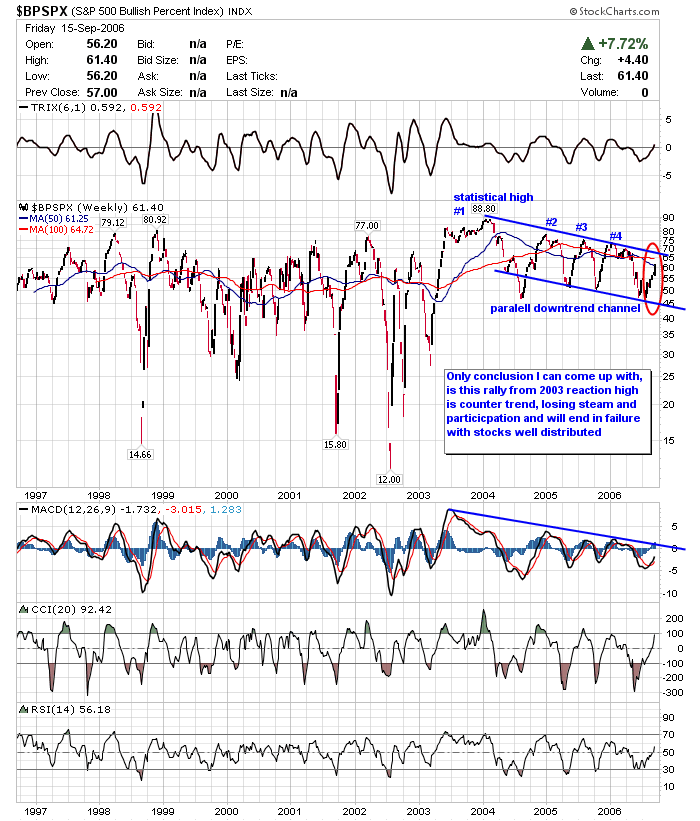
SAT MORNING POST
http://finance.yahoo.com/q?s=pnra
Tech somewhat, Dow 30 mostly, CONSUMER staples stocks like above, been batered....FOLLOW THE MONEY and that is not into OIL or GOLD IMHO
I suggest this will reverse, butnot until after NOV elections. NO OCT selloff lows? doesn't look like it, a test of 1326 SPX coming.....I also suggest not much fun until AFTER wed FED meeting.
FED leaves rates ALONE, won't this cause another FED IS DONE JIGGY WALTZ?
bears taken out to woodshed capitulate (many have).....normal bull in NOV is turned upside down as bulls turn to get spanked as DEM"S storm into majority as electorate THROWS out any Repub in BROAD LOUD message to imposter GW BUSH..take it to the bank!
L is sitting a smidgen away from broader buy signal, DOW is smidgen away from ALL TIME HIGH, but as we move ionto NOV/DEC, the MACD divergence will continue after over 2 1/2 years along with broad market non confirm like TRANSPORTS, as what WAS hot is not in a chase the donkey market, what appears unbeatable is a a mirage of chasing mkt for performance....with one leader PUNCTURED after another.
PLUNGING energy company profits, and slowing SPX earnings growth will be perfect setup for dissapointment, and a major bailout into JAN 2007 from this mkt.
Housing does not recover, continues to correct, finally job losses are counted.....worry shifts to slowing economy.....momo's bail leaving weak handed bag holder lemmings.
SPX energy has been main driver of historic earnings....has it not peaked?
PLUNGING commodoties have not yet broken Bond support levels, rates could begin to rise toward 5% again. Mortgage payments are reset. consumer confidence is FAR below historic peaks.
INcreasing cost to employers of workers in conjunction with falling productivity (should this continue) puts a HUGE damper on corporate profits.
Ford, INTC andmany other companies are forced to SHED workers to prop up earnings, same old 2000 song, see home builders etc do this en masse. GOOD money used for stock buybacks instead of investment, leave the US barren in any attempt at being competitive worldwide. Foreign suppliers have been MAIN beneficiary to the Consumer Spending BUBBLE unleashed from reckless FED policy.
With more talk of soft landing and willingness of speculators to bottom fish Home Builders, more trickes await than treats in the near future.
When BPSPX breaks support at 48 we will know for sure, it is also just underneathe downtrend line.
CAVEAT? is previous posts chart showing little adj monetary growth........tells me it better begin expanding or market will reflect this and maybe PPT and GS propping market in attempt to save BUSH
Tech somewhat, Dow 30 mostly, CONSUMER staples stocks like above, been batered....FOLLOW THE MONEY and that is not into OIL or GOLD IMHO
I suggest this will reverse, butnot until after NOV elections. NO OCT selloff lows? doesn't look like it, a test of 1326 SPX coming.....I also suggest not much fun until AFTER wed FED meeting.
FED leaves rates ALONE, won't this cause another FED IS DONE JIGGY WALTZ?
bears taken out to woodshed capitulate (many have).....normal bull in NOV is turned upside down as bulls turn to get spanked as DEM"S storm into majority as electorate THROWS out any Repub in BROAD LOUD message to imposter GW BUSH..take it to the bank!
L is sitting a smidgen away from broader buy signal, DOW is smidgen away from ALL TIME HIGH, but as we move ionto NOV/DEC, the MACD divergence will continue after over 2 1/2 years along with broad market non confirm like TRANSPORTS, as what WAS hot is not in a chase the donkey market, what appears unbeatable is a a mirage of chasing mkt for performance....with one leader PUNCTURED after another.
PLUNGING energy company profits, and slowing SPX earnings growth will be perfect setup for dissapointment, and a major bailout into JAN 2007 from this mkt.
Housing does not recover, continues to correct, finally job losses are counted.....worry shifts to slowing economy.....momo's bail leaving weak handed bag holder lemmings.
SPX energy has been main driver of historic earnings....has it not peaked?
PLUNGING commodoties have not yet broken Bond support levels, rates could begin to rise toward 5% again. Mortgage payments are reset. consumer confidence is FAR below historic peaks.
INcreasing cost to employers of workers in conjunction with falling productivity (should this continue) puts a HUGE damper on corporate profits.
Ford, INTC andmany other companies are forced to SHED workers to prop up earnings, same old 2000 song, see home builders etc do this en masse. GOOD money used for stock buybacks instead of investment, leave the US barren in any attempt at being competitive worldwide. Foreign suppliers have been MAIN beneficiary to the Consumer Spending BUBBLE unleashed from reckless FED policy.
With more talk of soft landing and willingness of speculators to bottom fish Home Builders, more trickes await than treats in the near future.
When BPSPX breaks support at 48 we will know for sure, it is also just underneathe downtrend line.
CAVEAT? is previous posts chart showing little adj monetary growth........tells me it better begin expanding or market will reflect this and maybe PPT and GS propping market in attempt to save BUSH
Duratek
Friday, September 15, 2006
PINTO !!!
Ford running out of gas!
Watching action CLOSE, a DEEP RED finish to day, would leave a NEW HIGH and lower close for week.
Transports already RED and NOT confirming new Dow highs.
D
Watching action CLOSE, a DEEP RED finish to day, would leave a NEW HIGH and lower close for week.
Transports already RED and NOT confirming new Dow highs.
D
ADJ MONEY SUPPLY DECLINING
http://research.stlouisfed.org/publications/usfd/page3.pdf
This is VERY worrisome and warns of some kind of top is upon us, IMHO
Duratek
This is VERY worrisome and warns of some kind of top is upon us, IMHO
Duratek
Thursday, September 14, 2006
SEARCHING FOR A TOP

It only took one year of MACD (also other momo indicators I use) divergences to seal a top of the longest running bull market in history. In RED you can see it has now been diverging as price rises for 2 1/2 years!
So either the MACD rises above downtrend line or price falls below uptrend line, IMHO
Bear did not correct maladjustments, and extremes from bubble action, in 2001 when FED began to draw down rates to a mere 1%, they decided to create ANOTHER FINANCIAL BUBBLE instead of dealing with after math of stock bubble bursting.
We see AIR coming out of housing bubble, so IMHO it is only a matter of time before the market begins PHASE II of the Secular Bear Market.
Duratek
Saturday, September 09, 2006
FIRE IN THE HOLE
All this talk about inverted yield curves and Recession is rather rediculous, as we all know the FED can avert any bad situation, and it's diferent this time.
I ask you, why are 10 yr yields falling? Oil is falling. Gold is falling. home prices are falling. Is this the inevitable pull of DEFLATION>? Or are we in the Goldilocks scenario?
Housing was a greater % of GDP back in the 60's and 70's, but currently with Hedonic pricing of computers, I feel this distorts this data, Hedonic pricing of computers had much less of an effect on GDP 30 years ago then it does now in the computer age.
I wonder if in the 60's and 70's they used their homes as ATM machines as thy do now? my friends it's all about BUILDING equity not sucking it dry. Home owners, especially new ones will be upside down on their mortgages if home prices fall even slightly because of the overleveraged positions they hold as result of new fangled loans like interest only.
The US $$ rose unexpectly this week, helping to put pressure on precious metals. I think partly due to Japan's Central Bank (BOJ) deciding to leave rates unchanged a rediculous .25% !! How strong is that economy they couldn't withstand .50% ??
Chinese goods are putting pricing pressure on all sorts of American goods. Chinese goods so far have eaten the commodity price surges, whereas US manufacturers are passing it along to Consumers. chinese goods are SO CHEAP they even put downward pressure on USED GOODS markets.
There isn't a shortage of a damn thing with seemingly limitless capacity in China to produce, where do you see too many dollars chasing too few goods?
The US is more competitive in manufacturing in what items? We are a consumptive society that produces very little outside of military machinery.
We are exceedingly at the mercy of Foreign lenders, not a good situation.
How is life at home? Bush wants to usurp our Constitution, AKA Vendetta. He knows what's best and he has helped to instill fear of TERRORISM so Americans will do anything, give up anything to be "safe", when his BOLD RECKLESS actions are helping to create the very thing we wish to avoid.
Has there been a lessening in blodshed anywhere? What has been accomplished by setting IRAQ for sectarian violence/Civil War? Was there a FLOOD of terrorists coming into Iraq before we invaded? The American public has been lied to and sold out and they do nothing? SEND A MESSAGE in NOVEMBER! Vote THEM OUT!
SO, this September is going to be different? No stock weakness? I DOUBT IT! SUmmer rally has begun to peter out and most of the rise coming from a pullback in SUPPLY (selling pressure) NOT from DEMAND (buying pressure).
I think the HIGHS are IN, and a DEFENSIVE posture is called for.
How important is housing to our economy? It adds to demand for employment at LOWES Home Depot, furniture stores, paint, remodling and new construction jobs, demand for nails, rubber, steel concrete etc.....demand for all commodities OIL etc, Demand for Banking services, real estate brokers, title searchers, lawyers, road construction, fabric , designers and archetects and so on and so on.
Have we not taken this housing bubble as far we can? These jobs we added are now in SERIOUS trouble.
I am asking the question, where are these jobs going to be absorbed? What other part of our economy will be growing to offer support?
WHY is oil now falling, broken through all akinds of supports? I say sure some speculation is pulling back but so is demand, supply is currently sufficient for demand.
And what elese will fall? RECORD oil company profits, which have been VERY supportive of record S and P profit growth. SO have financials, both charts of Banking and Energy have turned bearish. Housing has long time turned bearish even though it has seen a little dead cat bounce leately.
Home owners are stuck with rising property taxes. And new home owners with HUGE mortgages on elevated home prices they had to pay......debt is at HISTORIC levels as a % of just about anything.
I think we begin to see a little pushing away from the credit buffet. Merchants will begin to see this and cut prices to attract sales, even as they get squeezed at the wholesale level with nice price increases.
I don't see a soft landing, I think the 3 bears ate Goldilocks.....
Duratek
I ask you, why are 10 yr yields falling? Oil is falling. Gold is falling. home prices are falling. Is this the inevitable pull of DEFLATION>? Or are we in the Goldilocks scenario?
Housing was a greater % of GDP back in the 60's and 70's, but currently with Hedonic pricing of computers, I feel this distorts this data, Hedonic pricing of computers had much less of an effect on GDP 30 years ago then it does now in the computer age.
I wonder if in the 60's and 70's they used their homes as ATM machines as thy do now? my friends it's all about BUILDING equity not sucking it dry. Home owners, especially new ones will be upside down on their mortgages if home prices fall even slightly because of the overleveraged positions they hold as result of new fangled loans like interest only.
The US $$ rose unexpectly this week, helping to put pressure on precious metals. I think partly due to Japan's Central Bank (BOJ) deciding to leave rates unchanged a rediculous .25% !! How strong is that economy they couldn't withstand .50% ??
Chinese goods are putting pricing pressure on all sorts of American goods. Chinese goods so far have eaten the commodity price surges, whereas US manufacturers are passing it along to Consumers. chinese goods are SO CHEAP they even put downward pressure on USED GOODS markets.
There isn't a shortage of a damn thing with seemingly limitless capacity in China to produce, where do you see too many dollars chasing too few goods?
The US is more competitive in manufacturing in what items? We are a consumptive society that produces very little outside of military machinery.
We are exceedingly at the mercy of Foreign lenders, not a good situation.
How is life at home? Bush wants to usurp our Constitution, AKA Vendetta. He knows what's best and he has helped to instill fear of TERRORISM so Americans will do anything, give up anything to be "safe", when his BOLD RECKLESS actions are helping to create the very thing we wish to avoid.
Has there been a lessening in blodshed anywhere? What has been accomplished by setting IRAQ for sectarian violence/Civil War? Was there a FLOOD of terrorists coming into Iraq before we invaded? The American public has been lied to and sold out and they do nothing? SEND A MESSAGE in NOVEMBER! Vote THEM OUT!
SO, this September is going to be different? No stock weakness? I DOUBT IT! SUmmer rally has begun to peter out and most of the rise coming from a pullback in SUPPLY (selling pressure) NOT from DEMAND (buying pressure).
I think the HIGHS are IN, and a DEFENSIVE posture is called for.
How important is housing to our economy? It adds to demand for employment at LOWES Home Depot, furniture stores, paint, remodling and new construction jobs, demand for nails, rubber, steel concrete etc.....demand for all commodities OIL etc, Demand for Banking services, real estate brokers, title searchers, lawyers, road construction, fabric , designers and archetects and so on and so on.
Have we not taken this housing bubble as far we can? These jobs we added are now in SERIOUS trouble.
I am asking the question, where are these jobs going to be absorbed? What other part of our economy will be growing to offer support?
WHY is oil now falling, broken through all akinds of supports? I say sure some speculation is pulling back but so is demand, supply is currently sufficient for demand.
And what elese will fall? RECORD oil company profits, which have been VERY supportive of record S and P profit growth. SO have financials, both charts of Banking and Energy have turned bearish. Housing has long time turned bearish even though it has seen a little dead cat bounce leately.
Home owners are stuck with rising property taxes. And new home owners with HUGE mortgages on elevated home prices they had to pay......debt is at HISTORIC levels as a % of just about anything.
I think we begin to see a little pushing away from the credit buffet. Merchants will begin to see this and cut prices to attract sales, even as they get squeezed at the wholesale level with nice price increases.
I don't see a soft landing, I think the 3 bears ate Goldilocks.....
Duratek
Wednesday, September 06, 2006
CHARTS OF THE DAY

 WHY have Transports been weak with price of OIL/gas declining? Because there is NO correlation, they rose with price of gas, they passed on rising costs to manufacturers and retailers. Who then passed them on to CONSUMERS.
In the last 7 quarters S and P companies bought back nearly $650 BILLION of thier stock, reducing shares outstanding of course, which of course supports earnings they report as profits are divided by less shares. These are record numbers I believe and have supported market rally.
As they do this, like INTC announces AXING of some 10,000 jobs!
We have RECORD UNSOLD HOMES INVENTORY, and PRICES are PLUNGING, but we feel NO ILL EFFECTS?
Bond rally is due a breather, IMHO Gold is rising as the US dollar rises??!! Gold rally due a breather but we are IN seasonally strong period for the metal.
Per BLS data, productivity Y/Y is falling as costs to employers are rising. NOT a good condition,
GOLDILOCKS scenario my ass.
When will the job losses related to air coming out of housing bubble show up on stats? after NOV elections?
Some financials have been weak during this rally, COF JPM to name a few......AUG productivity on tap at 8:30
Duratek
Saturday, September 02, 2006
GLITTER OF GOLD? SAT POST
I understand the nature of inflation and deflation, and gold would do better than many items in deflation.
So far we have leaking air from housing bubble…if it leaks slowly we get more inflation, if it tumbles at some point, we get deflating demand for all kinds of things and deflationary “pressure” . SHARES could deflate while the metal not so much.
And we know how to fight deflation. FED is watching Inflation.
When never sure, we don’t put ALL eggs in one basket. $$ collapse could put pressure of currencies in general, GOLD should shine.
If housing is slowing and we see the numbers coming down, jobs will be shed like hair on a new convicts head. We don’t see this in the numbers t he gov shows you…yet.
121,000 added last report visa vi CES net birth death…stroke of pen. Next month those wont be there.
If reality is we have upsurge in unemployment the market will react violently to that….and the next one in Sept could start the ball rolling to FEAR of economy and we get our Oct bottom.
Duratek
So far we have leaking air from housing bubble…if it leaks slowly we get more inflation, if it tumbles at some point, we get deflating demand for all kinds of things and deflationary “pressure” . SHARES could deflate while the metal not so much.
And we know how to fight deflation. FED is watching Inflation.
When never sure, we don’t put ALL eggs in one basket. $$ collapse could put pressure of currencies in general, GOLD should shine.
If housing is slowing and we see the numbers coming down, jobs will be shed like hair on a new convicts head. We don’t see this in the numbers t he gov shows you…yet.
121,000 added last report visa vi CES net birth death…stroke of pen. Next month those wont be there.
If reality is we have upsurge in unemployment the market will react violently to that….and the next one in Sept could start the ball rolling to FEAR of economy and we get our Oct bottom.
Duratek
Friday, September 01, 2006
RUDE AWAKENING
*(look for Sat Morning Post sometime tomorrow)
BEST OF KURT RICHEBACHER
August 8, 2006
A RUDE AWAKENING AHEAD
Pundits worldwide are pondering what is irking the American investor. Is he scared of rising inflation and interest rates? Or is he scared of Fed overkill and weaker economic growth?
We have no idea what people in general are thinking or expecting. But what we have been reading until quite recently suggests to us the complete absence of any serious concern about the U.S. economy. Forecasts even from the international organizations envision economic growth above 3% as far as the eye can see. Some admit the probability of a little slowing in the second quarter, but after that, it is off to the races again. There is no talk even of a soft landing, because nobody sees any serious slowdown of the economy in the first place.
Economic data are, admittedly, mixed. So they certainly appear to most people. Not to us, though. Recent data have shown a sharp slowdown in economic activity in conjunction with continued acceleration in inflation. For the CPI, the annual inflation rate reported for May surged to 4.2%, from 3.6% in April. Focusing on the most important aggregates, we observe a distinct downshift in economic growth now in its third or fourth month, and accelerating.
Manifestly, these most important components are consumer spending, employment, income growth, residential building and asset prices.
In the last letter, we expressed the view that a recession and a bear market in asset prices are inevitable for the U.S. economy. It goes without saying that this will have very serious consequences for the rest of the world. Recent economic data leave no doubt that both are on their way. What keeps triggering rebounds in U.S. stocks is only the "bad news is good news" syndrome, reflecting the hope that economic weakness will stop the Fed’s rate hikes.
During the last three months, March–May, for which full data are available, consumer spending has risen 0.3% (1.2% annualized). Reported retail sales for June are down 0.1% before inflation adjustment. Year over year, they increased 5.7% before and 1.4% after inflation.
Nonfarm payrolls grew in the second quarter by 108,000 per month, well off the first quarter’s 176,000. It was the slowest quarter since Q3 2003, when the economy finally pulled out of the jobless recovery. The private sector added only 86,000 new jobs during the quarter.
Residential building contributed 0.38 percentage points to real GDP growth during the last two quarters (Q4 2005–Q1 2006). This compares with 1.18 percentage points in the first half of 2005. Consider that building has the highest multiplier effects, generating jobs and additional spending. Retail trade and residential building together account for 75% of GDP.
It is no secret what has mainly pulled the U.S. economy out of its 2001 recession. The Greenspan Fed succeeded in offsetting the depressive impact of plunging stock prices and business investment on the economy by inflating house prices, which lubricated an unprecedented consumer borrowing-and-spending binge. For the first time in history, a central bank systematically engineered an asset and credit bubble for the explicit purpose of precipitating economic growth.
"Asset-driven" economic growth became the new conventional label for this new pattern of growth. Policymakers and quite a few others have apparently come to appreciate it as a valid alternative to the traditional income-driven economic growth. It is not. It is the road into the next asset bust.
Appearances of a few years are deceptive. Asset-driven economic growth is a badly flawed and dangerous alternative for two reasons: First, asset prices cannot rise in perpetuity; and second, it involves exorbitant credit and debt growth, lured by the rising asset prices and excessively optimistic expectations.
Growth by way of the old-fashioned business cycle never ended, because it was self-sustaining. Bubble-driven growth invariably ends when asset prices stop rising. In the U.S. case of the late 1920s and Japan’s case of the late 1980s, asset prices collapsed, with huge damage to the balance sheets of banks, firms and private households…….
It is by now a moot question whether the U.S. economy will slow down. It is happening, and at a pretty fast clip. Most important aggregates — employment, retail sales and housing starts — are generating solid recession warnings. Firing people is apparently the first response by businesses. Over the past three months, private sector job gains were 44% below the average monthly gains in 2005. Recall it was a labor-intensive bubble.
Most people, apparently, expect a brief, mild economic downturn, followed by a quick economic rebound. First of all, the high inflation rates are sure to put considerable restraint on the Fed’s easing.
But what are the demand components that will probably respond to the new easing? After so many years of prior spending excess and, moreover, asset prices in a sharp fall, the consumer is sure to retrench. Nor is there, for sure, pent-up demand in residential building. There is talk of pent-up demand in business fixed investment. We see mostly companies, which appear to have a strong preference for mergers, acquisitions and stock buybacks, boosting shareholder value. In short, the U.S. economy’s rebound after a brief "pause" is an illusion.
There will be a rude awakening.
BEST OF KURT RICHEBACHER
August 8, 2006
A RUDE AWAKENING AHEAD
Pundits worldwide are pondering what is irking the American investor. Is he scared of rising inflation and interest rates? Or is he scared of Fed overkill and weaker economic growth?
We have no idea what people in general are thinking or expecting. But what we have been reading until quite recently suggests to us the complete absence of any serious concern about the U.S. economy. Forecasts even from the international organizations envision economic growth above 3% as far as the eye can see. Some admit the probability of a little slowing in the second quarter, but after that, it is off to the races again. There is no talk even of a soft landing, because nobody sees any serious slowdown of the economy in the first place.
Economic data are, admittedly, mixed. So they certainly appear to most people. Not to us, though. Recent data have shown a sharp slowdown in economic activity in conjunction with continued acceleration in inflation. For the CPI, the annual inflation rate reported for May surged to 4.2%, from 3.6% in April. Focusing on the most important aggregates, we observe a distinct downshift in economic growth now in its third or fourth month, and accelerating.
Manifestly, these most important components are consumer spending, employment, income growth, residential building and asset prices.
In the last letter, we expressed the view that a recession and a bear market in asset prices are inevitable for the U.S. economy. It goes without saying that this will have very serious consequences for the rest of the world. Recent economic data leave no doubt that both are on their way. What keeps triggering rebounds in U.S. stocks is only the "bad news is good news" syndrome, reflecting the hope that economic weakness will stop the Fed’s rate hikes.
During the last three months, March–May, for which full data are available, consumer spending has risen 0.3% (1.2% annualized). Reported retail sales for June are down 0.1% before inflation adjustment. Year over year, they increased 5.7% before and 1.4% after inflation.
Nonfarm payrolls grew in the second quarter by 108,000 per month, well off the first quarter’s 176,000. It was the slowest quarter since Q3 2003, when the economy finally pulled out of the jobless recovery. The private sector added only 86,000 new jobs during the quarter.
Residential building contributed 0.38 percentage points to real GDP growth during the last two quarters (Q4 2005–Q1 2006). This compares with 1.18 percentage points in the first half of 2005. Consider that building has the highest multiplier effects, generating jobs and additional spending. Retail trade and residential building together account for 75% of GDP.
It is no secret what has mainly pulled the U.S. economy out of its 2001 recession. The Greenspan Fed succeeded in offsetting the depressive impact of plunging stock prices and business investment on the economy by inflating house prices, which lubricated an unprecedented consumer borrowing-and-spending binge. For the first time in history, a central bank systematically engineered an asset and credit bubble for the explicit purpose of precipitating economic growth.
"Asset-driven" economic growth became the new conventional label for this new pattern of growth. Policymakers and quite a few others have apparently come to appreciate it as a valid alternative to the traditional income-driven economic growth. It is not. It is the road into the next asset bust.
Appearances of a few years are deceptive. Asset-driven economic growth is a badly flawed and dangerous alternative for two reasons: First, asset prices cannot rise in perpetuity; and second, it involves exorbitant credit and debt growth, lured by the rising asset prices and excessively optimistic expectations.
Growth by way of the old-fashioned business cycle never ended, because it was self-sustaining. Bubble-driven growth invariably ends when asset prices stop rising. In the U.S. case of the late 1920s and Japan’s case of the late 1980s, asset prices collapsed, with huge damage to the balance sheets of banks, firms and private households…….
It is by now a moot question whether the U.S. economy will slow down. It is happening, and at a pretty fast clip. Most important aggregates — employment, retail sales and housing starts — are generating solid recession warnings. Firing people is apparently the first response by businesses. Over the past three months, private sector job gains were 44% below the average monthly gains in 2005. Recall it was a labor-intensive bubble.
Most people, apparently, expect a brief, mild economic downturn, followed by a quick economic rebound. First of all, the high inflation rates are sure to put considerable restraint on the Fed’s easing.
But what are the demand components that will probably respond to the new easing? After so many years of prior spending excess and, moreover, asset prices in a sharp fall, the consumer is sure to retrench. Nor is there, for sure, pent-up demand in residential building. There is talk of pent-up demand in business fixed investment. We see mostly companies, which appear to have a strong preference for mergers, acquisitions and stock buybacks, boosting shareholder value. In short, the U.S. economy’s rebound after a brief "pause" is an illusion.
There will be a rude awakening.
PLACE YOR BETS
http://www.briefing.com/Investor/Public/MarketAnalysis/Calendars/EconomicCalendar.htm
PLACE TO GO FOR am data.
Net Birth (CES) Death "adjustment" accounted for ALL the months jobs.
Pure BS is what you get. 1308 is area of interest here, a SOUND break of 1302 could usher in some selling, a few bearish divergences are showing up.
D
PLACE TO GO FOR am data.
Net Birth (CES) Death "adjustment" accounted for ALL the months jobs.
Pure BS is what you get. 1308 is area of interest here, a SOUND break of 1302 could usher in some selling, a few bearish divergences are showing up.
D
Thursday, August 31, 2006
YELLOW BRICK ROAD
LOW investor sentiment towards dollar and bullishness of bonds are perfect recipe for a drop in bond prices, a rise in us $ and a fall in gold prices, though it appears until Iran deadline (today) passes, some FEAR buying of gold still exists.
The argument for RAMPANT inflation driving gold like in the 70's is not a valid argument, bond yields dont back it up. $70 PLUS oil has NOT produced what HIGH oil did back then, because of ASIAN producers.
Housing prices are "deflating". The world banks are tightening. NO ONE talks of delfation, barely even Precther. What we have is STAGFLATION. We are NOT in Goldilocks -land, we either get one evil or the other.
When the IMPACT of the bursting HOME BUBBLE is realized............the exits will be JAMMED with lemmings of the likes you have never seen before
The argument for RAMPANT inflation driving gold like in the 70's is not a valid argument, bond yields dont back it up. $70 PLUS oil has NOT produced what HIGH oil did back then, because of ASIAN producers.
Housing prices are "deflating". The world banks are tightening. NO ONE talks of delfation, barely even Precther. What we have is STAGFLATION. We are NOT in Goldilocks -land, we either get one evil or the other.
When the IMPACT of the bursting HOME BUBBLE is realized............the exits will be JAMMED with lemmings of the likes you have never seen before
Wednesday, August 30, 2006
Oil is Near RECORD Highs Still BUT
http://stockcharts.com/candleglance/?FCL,FDG,ACI,MEE,VLO,ECA,uso,BTU,xle%20,oihBA12,26,9
Something does not add up my friends. This is NOT what you think you'd see? in these related firms? and COAL???
Duratek
Something does not add up my friends. This is NOT what you think you'd see? in these related firms? and COAL???
Duratek
GDP LOWER
GDP growth revised up less than expectedWed Aug 30, 2006 8:48 AM ET
WASHINGTON (Reuters) - The U.S. economy grew at a 2.9 percent annual pace in the second quarter, faster than originally reported but less of an upward revision than expected, as higher business investment offset a drop in residential construction, a Commerce Department report showed on Wednesday.
Analysts polled by Reuters were expecting the second pass at GDP estimates for the April-June quarter to be revised up to a 3 percent annual pace from the initial 2.5 percent estimate for the quarter released last month.
Even so, excluding the Hurricane Katrina-affected final quarter of last year, it was the slowest quarterly U.S. growth pace since a 2.6 percent gain in the fourth quarter of 2004 on the biggest decline in homebuilding in more than ten years.
An inflation gauge favored by the Federal Reserve - a measure of personal consumption expenditure prices minus food and energy - was revised slightly downward to a 2.8 percent gain from an originally reported 2.9 percent rise. The last time there was an equivalent rise in the category was in the first quarter of 2001.
Businesses spent more on buildings, plants and factories than originally thought in the second quarter. The 22.2 percent rise was the biggest gain in nonresidential fixed investment in structures since the second quarter of 1994.
However, in a sign the housing sector is cooling rapidly, investment on residential structures fell 9.8 percent, the biggest decline since a 12.2 percent fall in the second quarter of 1995, the Commerce Department said.
Investment in inventories, exports, and spending by state and local governments were also higher than first thought.
But business investment in equipment and software was revised to a larger decline of 1.6 percent, the biggest drop since the fourth quarter of 2002.
Corporate profits after taxes rose 2.1 percent in the second quarter, a much smaller gain than the 14.8 percent rise in the first three months of the year.
The Federal Reserve has been counting on a slowdown in economic growth to keep inflation in check. Minutes of the Fed's August 8 meeting - when the Fed halted a two-year string of interest rate increases -- showed policy makers concerned about rising prices but patient on the need for more rate hikes as they awaited further economic data.
WASHINGTON (Reuters) - The U.S. economy grew at a 2.9 percent annual pace in the second quarter, faster than originally reported but less of an upward revision than expected, as higher business investment offset a drop in residential construction, a Commerce Department report showed on Wednesday.
Analysts polled by Reuters were expecting the second pass at GDP estimates for the April-June quarter to be revised up to a 3 percent annual pace from the initial 2.5 percent estimate for the quarter released last month.
Even so, excluding the Hurricane Katrina-affected final quarter of last year, it was the slowest quarterly U.S. growth pace since a 2.6 percent gain in the fourth quarter of 2004 on the biggest decline in homebuilding in more than ten years.
An inflation gauge favored by the Federal Reserve - a measure of personal consumption expenditure prices minus food and energy - was revised slightly downward to a 2.8 percent gain from an originally reported 2.9 percent rise. The last time there was an equivalent rise in the category was in the first quarter of 2001.
Businesses spent more on buildings, plants and factories than originally thought in the second quarter. The 22.2 percent rise was the biggest gain in nonresidential fixed investment in structures since the second quarter of 1994.
However, in a sign the housing sector is cooling rapidly, investment on residential structures fell 9.8 percent, the biggest decline since a 12.2 percent fall in the second quarter of 1995, the Commerce Department said.
Investment in inventories, exports, and spending by state and local governments were also higher than first thought.
But business investment in equipment and software was revised to a larger decline of 1.6 percent, the biggest drop since the fourth quarter of 2002.
Corporate profits after taxes rose 2.1 percent in the second quarter, a much smaller gain than the 14.8 percent rise in the first three months of the year.
The Federal Reserve has been counting on a slowdown in economic growth to keep inflation in check. Minutes of the Fed's August 8 meeting - when the Fed halted a two-year string of interest rate increases -- showed policy makers concerned about rising prices but patient on the need for more rate hikes as they awaited further economic data.
Tuesday, August 29, 2006
4 YEAR CYCLE LOWS

(click to enlarge, click bottom right corner *4 arrows to see orig)
http://www.walterbressert.com/PAGES/FREESTUFF/STOCKMARKET/092203/092203.htm
The 4-Year Cycle bottom that occurred in 2002 was the first 4-Year Cycle since 1974 to drop below a previous 4-Year Cycle bottom (as indicated by the horizontal red line), and our expectation is for at least a rise to the 50% retracement level at 1161, and quite possibly to the 78.6% retracement of 1365 as the current 4-Year Cycle tops, January through July, 2004.
**It is time to heed history. Market has made lows in OCT 9 of last 10 years. 4 yr cycle bottom is approaching. Congressional cycle (market does worse while in session, due back in Sept). Good news is out, Israel/Hessbolah war over. Oil is falling. Interest rates have declined.
Bear market which began in 2000 has not been satisfied. AT Oct 2002 lows the SPX was at 30X PE and yielded a scant 1.6% !!! (AVG PRIOR LOWS? 6% yields and single digit PE'S) WHere are we now? SPX X17 SPX yield near 2%.....more like a top than bottom. EVERY BEAR MKT has been satisfied as I described, this one will be no different.
What delayed the bottom? Near ZERO % interest rates, and a flood of liquidity. Tech bubble replaced by housing bubble.
There is ample data as I discussed previous to believe the bubble has been pricked in housing, prices have JUST begun to decline. We read more of SOFT landing than those who believe something much worse is lurking. We have 4 decades high in housing inventory.
Slowdown in housing is going to trickle down to almost every aspect of our economy. It will be devestating. The mountain of debt that exists is historic. 30% of recent home loans were of dubious quality with schemes like "interest only" loans.
Market is making new highs with less and less stocks moving in strength, very FEW new highs. Market move is coming as result of less selling vs more buying. This IMHO is not sustaianable.
Inflation is above FED targets. Minutes from meeting due today. Could be market mover.
Consumer sentiment due at 10 AM, could be market mover.
Wed GDP data, could be market mover.
AVG retrace from from initial Bear MArket lows last avg of 3.5 years. That was in May, near the 2006 highs.
WHY are companies NOT investing in themselves with capital spending? ALL they are doing is M and A and buying back stock.
YOU will KNOW when a low is near, fear and blood will run in the streets, and you will be petrified to touch ANY stock with 10' pole.
Duratek
Monday, August 28, 2006
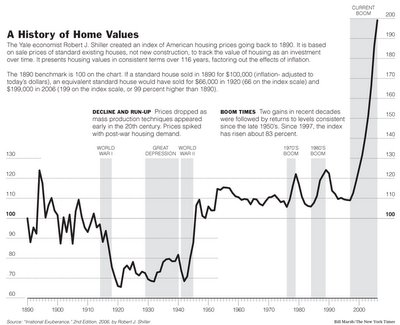
IF THIS ISN'T A BUBBLE THEN WHAT IS?
Click to enlarge
http://www.nytimes.com/2006/08/27/weekinreview/27leonhardt.html?_r=1&oref=slogin

http://www.nytimes.com/2006/08/27/weekinreview/27leonhardt.html?_r=1&oref=slogin
Parabolic moves tend to be completely retraced. I wish but with record inventory to sell and sales plummeting, soft landing my ass.
Duratek


Saturday, August 26, 2006
SATURDAY MORNING POST " A PICTURE OF HEALTH?"
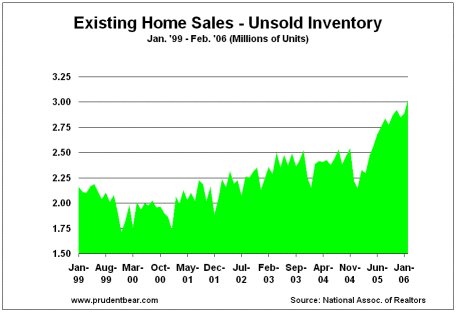
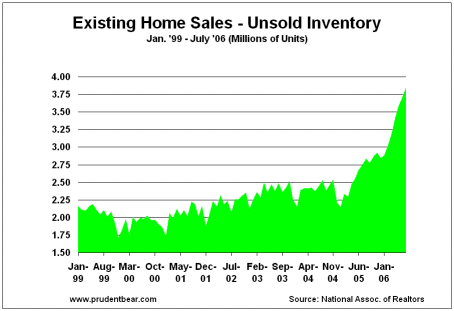
Recent reports show inventory of UNSOLD homes now stands at a historic record! After huffing and puffing this bubble, she has gone as far as she can go. Many speculators and new home buyers are STUCK in homes they have NO equity or aren't able to flip or sell. The result is signs like "RECENTLY REDUCED" or "NEW LOW PRICE" high inventory lack of demand will result in a housing price decline.
LOW interest rates alone are not enough to spur demand.
Shanghai real estate has risne 300% in last 3 years. The world is raising interest rates, trying to sop up excess liquidity or so it seems. As the FED has paused, that does not mean addt'l hikes are not possible. Falling long term rates do not give a picture of inflation nor of a healthy economy.
The market has been able to remain stable as there has been a respite in SUPPLY but demand has been flat, so we have gone nowhere.
Because the Dow consists of just 30 stocks, barely 2% of valuations, it can be manipulated. And the broader market has benefited from a strong performance of Bond funds and some foreign stocks. PEEL them away and you get a MUCH different picture.
If supply picks up with any force, the market will be set for a serious decline. We are nearing an end of seasonal strength. Sept/Oct is right around the corner.
Odd statistic, when Congress is in session, stocks do worse, is why when in recess, stocks get a summer rally some studies suggest.
And they are now do back, but recess again in OCT, could that be reason stocks usually bottom in October? 9 of last 10 years they have!
My eye is on the housing market, I see at this time NO other part of economy able to pick us up, if home prices continue to decline MANY will default, there has been recent weakness in the FInancial sector.
I remain vigilant until OCT has passed.
Duratek
Friday, August 25, 2006
"ROUBINI" ON HOUSING AND RECESSION
By Rex Nutting, MarketWatch
Aug 23, 2006
WASHINGTON (MarketWatch) -- The United States is headed for a recession that will be "much nastier, deeper and more protracted" than the 2001 recession, says Nouriel Roubini, president of Roubini Global Economics.
Writing on his blog Wednesday, Roubini repeated his call that the U.S. would be in recession in 2007, arguing that the collapse of housing would bring down the rest of the economy. Read more.
Roubini wrote after the National Association of Realtors reported Wednesday that sales of existing homes fell 4.1% in July, while inventories soared to a 13-year high and prices flattened out on a year-over-year basis. See full story.
'This is the biggest housing slump in the last four or five decades: every housing indicator is in free fall, including now housing prices.'
— Nouriel Roubini, Roubini Global Economics
"This is the biggest housing slump in the last four or five decades: every housing indicator is in free fall, including now housing prices," Roubini said. The decline in investment in the housing sector will exceed the drop in investment when the Nasdaq collapsed in 2000 and 2001, he said.
And the impact of the bursting of the bubble will affect every household in America, not just the few people who owned significant shares in technology companies during the dot-com boom, he said. Prices are falling even in the Midwest, which never experienced a bubble, "a scary signal" of how much pain the drop in household wealth could cause.
Roubini is a professor of economics at New York University and was a senior economist in the White House and the Treasury Department in the late 1990s. His firm focuses largely on global macroeconomics.
While many economists share Roubini's concerns about imbalances in the global economy and in the U.S. housing sector, he stands nearly alone in predicting a recession next year.
Fed watcher Tim Duy called Roubini the "the current archetypical Eeyore," responding to a comment Dallas Fed President Richard Fisher made last week in referring to economic pessimists as "Eeyores," after Winnie the Pooh's grumpy friend.
"By itself this slump is enough to trigger a U.S. recession: its effects on real residential investment, wealth and consumption, and employment will be more severe than the tech bust that triggered the 2001 recession," Roubini said.
Housing has accounted, directly and indirectly, for about 30% of employment growth during this expansion, including employment in retail and in manufacturing producing consumer goods, he said.
In the past year, consumers spent about $200 billion of the money they pulled out of their home equity, he estimated. Already, sales of consumer durables such as cars and furniture have weakened.
"As the housing sector slumps, the job and income and wage losses in housing will percolate throughout the economy," Roubini said.
Consumers also face high energy prices, higher interest rates, stagnant wages, negative savings and high debt levels, he noted.
"This is the tipping point for the U.S. consumer and the effects will be ugly," he said. "Expect the great recession of 2007 to be much nastier, deeper and more protracted than the 2001 recession."
He also sees many of the same warning signs in other economies, including some in Europe.
Rex Nutting is Washington bureau chief of MarketWatch.
Aug 23, 2006
WASHINGTON (MarketWatch) -- The United States is headed for a recession that will be "much nastier, deeper and more protracted" than the 2001 recession, says Nouriel Roubini, president of Roubini Global Economics.
Writing on his blog Wednesday, Roubini repeated his call that the U.S. would be in recession in 2007, arguing that the collapse of housing would bring down the rest of the economy. Read more.
Roubini wrote after the National Association of Realtors reported Wednesday that sales of existing homes fell 4.1% in July, while inventories soared to a 13-year high and prices flattened out on a year-over-year basis. See full story.
'This is the biggest housing slump in the last four or five decades: every housing indicator is in free fall, including now housing prices.'
— Nouriel Roubini, Roubini Global Economics
"This is the biggest housing slump in the last four or five decades: every housing indicator is in free fall, including now housing prices," Roubini said. The decline in investment in the housing sector will exceed the drop in investment when the Nasdaq collapsed in 2000 and 2001, he said.
And the impact of the bursting of the bubble will affect every household in America, not just the few people who owned significant shares in technology companies during the dot-com boom, he said. Prices are falling even in the Midwest, which never experienced a bubble, "a scary signal" of how much pain the drop in household wealth could cause.
Roubini is a professor of economics at New York University and was a senior economist in the White House and the Treasury Department in the late 1990s. His firm focuses largely on global macroeconomics.
While many economists share Roubini's concerns about imbalances in the global economy and in the U.S. housing sector, he stands nearly alone in predicting a recession next year.
Fed watcher Tim Duy called Roubini the "the current archetypical Eeyore," responding to a comment Dallas Fed President Richard Fisher made last week in referring to economic pessimists as "Eeyores," after Winnie the Pooh's grumpy friend.
"By itself this slump is enough to trigger a U.S. recession: its effects on real residential investment, wealth and consumption, and employment will be more severe than the tech bust that triggered the 2001 recession," Roubini said.
Housing has accounted, directly and indirectly, for about 30% of employment growth during this expansion, including employment in retail and in manufacturing producing consumer goods, he said.
In the past year, consumers spent about $200 billion of the money they pulled out of their home equity, he estimated. Already, sales of consumer durables such as cars and furniture have weakened.
"As the housing sector slumps, the job and income and wage losses in housing will percolate throughout the economy," Roubini said.
Consumers also face high energy prices, higher interest rates, stagnant wages, negative savings and high debt levels, he noted.
"This is the tipping point for the U.S. consumer and the effects will be ugly," he said. "Expect the great recession of 2007 to be much nastier, deeper and more protracted than the 2001 recession."
He also sees many of the same warning signs in other economies, including some in Europe.
Rex Nutting is Washington bureau chief of MarketWatch.
Saturday, August 19, 2006
WHO'S YOUR DADDY?
http://safehaven.com/article-5725.htm "W" pattern forming on the SPX, same pattern preceeded OCT 1987 CRASH
D
D
Doug Noland A Must Read
This excerpt is the heart of our current predicament, so you understand better what environment we are currently in.
Duratek
http://www.prudentbear.com/archive_comm_article.asp?category=Credit+Bubble+Bulletin&content_idx=57477
To get started, where’s the heightened risk aversion one would expect late in a tightening cycle? Where are the tightened “financial conditions” after 17 Fed rate increases? Where are the chastened borrowers, lenders, financiers, and speculators? Well, the leveraged speculating community flourishes and hasn’t missed a beat, and with this growth comes a thus far insatiable appetite for risky assets. Combining the powerful Wall Street firms, the global money center securities/insurance/”banks,” and thousands of hedge funds and you’ve got one almighty juggernaut “speculator community” that controls $10’s of Trillions of U.S. and global assets. To be sure, players today operate with an incentive structure unrecognizable to the traditional bank loan officer. Hedge funds typically take 20% of (realized and unrealized) fund gains at year-end, while Wall Street traders, investment bankers, derivative specialists and the like enjoy a share of booked profits with the arrival of their generous year-end bonuses. Such incentive structures nurture an all-consuming institutional inflationary bias.
It is, apparently, going to take a more intimidating housing slowdown to alarm speculators enticed by higher-yielding mortgage securities. The conspicuous excess that has of late beset corporate finance is anything but dissuading speculation in risky PIK (payment in kind) debt and other high-yielding corporate securities – especially not with the convenient embracement of “mark-to-model” pricing. And the incentive to write insurance (and immediately book much of the premium as “profit”) is simply too enticing to pass up, whether it is catastrophic weather reinsurance, Credit default derivatives, market hedges, or the myriad types of financial insurance/guarantees that have taken the U.S. and global Credit systems by storm. It is also clear that the perception of ongoing Federal Reserve accommodation has emerging market securities again in hot demand.
The current Financial Structure, dominated by Wall Street securitizations, leveraging, derivatives, and asset/securities speculation, inherently incites and then feeds runaway Credit, asset and speculative Bubbles. Under present conditions, the nature of this energized financing mechanism is not going to change, but rather only the sectors and asset classes where over-financing ensures spectacular boom and bust cycles.
“It appears that the current housing slowdown, which we first saw in September ‘05, is somewhat unique: It is the first downturn in forty years – in the forty years since we entered the business that was not precipitated by high interest rates, a weak economy, job losses or other macroeconomic factors. Instead, it seems to be the result of an oversupply of inventory and a decline in confidence. Speculative buyers who spurred demand in ‘04 and ‘05 are now sellers; builders who built speculative homes must now move their specs; and nervous buyers are canceling contracts for homes already under construction.” Robert Toll, Chairman & CEO Toll Brothers
In a predictable replay of the Technology Bubble, the U.S. homebuilding industry now faces the inevitable consequences from a period of spectacular over-finance and over-speculation (including massive industry overcapacity, collapsing profit margins and acute price uncertainty and instability). Industry executives have not previously experienced similar dynamics to this downturn specifically because there has never been a Financial Structure so capable of completely inundating the entire housing and mortgage arenas with cheap finance for such an extended period – never. As we witnessed with tech, destabilizing speculative flows appear seductively miraculous until they don’t.
Ultra-easy finance incited and then fed a speculative Bubble in home buying. At the same time, the nature of the Financial Structure saw to it that the homebuilders were also overwhelmed with finance, ensuring an enormous, destabilizing and self-reinforcing building boom. And the higher homebuilder stock prices ran and the cheaper their debt financings became, the greater the incentive to ignore the warning signs and race to develop more properties – to keep the dream alive and the liquidity spigot wide open. Moreover, the greater the boom the more the various segments of the ballooning U.S. Financial Sphere that wanted their piece of the action. And the resulting creative financing arrangements and instruments – and greater Credit Availability generally – the easier it became to finance ballooning transactions at higher prices (yet with lower individual mortgage payments!). Households inevitably succumbed to panic buying.
Many analysts these days hone in on the housing slowdown and the likelihood that the Fed has already raised rates too much to sustain the economic boom. My focus and concerns are instead directed at the precarious nature of a prevailing Financial Structure that ensures Serial Bubbles and Cumulative Economic Impairment and Financial Fragility. With acute vulnerability pervading some key housing markets - as well as the general risk to the Mortgage Finance Bubble - in the spotlight, the Fed is poised to accommodate the ongoing profligate financing environment. I find it astounding that our policymakers have absolutely no inclination – or demonstrate any sensitivity to their responsibility - to discipline or subdue “Wall Street finance.” Instead, they are determined to safeguard a highly improvident and destabilizing financial backdrop and incentive structure. This may very well perpetuate the current aged boom somewhat, but their will be no avoiding the painful aftermath. Today’s Menacing Financial Structure has decisively sealed such a fate.
Duratek
http://www.prudentbear.com/archive_comm_article.asp?category=Credit+Bubble+Bulletin&content_idx=57477
To get started, where’s the heightened risk aversion one would expect late in a tightening cycle? Where are the tightened “financial conditions” after 17 Fed rate increases? Where are the chastened borrowers, lenders, financiers, and speculators? Well, the leveraged speculating community flourishes and hasn’t missed a beat, and with this growth comes a thus far insatiable appetite for risky assets. Combining the powerful Wall Street firms, the global money center securities/insurance/”banks,” and thousands of hedge funds and you’ve got one almighty juggernaut “speculator community” that controls $10’s of Trillions of U.S. and global assets. To be sure, players today operate with an incentive structure unrecognizable to the traditional bank loan officer. Hedge funds typically take 20% of (realized and unrealized) fund gains at year-end, while Wall Street traders, investment bankers, derivative specialists and the like enjoy a share of booked profits with the arrival of their generous year-end bonuses. Such incentive structures nurture an all-consuming institutional inflationary bias.
It is, apparently, going to take a more intimidating housing slowdown to alarm speculators enticed by higher-yielding mortgage securities. The conspicuous excess that has of late beset corporate finance is anything but dissuading speculation in risky PIK (payment in kind) debt and other high-yielding corporate securities – especially not with the convenient embracement of “mark-to-model” pricing. And the incentive to write insurance (and immediately book much of the premium as “profit”) is simply too enticing to pass up, whether it is catastrophic weather reinsurance, Credit default derivatives, market hedges, or the myriad types of financial insurance/guarantees that have taken the U.S. and global Credit systems by storm. It is also clear that the perception of ongoing Federal Reserve accommodation has emerging market securities again in hot demand.
The current Financial Structure, dominated by Wall Street securitizations, leveraging, derivatives, and asset/securities speculation, inherently incites and then feeds runaway Credit, asset and speculative Bubbles. Under present conditions, the nature of this energized financing mechanism is not going to change, but rather only the sectors and asset classes where over-financing ensures spectacular boom and bust cycles.
“It appears that the current housing slowdown, which we first saw in September ‘05, is somewhat unique: It is the first downturn in forty years – in the forty years since we entered the business that was not precipitated by high interest rates, a weak economy, job losses or other macroeconomic factors. Instead, it seems to be the result of an oversupply of inventory and a decline in confidence. Speculative buyers who spurred demand in ‘04 and ‘05 are now sellers; builders who built speculative homes must now move their specs; and nervous buyers are canceling contracts for homes already under construction.” Robert Toll, Chairman & CEO Toll Brothers
In a predictable replay of the Technology Bubble, the U.S. homebuilding industry now faces the inevitable consequences from a period of spectacular over-finance and over-speculation (including massive industry overcapacity, collapsing profit margins and acute price uncertainty and instability). Industry executives have not previously experienced similar dynamics to this downturn specifically because there has never been a Financial Structure so capable of completely inundating the entire housing and mortgage arenas with cheap finance for such an extended period – never. As we witnessed with tech, destabilizing speculative flows appear seductively miraculous until they don’t.
Ultra-easy finance incited and then fed a speculative Bubble in home buying. At the same time, the nature of the Financial Structure saw to it that the homebuilders were also overwhelmed with finance, ensuring an enormous, destabilizing and self-reinforcing building boom. And the higher homebuilder stock prices ran and the cheaper their debt financings became, the greater the incentive to ignore the warning signs and race to develop more properties – to keep the dream alive and the liquidity spigot wide open. Moreover, the greater the boom the more the various segments of the ballooning U.S. Financial Sphere that wanted their piece of the action. And the resulting creative financing arrangements and instruments – and greater Credit Availability generally – the easier it became to finance ballooning transactions at higher prices (yet with lower individual mortgage payments!). Households inevitably succumbed to panic buying.
Many analysts these days hone in on the housing slowdown and the likelihood that the Fed has already raised rates too much to sustain the economic boom. My focus and concerns are instead directed at the precarious nature of a prevailing Financial Structure that ensures Serial Bubbles and Cumulative Economic Impairment and Financial Fragility. With acute vulnerability pervading some key housing markets - as well as the general risk to the Mortgage Finance Bubble - in the spotlight, the Fed is poised to accommodate the ongoing profligate financing environment. I find it astounding that our policymakers have absolutely no inclination – or demonstrate any sensitivity to their responsibility - to discipline or subdue “Wall Street finance.” Instead, they are determined to safeguard a highly improvident and destabilizing financial backdrop and incentive structure. This may very well perpetuate the current aged boom somewhat, but their will be no avoiding the painful aftermath. Today’s Menacing Financial Structure has decisively sealed such a fate.
DREAMING
'I'M JUST A DREAMER, I DREAM MY LIFE AWAY (OH YEAH)
I'M JUST A DREAMER WHO DREAMS OF BETTER DAYS"
IF ONLY WE COULD ALL FIND SERENITY
IT WOULD BE NICE IF WE COULD LIVE AS ONE
WHEN WILL ALL THIS HATE AND BIGOTRY BE GONE
I'M JUST A DREAMER SEARCHING FOR THE WAY, TODAY
I'M JUST A DREAMER DREAMING OF BETTER DAYS"
THANKS OZZIE
D
I'M JUST A DREAMER WHO DREAMS OF BETTER DAYS"
IF ONLY WE COULD ALL FIND SERENITY
IT WOULD BE NICE IF WE COULD LIVE AS ONE
WHEN WILL ALL THIS HATE AND BIGOTRY BE GONE
I'M JUST A DREAMER SEARCHING FOR THE WAY, TODAY
I'M JUST A DREAMER DREAMING OF BETTER DAYS"
THANKS OZZIE
D
LISTENING IN WITH DURATEK
And just when I am really on to a “system” I get overloaded with data, I use to never use any TA, but I feel it is a MUST to understand now. I wish I was where I am now 6 years ago, but reading Jim Puplava saved my ass, as that began my quest for knowledge and truth, I did not however heed his advise for gold and oil, didn’t know better then. SO I steered clear of bear ravage, but sat out most of recovery….but I do try not to look back much, I cannot complain where I sit now.
I believe in Trend Trading, yet I am not sure I can stomach STEEP draw downs to keep on trend.
I am in more agreement with you and KJ, that if they want to pay me 4% plus to sit there and do nothing so be it. I have 401K and get matching funds so that’s a cant lose deal, but you have sweet situation.
I cant seem to trust anyone with my money, so I continue the quest to get it right myself, sometimes the STRESS gets to me but I see no other way. I’m in TOO Deep, invested too much time and energy to leave a job yet unfinished.
I feel BEST method would be to avg that in each month into balanced portfolio, I would probably adapt the Brinker model, a proven winner in good markets.
But I don’t want to put my sidelined cash into this market, when we get to a identifiable bottom, then I will begin to slide it in. WONT do it at current levels.
ALL I know is what RR had pointed out, at OCT or March bottom 2002/2003 we had SPX at 30X and div yields ABOVE other known TOPS!! I see earnings rise and SPXPE come way down….but DIV yields show NO improvement.
We have one of longest periods of no 10% SPX correction, we have HISTORIC Dow Theory non confirmation.
I cannot believe the smartass FED and Bush skate free (though people suffer) with their plan to enrich those who don’t need it and enslave the others. And what PLAN that drives debt to historic levels ends well?
NAZ has had death cross of MA’S I follow, gold and energy seem to be correcting, so I cannot do much yet there, but I will.
Housing reports next week, I have been tempted to position in bond market, something holding me back, like safe MM yields, but they will begin to fall.
Master plan drove money out of MM’s in 2003 forcing investors to take on risk, it has worked well til now. Now MM’s fight for cash with market.
Recent rally has me on edge of my seat, scratching my head, but 9 of 10 years past mkt bottom IN OCT, so I cannot chase this move. I would however take some risks come selloff into OCT, bet your ass I will. And leave in DEC.
Income funds selloff into DEC so I would look there maybe.
Agree of course with being liquid, one reason Bonds not my bag.
I will check out your link today later, the same old game is played by yes these crooks…..fox in the henhouse again. Heck out situation on XNL, a BB stock (many have) found it easy to catch on AMEX, but seems something fishy going on there, many lemmings trapped.
Same old game… enjoy the conversation James
I believe in Trend Trading, yet I am not sure I can stomach STEEP draw downs to keep on trend.
I am in more agreement with you and KJ, that if they want to pay me 4% plus to sit there and do nothing so be it. I have 401K and get matching funds so that’s a cant lose deal, but you have sweet situation.
I cant seem to trust anyone with my money, so I continue the quest to get it right myself, sometimes the STRESS gets to me but I see no other way. I’m in TOO Deep, invested too much time and energy to leave a job yet unfinished.
I feel BEST method would be to avg that in each month into balanced portfolio, I would probably adapt the Brinker model, a proven winner in good markets.
But I don’t want to put my sidelined cash into this market, when we get to a identifiable bottom, then I will begin to slide it in. WONT do it at current levels.
ALL I know is what RR had pointed out, at OCT or March bottom 2002/2003 we had SPX at 30X and div yields ABOVE other known TOPS!! I see earnings rise and SPXPE come way down….but DIV yields show NO improvement.
We have one of longest periods of no 10% SPX correction, we have HISTORIC Dow Theory non confirmation.
I cannot believe the smartass FED and Bush skate free (though people suffer) with their plan to enrich those who don’t need it and enslave the others. And what PLAN that drives debt to historic levels ends well?
NAZ has had death cross of MA’S I follow, gold and energy seem to be correcting, so I cannot do much yet there, but I will.
Housing reports next week, I have been tempted to position in bond market, something holding me back, like safe MM yields, but they will begin to fall.
Master plan drove money out of MM’s in 2003 forcing investors to take on risk, it has worked well til now. Now MM’s fight for cash with market.
Recent rally has me on edge of my seat, scratching my head, but 9 of 10 years past mkt bottom IN OCT, so I cannot chase this move. I would however take some risks come selloff into OCT, bet your ass I will. And leave in DEC.
Income funds selloff into DEC so I would look there maybe.
Agree of course with being liquid, one reason Bonds not my bag.
I will check out your link today later, the same old game is played by yes these crooks…..fox in the henhouse again. Heck out situation on XNL, a BB stock (many have) found it easy to catch on AMEX, but seems something fishy going on there, many lemmings trapped.
Same old game… enjoy the conversation James
Friday, August 18, 2006
CONTRACTION
http://research.stlouisfed.org/publications/usfd/page3.pdf
We are at ZERO growth here, nowhere close to even the slowing growth seen only partially here in 2005. Am I alone that find this troubling for the economy?
PS also steep DROP in Consumer Confidence this AM
D
We are at ZERO growth here, nowhere close to even the slowing growth seen only partially here in 2005. Am I alone that find this troubling for the economy?
PS also steep DROP in Consumer Confidence this AM
D
PENSION REFORM
http://money.cnn.com/2006/08/17/pf/retirement/pension_signing/index.htm Important changes you should be aware of.
Today is options expiration day, 3rd Friday of every month. It could be a volatile day, but I am not expecting a big move either way. Consumer confidence numbers come out 10 AM
DELL numbers last night were horrid! 50% decline in earnings and income. Not sure in current environment if it will sink the NAZ today, might hold it down perhaps.
Commodities have been falling like a stone, like interest rates could be signalling an economic slowdown which at some point I believe will beome the MAIN focus of the stock market.
I missed the top in the 10 yr, as most of us have been focused by the FED and inflation near 5.25%, it is now about 4.87%
I see potential for rates to drop all the way back to 4.2% area, bottom of a channel I have drawn.....and I wonder if they will even challenge 5% again anytime soon.
I have been considering a few income stocks and funds for a part of my portfolio.
I am still expecting stocks to bottom in OCT timeframe, though recent runup has challenged my views, the recent Leading Inidcators have signalled trouble and I am steadfast that will become center stage when the NO MORE FED RAISE HYPE dies down.
I also get feeling most of easy money has been made on this move.
Duratek
Today is options expiration day, 3rd Friday of every month. It could be a volatile day, but I am not expecting a big move either way. Consumer confidence numbers come out 10 AM
DELL numbers last night were horrid! 50% decline in earnings and income. Not sure in current environment if it will sink the NAZ today, might hold it down perhaps.
Commodities have been falling like a stone, like interest rates could be signalling an economic slowdown which at some point I believe will beome the MAIN focus of the stock market.
I missed the top in the 10 yr, as most of us have been focused by the FED and inflation near 5.25%, it is now about 4.87%
I see potential for rates to drop all the way back to 4.2% area, bottom of a channel I have drawn.....and I wonder if they will even challenge 5% again anytime soon.
I have been considering a few income stocks and funds for a part of my portfolio.
I am still expecting stocks to bottom in OCT timeframe, though recent runup has challenged my views, the recent Leading Inidcators have signalled trouble and I am steadfast that will become center stage when the NO MORE FED RAISE HYPE dies down.
I also get feeling most of easy money has been made on this move.
Duratek
Thursday, August 17, 2006
CSCO CHIEF SELLING ALL HE CAN
http://www.thestreet.com/_yahoo/newsanalysis/technetworking/10304330.html
Hey, it's American to talk up your company forecasts as you are selling out the back door, say it aint so John I crown the' hypster king
D
Hey, it's American to talk up your company forecasts as you are selling out the back door, say it aint so John I crown the' hypster king
D
"IS BUSH AN IDIOT"
http://www.huffingtonpost.com/joe-scarborough/is-bush-an-idiot_b_27408.html
hEY, I DONT MAKE IT UP, THIS FROM USUALLY PRAISING JOE SCARBOROUGH
d
hEY, I DONT MAKE IT UP, THIS FROM USUALLY PRAISING JOE SCARBOROUGH
d
Wednesday, August 16, 2006
RED TIDE
Holy crap markets on a tear! NAZ leading way, but DOW has had 2 back to back 80% upside volume days, this is strong move.
Dow has broken free of 11,250 zone ending today at 11,327. Isn't an ALL TIME high so close you can taste it? WOuld NAZ need to play catch up and really catch fire?
It doesn't pay to be STUBBORN when the market moves against your positions or beliefs. Housing bubble, falling prices, terrorism etc etc, high oil.....markets taken it all in and spit it back out.
Transports now need to play catch up, what then was their plummet from the 5,000 area all time high double top about? DO trasnports like falling oil? Does the markets?
Only the NAZ has given me a BEAR signal from my TA work. This signal has only been given 2 other times in last 6 years.
Market likes and believes FED is done raising interest rates, as they were in 2000 right before the top! but it likes it. It likes the manipulated PPI and CPI, says it doesnt have to worry about inflation.
Q's MAX PAIN # is $37. not sure how accurate it is, but that is where most pain would be felt by otpions buyers.....it makes sense mkt would gravitate near there, but it doesnt always.
SO we have weaker oil, truce in Middle East, same old shit in Iraq, falling long term interest rates, well THEY say it is because it isnt buying inflation story, but it could be saying economy is weaker than you think.
The nature of any retrace will tell us bundles.
Duratek
Dow has broken free of 11,250 zone ending today at 11,327. Isn't an ALL TIME high so close you can taste it? WOuld NAZ need to play catch up and really catch fire?
It doesn't pay to be STUBBORN when the market moves against your positions or beliefs. Housing bubble, falling prices, terrorism etc etc, high oil.....markets taken it all in and spit it back out.
Transports now need to play catch up, what then was their plummet from the 5,000 area all time high double top about? DO trasnports like falling oil? Does the markets?
Only the NAZ has given me a BEAR signal from my TA work. This signal has only been given 2 other times in last 6 years.
Market likes and believes FED is done raising interest rates, as they were in 2000 right before the top! but it likes it. It likes the manipulated PPI and CPI, says it doesnt have to worry about inflation.
Q's MAX PAIN # is $37. not sure how accurate it is, but that is where most pain would be felt by otpions buyers.....it makes sense mkt would gravitate near there, but it doesnt always.
SO we have weaker oil, truce in Middle East, same old shit in Iraq, falling long term interest rates, well THEY say it is because it isnt buying inflation story, but it could be saying economy is weaker than you think.
The nature of any retrace will tell us bundles.
Duratek
RANDOM THOUGHTS BEFORE AM DATA
Investors More Concerned About Spending at Medifast Than Record Earnings
NEW YORK (AP) -- Investors in Medifast Inc., which makes weight-loss products, on Tuesday will have to determine whether they think the company is shrewdly increasing dollars spent on advertising to grow sales, or is merely throwing money away. (PLUNGING by $5 !!!! who saw that coming??)
TUES data was a WEAK pHILA FED number, and a ZOOMING NEt Foreign PUrchases $75B !!!! WTF is saying foreignors are sick of our debt???
WASHINGTON (AP) -- Economists are predicting a 0.4 percent rise in consumer prices in July when the numbers are released this morning by the Labor Department.
Yesterday, it was announced that prices at the wholesale level edged up by the smallest amount in five months in July as falling food prices helped offset another rise in energy costs. (are you bleep bleep kidding me!??? there was a " seasonal adj to data !!!!!" this is pure BS!!! and what rally is based on, WHY I am not excited)
Consumer inflation slowed in June, helped by a temporary drop in energy prices. (again WTF???? WHAT DROP in energy pals what what???)The CPI rose by just 0.2 percent in June, the smallest increase in four months and just half of the 0.4 percent May rise.
contrast:
For July, energy prices were up 1.3 percent, the biggest increase since a 4 percent jump in April. Gasoline prices were up 0.7 percent, natural gas for home use was up 0.9 percent and residential electricity costs jumped 1.8 percent, the biggest increase since January.
Those higher energy costs were expected to show up quickly in higher consumer energy bills
***(I was getting my beloved some Kalamata Olives from Safeway last night, a meager looking fellow was counting loose change to pay for his $5 plus few items.....some reason had to be scanned again, maybe he gave something back he couldn't pay for. He quipped " Sorry about that, all this change, I paid my $2,800 mortgage !!!??? I'll be lucky to eat dogfood rest of month..." Checkout gal says "at least you paid it...." WOWEEEEEEE
Analysts are worried that rising inflation pressures may force the Fed off hold and result in further interest rate increases in coming months.
The 0.3 percent drop in food costs reflected a retreat in a variety of food costs which had surged in June. Egg prices fell by 26.1 percent, the biggest one-month drop in six years while fish prices were down 9.1 percent and soft drink prices dropped by 1.4 percent.
Outside of food and energy, prices were mostly lower with some notable exceptions. Tire prices jumped 3.5 percent, the biggest one-month gain in 27 years.
Offsetting that increase, the price of newspapers dropped by 1.2 percent, the biggest decline in 13 years, while the cost of light trucks was down 3.1 percent and the price of passenger cars fell by 0.8 percent.
http://biz.yahoo.com/ap/060810/analyst_note_ethanol_sector.html?.v=1 ethanol
Rousseau said VeraSun "is ahead of its peers in terms of capacity expansion plans." Aventine, meanwhile, is one of the lowest-cost producers of ethanol due to its particular milling technology and use of coal as a power source. The analyst called Pacific Ethanol's plan to build plants on the West Coast and ship corn from the Midwest "a unique but unproven business model."
Rousseau's outlook, however rosy, couldn't counteract the dampening effect of lower crude prices Thursday, and ethanol stocks moved lower in line with falling oil prices.
On Tuesday, VeraSun Energy shares got a boost after the company posted solid second-quarter profit, reversing a year-ago loss and coming in ahead of Wall Street's expectations.
NEW YORK (AP) -- Investors in Medifast Inc., which makes weight-loss products, on Tuesday will have to determine whether they think the company is shrewdly increasing dollars spent on advertising to grow sales, or is merely throwing money away. (PLUNGING by $5 !!!! who saw that coming??)
TUES data was a WEAK pHILA FED number, and a ZOOMING NEt Foreign PUrchases $75B !!!! WTF is saying foreignors are sick of our debt???
WASHINGTON (AP) -- Economists are predicting a 0.4 percent rise in consumer prices in July when the numbers are released this morning by the Labor Department.
Yesterday, it was announced that prices at the wholesale level edged up by the smallest amount in five months in July as falling food prices helped offset another rise in energy costs. (are you bleep bleep kidding me!??? there was a " seasonal adj to data !!!!!" this is pure BS!!! and what rally is based on, WHY I am not excited)
Consumer inflation slowed in June, helped by a temporary drop in energy prices. (again WTF???? WHAT DROP in energy pals what what???)The CPI rose by just 0.2 percent in June, the smallest increase in four months and just half of the 0.4 percent May rise.
contrast:
For July, energy prices were up 1.3 percent, the biggest increase since a 4 percent jump in April. Gasoline prices were up 0.7 percent, natural gas for home use was up 0.9 percent and residential electricity costs jumped 1.8 percent, the biggest increase since January.
Those higher energy costs were expected to show up quickly in higher consumer energy bills
***(I was getting my beloved some Kalamata Olives from Safeway last night, a meager looking fellow was counting loose change to pay for his $5 plus few items.....some reason had to be scanned again, maybe he gave something back he couldn't pay for. He quipped " Sorry about that, all this change, I paid my $2,800 mortgage !!!??? I'll be lucky to eat dogfood rest of month..." Checkout gal says "at least you paid it...." WOWEEEEEEE
Analysts are worried that rising inflation pressures may force the Fed off hold and result in further interest rate increases in coming months.
The 0.3 percent drop in food costs reflected a retreat in a variety of food costs which had surged in June. Egg prices fell by 26.1 percent, the biggest one-month drop in six years while fish prices were down 9.1 percent and soft drink prices dropped by 1.4 percent.
Outside of food and energy, prices were mostly lower with some notable exceptions. Tire prices jumped 3.5 percent, the biggest one-month gain in 27 years.
Offsetting that increase, the price of newspapers dropped by 1.2 percent, the biggest decline in 13 years, while the cost of light trucks was down 3.1 percent and the price of passenger cars fell by 0.8 percent.
http://biz.yahoo.com/ap/060810/analyst_note_ethanol_sector.html?.v=1 ethanol
Rousseau said VeraSun "is ahead of its peers in terms of capacity expansion plans." Aventine, meanwhile, is one of the lowest-cost producers of ethanol due to its particular milling technology and use of coal as a power source. The analyst called Pacific Ethanol's plan to build plants on the West Coast and ship corn from the Midwest "a unique but unproven business model."
Rousseau's outlook, however rosy, couldn't counteract the dampening effect of lower crude prices Thursday, and ethanol stocks moved lower in line with falling oil prices.
On Tuesday, VeraSun Energy shares got a boost after the company posted solid second-quarter profit, reversing a year-ago loss and coming in ahead of Wall Street's expectations.
Tuesday, August 15, 2006
MORNING DATA LEADS TO BULL SNORTING
Key Factors briefing.com
Expected growth leaves lower annual growth of 4.4% yoy and 1.7% yoy for the core.
Annual growth peaked at a 15 year high of 6.9% (Sept 2005) and a decade high of 2.8% (July 2005) for the core.
Energy prices leave a 5th consecutive lift as seasonal adjustment lessens the July pain.
Pipeline pressure is rebuilding in core crude goods prices which reached a multi-decade high of 33% yoy in June.
Core intermediate goods prices at 7.3% yoy from a 23 year high of 8.5% in Jan 2005.
YES, futures are raging green, and an opening AM POP of 100 points or more looks likely and NAZ to 20 plus.....BUT this euphoria in this volatile and manipulated data is UNFOUNDED.
ENERGY prices remain at HIGHEST LEVELS of the year, I see NO refrain for consumer.
How did "they" do it? Energy prices leave a 5th consecutive lift as seasonal adjustment lessens the July pain. WHAT "seasonal adj"????
I am getting ACROSS THE BOARD 6% HIKES and more from ALL my suppliers, and this is AM passing on! Highest price hikes in 10 years!
I REMAIN cautious per seasonality as AUG nears a close, I CHOOSE not to jump on board, plus as GAP UP Likely, opening will hold near HOD. IMHO (a REVERSAL LIKE YESTERDAY WOULD DESTROY BULL CAUSE)
While they have you looking one way, here from CNN is reason for hooplah and 2 news blurbs you won't read:
Futures rally on inflation report Aug 15: 8:43a
Markets set for surge at open as tame report heightens hopes of further Fed pause.(here we freakin go again!) (more)
Wholesale inflation on the wane
Home Depot warns on full-year results and WALMART warns!!! (earnings have PEAKED IMHO)
AND MORE: (yhoo finance)
Analysts are worried that rising inflation pressures may force the Fed off hold and result in further interest rate increases in coming months.
The 0.3 percent drop in food costs reflected a retreat in a variety of food costs which had surged in June. Egg prices fell by 26.1 percent, the biggest one-month drop in six years while fish prices were down 9.1 percent and soft drink prices dropped by 1.4 percent.
Outside of food and energy, prices were mostly lower with some notable exceptions. Tire prices jumped 3.5 percent, the biggest one-month gain in 27 years.
Offsetting that increase, the price of newspapers dropped by 1.2 percent, the biggest decline in 13 years, while the cost of light trucks was down 3.1 percent and the price of passenger cars fell by 0.8 percent.
D
Expected growth leaves lower annual growth of 4.4% yoy and 1.7% yoy for the core.
Annual growth peaked at a 15 year high of 6.9% (Sept 2005) and a decade high of 2.8% (July 2005) for the core.
Energy prices leave a 5th consecutive lift as seasonal adjustment lessens the July pain.
Pipeline pressure is rebuilding in core crude goods prices which reached a multi-decade high of 33% yoy in June.
Core intermediate goods prices at 7.3% yoy from a 23 year high of 8.5% in Jan 2005.
YES, futures are raging green, and an opening AM POP of 100 points or more looks likely and NAZ to 20 plus.....BUT this euphoria in this volatile and manipulated data is UNFOUNDED.
ENERGY prices remain at HIGHEST LEVELS of the year, I see NO refrain for consumer.
How did "they" do it? Energy prices leave a 5th consecutive lift as seasonal adjustment lessens the July pain. WHAT "seasonal adj"????
I am getting ACROSS THE BOARD 6% HIKES and more from ALL my suppliers, and this is AM passing on! Highest price hikes in 10 years!
I REMAIN cautious per seasonality as AUG nears a close, I CHOOSE not to jump on board, plus as GAP UP Likely, opening will hold near HOD. IMHO (a REVERSAL LIKE YESTERDAY WOULD DESTROY BULL CAUSE)
While they have you looking one way, here from CNN is reason for hooplah and 2 news blurbs you won't read:
Futures rally on inflation report Aug 15: 8:43a
Markets set for surge at open as tame report heightens hopes of further Fed pause.(here we freakin go again!) (more)
Wholesale inflation on the wane
Home Depot warns on full-year results and WALMART warns!!! (earnings have PEAKED IMHO)
AND MORE: (yhoo finance)
Analysts are worried that rising inflation pressures may force the Fed off hold and result in further interest rate increases in coming months.
The 0.3 percent drop in food costs reflected a retreat in a variety of food costs which had surged in June. Egg prices fell by 26.1 percent, the biggest one-month drop in six years while fish prices were down 9.1 percent and soft drink prices dropped by 1.4 percent.
Outside of food and energy, prices were mostly lower with some notable exceptions. Tire prices jumped 3.5 percent, the biggest one-month gain in 27 years.
Offsetting that increase, the price of newspapers dropped by 1.2 percent, the biggest decline in 13 years, while the cost of light trucks was down 3.1 percent and the price of passenger cars fell by 0.8 percent.
D
FIZZLE? AUGUST STEPHEN ROACH
There is nothing like the seduction of a boom. The recent vigour of global economic growth is a siren song. By International Monetary Fund metrics, world gross domestic product growth probably averaged 4.8 percent over 2003-06, the strongest four years since the early 1970s.
As tempting as it is to extrapolate this into the future, that may be a serious mistake. There is a much better chance that global growth has peaked and the boom is about to fizzle.
The world’s main growth engine, the US, is slowing. That is the verdict from the labour market, with job growth in the past four months running 35 percent below average since early 2004. It is the verdict from the housing market, where an emerging downturn in residential construction activity is knocking at least 1 percentage point off the GDP growth trend of the past three years. And notwithstanding July’s temporary bounce-back in retail sales, it is a message from the consumer, whose inflation-adjusted spending growth fell to 2.5 percent in the spring period – one percentage point below the heady trend of the past decade.
America’s slowdown represents an important transition in the sources of economic growth, away from the vigorous wealth creation of asset bubbles – first equities, then housing – and back towards more subdued labour income generation. The delayed impact of higher interest rates is also taking a toll. Even though the Federal Reserve has put its two-year monetary tightening campaign on hold, there is a risk it has already gone too far. The confluence of higher energy prices, rising debt-servicing burdens, and negative personal saving rates reinforces the possibility of a pullback in discretionary US consumption and GDP growth.
This is an equally critical transition for the global economy. The world is about to lose significant support from the key driving force on the demand side of the equation – the American consumer. In a post-bubble climate, US households will be unable to save through asset appreciation, prompting America to increase income-based saving and reduce its claim on the pool of global saving. That points to a long-awaited reduction in the big US current account deficit – initially painful for export-dependent economies elsewhere in the world but ultimately a welcome resolution for global imbalances.
But who ill fill the void as the US consumer pulls back? The simple answer is; maybe no one. Europe, the world’s second largest consumer, is an unlikely candidate. Surprising economic growth on the Continent this year may be borrowing from gains that might have otherwise occurred in 2007. The European economy is about to be hit with a “triple whammy”: a big tightening in fiscal policy, the delayed impact of monetary tightening, and the drag of a stronger euro. Growth in the eurozone may exceed 2.5 percent this year, marking the strongest gain since 2000. Next year, it could slip back below 1.5 percent.
Do not count on a rejuvenated Japanese economy to fill the gap either. In dollar terms, Japanese personal consumption is only 30 percent of that in America; that means every 1 percentage point of slower consumption growth in the US would have to be replaced by about 3 percentage points of acceleration from Japan. As a weak second quarter GDP report indicates, such a surge is unlikely, especially as Japan copes with a stronger yen and higher energy prices. While growth in Japanese GDP should exceed 2.5 percent this year, in 2007 it could slow to less than 2 percent.
Nor are the two dynamos of developing Asia – China and India – likely to counter the slowing trend in the developed world. China has a seriously overheated economy. With real GDP surging at an 11.3 percent annual rate in the spring period and industrial output growing at a record 19.5 percent year on year in June, Beijing has little choice but to introduce tightening initiatives. A failure to do so could see trade protectionism squeezing exports and a deflationary overhang of excess capacity leading to an investment bust. China must shift its economy towards private consumption, a sector that sagged to just 38 percent of GDP in 2005. (A healthy rate would be at least 50 percent.)
All this points to a moderation of China’s growth beginning in 2007, with attendant reductions in its voracious appetite for commodities. That should spawn additional ripple effects in commodity producers such as Australia, Canada, Brazil and Africa. The world’s big oil producers would also feel repercussions from a Chinese slowdown. As would China’s Asian suppliers, such as Japan, Korea and Taiwan.
India is far too small to pick up the slack – less than half the size of China on a purchasing power parity basis. After more than 15 years of reforms, its growth has broken out to the upside – averaging 8 percent in fiscal years 2004-5. There was hope that a rebalancing from services to manufacturing would provide new impetus to growth, and the government seemed willing to tackle deficiencies of infrastructure, foreign direct investment, and saving. Unfortunately, the reformers have been stymied by the politics of coalition management. Imperatives of fiscal consolidation, with the delayed effects of recent monetary tightening, could also tip growth risks to the downside.
There is a deeper meaning to the coming slowdown. The global boom of the past four years was never sustainable. It was supported by the excesses of the liquidity cycle, which arose from emergency anti-deflationary actions of the world’s big central banks. The ensuing vigour of global growth was dominated by the US consumer, but America’s binge came at the cost of a record drawdown of domestic saving funded by the capital inflows of a record US current account deficit. The boom was balanced precariously on unprecedented global imbalances.
Excess liquidity bought time for a precarious world. As central banks move to normalise monetary policy, that time has run out. Without the unsustainable support of asset bubbles, it is back to basics – with aggregate demand supported by more modest labour income generation rather than the excesses of wealth creation. So much for the artificial boom of an unbalanced world. It could be about to fizzle out.
Note: This appeared as an editorial feature in the 14 August 2006 edition of the Financial Times.
As tempting as it is to extrapolate this into the future, that may be a serious mistake. There is a much better chance that global growth has peaked and the boom is about to fizzle.
The world’s main growth engine, the US, is slowing. That is the verdict from the labour market, with job growth in the past four months running 35 percent below average since early 2004. It is the verdict from the housing market, where an emerging downturn in residential construction activity is knocking at least 1 percentage point off the GDP growth trend of the past three years. And notwithstanding July’s temporary bounce-back in retail sales, it is a message from the consumer, whose inflation-adjusted spending growth fell to 2.5 percent in the spring period – one percentage point below the heady trend of the past decade.
America’s slowdown represents an important transition in the sources of economic growth, away from the vigorous wealth creation of asset bubbles – first equities, then housing – and back towards more subdued labour income generation. The delayed impact of higher interest rates is also taking a toll. Even though the Federal Reserve has put its two-year monetary tightening campaign on hold, there is a risk it has already gone too far. The confluence of higher energy prices, rising debt-servicing burdens, and negative personal saving rates reinforces the possibility of a pullback in discretionary US consumption and GDP growth.
This is an equally critical transition for the global economy. The world is about to lose significant support from the key driving force on the demand side of the equation – the American consumer. In a post-bubble climate, US households will be unable to save through asset appreciation, prompting America to increase income-based saving and reduce its claim on the pool of global saving. That points to a long-awaited reduction in the big US current account deficit – initially painful for export-dependent economies elsewhere in the world but ultimately a welcome resolution for global imbalances.
But who ill fill the void as the US consumer pulls back? The simple answer is; maybe no one. Europe, the world’s second largest consumer, is an unlikely candidate. Surprising economic growth on the Continent this year may be borrowing from gains that might have otherwise occurred in 2007. The European economy is about to be hit with a “triple whammy”: a big tightening in fiscal policy, the delayed impact of monetary tightening, and the drag of a stronger euro. Growth in the eurozone may exceed 2.5 percent this year, marking the strongest gain since 2000. Next year, it could slip back below 1.5 percent.
Do not count on a rejuvenated Japanese economy to fill the gap either. In dollar terms, Japanese personal consumption is only 30 percent of that in America; that means every 1 percentage point of slower consumption growth in the US would have to be replaced by about 3 percentage points of acceleration from Japan. As a weak second quarter GDP report indicates, such a surge is unlikely, especially as Japan copes with a stronger yen and higher energy prices. While growth in Japanese GDP should exceed 2.5 percent this year, in 2007 it could slow to less than 2 percent.
Nor are the two dynamos of developing Asia – China and India – likely to counter the slowing trend in the developed world. China has a seriously overheated economy. With real GDP surging at an 11.3 percent annual rate in the spring period and industrial output growing at a record 19.5 percent year on year in June, Beijing has little choice but to introduce tightening initiatives. A failure to do so could see trade protectionism squeezing exports and a deflationary overhang of excess capacity leading to an investment bust. China must shift its economy towards private consumption, a sector that sagged to just 38 percent of GDP in 2005. (A healthy rate would be at least 50 percent.)
All this points to a moderation of China’s growth beginning in 2007, with attendant reductions in its voracious appetite for commodities. That should spawn additional ripple effects in commodity producers such as Australia, Canada, Brazil and Africa. The world’s big oil producers would also feel repercussions from a Chinese slowdown. As would China’s Asian suppliers, such as Japan, Korea and Taiwan.
India is far too small to pick up the slack – less than half the size of China on a purchasing power parity basis. After more than 15 years of reforms, its growth has broken out to the upside – averaging 8 percent in fiscal years 2004-5. There was hope that a rebalancing from services to manufacturing would provide new impetus to growth, and the government seemed willing to tackle deficiencies of infrastructure, foreign direct investment, and saving. Unfortunately, the reformers have been stymied by the politics of coalition management. Imperatives of fiscal consolidation, with the delayed effects of recent monetary tightening, could also tip growth risks to the downside.
There is a deeper meaning to the coming slowdown. The global boom of the past four years was never sustainable. It was supported by the excesses of the liquidity cycle, which arose from emergency anti-deflationary actions of the world’s big central banks. The ensuing vigour of global growth was dominated by the US consumer, but America’s binge came at the cost of a record drawdown of domestic saving funded by the capital inflows of a record US current account deficit. The boom was balanced precariously on unprecedented global imbalances.
Excess liquidity bought time for a precarious world. As central banks move to normalise monetary policy, that time has run out. Without the unsustainable support of asset bubbles, it is back to basics – with aggregate demand supported by more modest labour income generation rather than the excesses of wealth creation. So much for the artificial boom of an unbalanced world. It could be about to fizzle out.
Note: This appeared as an editorial feature in the 14 August 2006 edition of the Financial Times.
Monday, August 14, 2006
Friday, August 11, 2006
Is the NAZ ready to rally?
http://stockcharts.com/h-sc/ui?s=$NDX&p=W&yr=2&mn=0&dy=0&id=p01607842149 (After PLEASE look at my weekly chart, you tell me why I should be looking to go long? On the weekly even more convincing we have JUST BEGUN)
http://stockcharts.com/h-sc/ui?s=$NDX&p=M&yr=10&mn=0&dy=0&id=p58304240138 (Then this monthly, look after over a decade of seperation, these Monthly MA'S have all converged JUST above current prices, and MACD is below zero for first time SINCE 2000!!)
Even my daily chart will show you what I see, and is a downtrend until it isnt, IMHO
http://stockcharts.com/h-sc/ui?s=$NDX&p=D&yr=0&mn=6&dy=0&id=p34930657201&a=82314172
D
http://stockcharts.com/h-sc/ui?s=$NDX&p=M&yr=10&mn=0&dy=0&id=p58304240138 (Then this monthly, look after over a decade of seperation, these Monthly MA'S have all converged JUST above current prices, and MACD is below zero for first time SINCE 2000!!)
Even my daily chart will show you what I see, and is a downtrend until it isnt, IMHO
http://stockcharts.com/h-sc/ui?s=$NDX&p=D&yr=0&mn=6&dy=0&id=p34930657201&a=82314172
D
Thursday, August 10, 2006
ANTI-TRUST CASE AGAINST INTEL and MORNING COMMENTARY
http://money.cnn.com/magazines/fortune/fortune_archive/2006/08/21/8383598/index.htm
AMD suing over monopolistic practices at INTC, mainly in JAPAN.
The GENERALS, DELL; INTC;YHOO;EBAY;AMZN;GOOG;AMD; and a SLEW of others have been captured and hanged. You dont win military action without any generals, NAZ off 15% this year already.
General market leadership? Beaten down recent leaders.....CAT;MMM;DD;.......how many of the DOW 30 are near their 52 week highs?
Transports: Off nearly 20% from its "double top" all time highs. It is never good to have ONE INDEX going one way with the other/s going another way.
I believe the Transports are blowing a TUBA sized alarm, that ALL IS NOT WELL.
How is Housing doing? Largest UNSOLD inventory in at least 40 years? with prices still TOO HIGH?? DO you think weakness here will affect the employment scene? hasnt shown up yet has it?
Now the FED is pausing, watch LONGER term rates, will they defy logic and rise??????
Rest of world is TIGHTENING!!! OIL prices refuse to come down. Inflationary prices are now being PASSED ON and will filter into economy, FED sees this but can do nothing?
I am getting 6% price increases from most companies, got a 20% increase from one Canadian company.
REFI activity has EVAPORATED, this money WAS consumer spending backbone.
EMPLOYER employeee costs are RISING just as PRODUCTIVITY is FALLING!!!
I believe we have PASSED the PEAK in earnings........stock prices will fall IMHO.
Many indexes made their highs in typical fashion last MArch, it is my opinion and I am going to wait for a tradable bottom to appear in its traditional time frame SEPT/OCT and run with it thru DEC and cash out!
The FED pushed the envelope TOO HARD in housing to get us out of our deflationary bubble bursting spiral, but now it appears the HOUSING BUBBLE has been pierced.....and my friends, that can't be good.
Yesterdays reversal after a hoot n ninny open based on LOL CSCO!!!! WOOOOOOOOO was incinerated, cant be leaving bullsih traders with a warm fuzzy.
Duratek.....who you going to come to for the REAL STORY??
AMD suing over monopolistic practices at INTC, mainly in JAPAN.
The GENERALS, DELL; INTC;YHOO;EBAY;AMZN;GOOG;AMD; and a SLEW of others have been captured and hanged. You dont win military action without any generals, NAZ off 15% this year already.
General market leadership? Beaten down recent leaders.....CAT;MMM;DD;.......how many of the DOW 30 are near their 52 week highs?
Transports: Off nearly 20% from its "double top" all time highs. It is never good to have ONE INDEX going one way with the other/s going another way.
I believe the Transports are blowing a TUBA sized alarm, that ALL IS NOT WELL.
How is Housing doing? Largest UNSOLD inventory in at least 40 years? with prices still TOO HIGH?? DO you think weakness here will affect the employment scene? hasnt shown up yet has it?
Now the FED is pausing, watch LONGER term rates, will they defy logic and rise??????
Rest of world is TIGHTENING!!! OIL prices refuse to come down. Inflationary prices are now being PASSED ON and will filter into economy, FED sees this but can do nothing?
I am getting 6% price increases from most companies, got a 20% increase from one Canadian company.
REFI activity has EVAPORATED, this money WAS consumer spending backbone.
EMPLOYER employeee costs are RISING just as PRODUCTIVITY is FALLING!!!
I believe we have PASSED the PEAK in earnings........stock prices will fall IMHO.
Many indexes made their highs in typical fashion last MArch, it is my opinion and I am going to wait for a tradable bottom to appear in its traditional time frame SEPT/OCT and run with it thru DEC and cash out!
The FED pushed the envelope TOO HARD in housing to get us out of our deflationary bubble bursting spiral, but now it appears the HOUSING BUBBLE has been pierced.....and my friends, that can't be good.
Yesterdays reversal after a hoot n ninny open based on LOL CSCO!!!! WOOOOOOOOO was incinerated, cant be leaving bullsih traders with a warm fuzzy.
Duratek.....who you going to come to for the REAL STORY??
Wednesday, August 09, 2006
"OVERSUPPLY SLUMP WORST IN 40 YEARS!"
http://money.cnn.com/2006/08/09/news/companies/aig.reut/index.htm (also AIG earnings PLUNGE 29%)
Builder: Oversupply slump worst in 40 years
Toll Brothers slashes outlook on new homes as orders plunge and revenue misses forecasts.
August 9 2006: 4:15 PM EDT
NEW YORK (CNNMoney.com) -- Homebuilder Toll Brothers said the current slump in residential construction is unlike any it has seen in 40 years as it became the latest to warn of a glut in new homes for sale and a slowdown in the closely watched real estate market.
The builder of luxury homes also reported weaker than expected preliminary results for the just completed quarter and cut its outlook for the homes it will sell in the current period. Toll Brothers (Charts) shares fell 4 percent in premarket trading.
The housing and homebuilding markets have helped drive the national economy during the past few years. Any downturns in these critical sectors could add to the problems of an already unsteady situation.
In a statement, company chairman Robert Toll warned there is a glut of supply of homes for sale in the market, as the building boom of recent years seems to be turning into a bust.
The slowdown "is the first downturn in the forty years since we entered the business that was not precipitated by high interest rates, a weak economy, job losses or other macroeconomic factors," Toll said in his statement.
"Instead, it seems to be the result of an oversupply of inventory and a decline in confidence," he added. "Speculative buyers who spurred demand in 2004 and 2005 are now sellers; builders that built speculative homes must now move their specs; and nervous buyers are canceling contracts for homes already under construction."
Markets where the company recorded big increases in cancellation rates included Orlando, Northern California, Palm Springs, Las Vegas and Phoenix.
The company's reported homebuilding revenues were approximately $1.53 billion in the quarter ending July 31, compared to the record of $1.54 billion a year earlier. Analysts surveyed by earnings tracker First Call had been forecasting a 7 percent increase in overall revenue at the company.
The Pennsylvania-based builder said it expects to deliver 2,500 to 2,800 homes in the current quarter, a cut of at least 14 percent from its previous guidance of 2,900 to 3,300. And the company announced signed contracts in the just completed quarter plunged 45 percent to $1.05 billion from a record of $1.92 billion a year earlier.
The company said it is not under as much pressure as many builders to cut prices because it builds relatively few homes on spec. But Toll said that much of the supply of finished and near-finished product is being marketed using advertised price reductions and increased sales incentives, which in turn is leading many potential buyers to delay their purchase decisions as they wonder about the direction of home prices.
But Toll said the company believes that, as there is a cutback in supply by builders, the housing market should be able get back on the growth track of recent years.
"With many potential buyers on the sidelines right now, we believe there is growing pent-up demand that will come into the market once buyer sentiment improves."
Toll said on a conference call Wednesday afternoon that he expects the slump to last at least through the end of the year, however, adding it could drag on for another two.
"But the market isn't dead," Toll said. "It's concerned with the direction of home prices and if it has reached the bottom. You might argue that this is the best time to buy a home, with comparatively low mortgage rates and incentives. It's very hard to pick a bottom and anyone who tries will probably have a problem."
Toll named some once previously hot markets as underperformers lately.
Florida has been fair or poor, for the most part, not an unexpected assessment during the summertime. Other down markets were Las Vegas and Reno, Chicago, Minnesota and the Maryland shore.
Stronger markets he named were Hoboken, Delaware, Colorado and Phoenix.
Builder: Oversupply slump worst in 40 years
Toll Brothers slashes outlook on new homes as orders plunge and revenue misses forecasts.
August 9 2006: 4:15 PM EDT
NEW YORK (CNNMoney.com) -- Homebuilder Toll Brothers said the current slump in residential construction is unlike any it has seen in 40 years as it became the latest to warn of a glut in new homes for sale and a slowdown in the closely watched real estate market.
The builder of luxury homes also reported weaker than expected preliminary results for the just completed quarter and cut its outlook for the homes it will sell in the current period. Toll Brothers (Charts) shares fell 4 percent in premarket trading.
The housing and homebuilding markets have helped drive the national economy during the past few years. Any downturns in these critical sectors could add to the problems of an already unsteady situation.
In a statement, company chairman Robert Toll warned there is a glut of supply of homes for sale in the market, as the building boom of recent years seems to be turning into a bust.
The slowdown "is the first downturn in the forty years since we entered the business that was not precipitated by high interest rates, a weak economy, job losses or other macroeconomic factors," Toll said in his statement.
"Instead, it seems to be the result of an oversupply of inventory and a decline in confidence," he added. "Speculative buyers who spurred demand in 2004 and 2005 are now sellers; builders that built speculative homes must now move their specs; and nervous buyers are canceling contracts for homes already under construction."
Markets where the company recorded big increases in cancellation rates included Orlando, Northern California, Palm Springs, Las Vegas and Phoenix.
The company's reported homebuilding revenues were approximately $1.53 billion in the quarter ending July 31, compared to the record of $1.54 billion a year earlier. Analysts surveyed by earnings tracker First Call had been forecasting a 7 percent increase in overall revenue at the company.
The Pennsylvania-based builder said it expects to deliver 2,500 to 2,800 homes in the current quarter, a cut of at least 14 percent from its previous guidance of 2,900 to 3,300. And the company announced signed contracts in the just completed quarter plunged 45 percent to $1.05 billion from a record of $1.92 billion a year earlier.
The company said it is not under as much pressure as many builders to cut prices because it builds relatively few homes on spec. But Toll said that much of the supply of finished and near-finished product is being marketed using advertised price reductions and increased sales incentives, which in turn is leading many potential buyers to delay their purchase decisions as they wonder about the direction of home prices.
But Toll said the company believes that, as there is a cutback in supply by builders, the housing market should be able get back on the growth track of recent years.
"With many potential buyers on the sidelines right now, we believe there is growing pent-up demand that will come into the market once buyer sentiment improves."
Toll said on a conference call Wednesday afternoon that he expects the slump to last at least through the end of the year, however, adding it could drag on for another two.
"But the market isn't dead," Toll said. "It's concerned with the direction of home prices and if it has reached the bottom. You might argue that this is the best time to buy a home, with comparatively low mortgage rates and incentives. It's very hard to pick a bottom and anyone who tries will probably have a problem."
Toll named some once previously hot markets as underperformers lately.
Florida has been fair or poor, for the most part, not an unexpected assessment during the summertime. Other down markets were Las Vegas and Reno, Chicago, Minnesota and the Maryland shore.
Stronger markets he named were Hoboken, Delaware, Colorado and Phoenix.
MARKET ACTION ALERT
http://stockcharts.com/h-sc/ui?s=$TRAN&p=D&yr=1&mn=0&dy=0&id=p82466192234 CHART OF TRANSPORTS DAILY.
Just made a new LOW for move and is RED for the day, non confirmations can be deadly,
D
Just made a new LOW for move and is RED for the day, non confirmations can be deadly,
D
Tuesday, August 08, 2006
HISTORY OF STOCK MARKET PERFORMANCE WHEN THE FED IS DONE?
http://answers.google.com/answers/threadview?id=740006
**In my searching this is best info I could gather, and I bet it isnt what you expected.
Duratek
Subject: Re: stock market Answered By: wonko-ga on 27 Jun 2006 14:15 PDT
Despite experts recommending large cap stocks as good investments at
the end of a Fed rate tightening cycle, recent studies suggest that
both the S&P 500 and the Dow Jones Industrials have tended to trend
lower for the following 6 and 12 month periods. History does not
appear to support the popular thesis that the end of a tightening
cycle is uniformly good for stocks in general. However, financials,
health care, real estate, technology, and utilities have historically
performed well at the conclusion of a Fed rate tightening cycle.
Sincerely,
Wonko
Sources:
"Ironically enough, even in the unlikely event that the Fed is
finished raising rates, history has shown that alone is not enough to
boost stock prices. In fact, according to statistics gathered by Jason
Goepfert of SentimentTrader.com, since 1950, the average return in the
Dow Jones Industrials in the six months that follow the end of a rate
hike cycle is –2.7%. Basically, stocks generally move lower when the
Fed stops raising rates. Not the other way around. The idea that the
end of a rate hike cycle is bullish for stocks is not supported by the
market’s historical performance."
"INDEX INTELLIGENCE: Don’t Bet on the Fed" By Frederic Ruffy,
Optionetics.com (5/9/2006)
http://www.optionetics.com/articles/article_full.asp?idNo=14816
"But what the bulls see as an all-clear signal is far from a sure
thing. "There's quite a bit of talk about the market doing better once
the Fed (stops)," says Ed Clissold, senior global analyst at Ned Davis
Research (NDR). "However, more often than not the market has struggled
after the last rate hike."
Going back to 1929, the Standard & Poor's 500 was actually lower six
months after the last rate increase 71% of the time and down 64% of
the time 12 months later, according to data that NDR compiled for USA
TODAY."
"Odds are that stocks will drop once rate-rising stops" By Adam Shell,
USA TODAY (January 29, 2006)
http://www.usatoday.com/money/markets/us/2006-01-29-fed-stops-usat_x.htm
"Stock investors typically welcome the end of Fed tightening with open
arms, although the picture can be mixed for equities. The S&P 500 has
posted an average advance of about 8% in the year after the end of Fed
tightening, even as the economy loses serious momentum. This is
despite the fact that stocks have posted double-digit declines in two
of the cycles (after 2000 and 1981)—both times because the economy
slipped into outright recession. However, the good news is that
equities have normally posted even stronger gains (averaging almost
20%) in the second year after the Fed finishes tightening. The only
exception was the 2000 episode, when stocks were still melting from
extremely overvalued levels. Just as that cycle appears to be an
outlier, so too does the huge rally after the end of the 1995
tightening cycle, when stocks jumped 35% in the first year. Overall,
it seems that stocks are less beholden to the Fed rate cycle in recent
years (Chart 1)."
"When the Fed Stops" by Douglas Porter, Focus (June 9, 2006)
http://www.bmonesbittburns.com/economics/focus/20060609/
Experts are favoring large-cap stocks. Financial stocks are mentioned
by multiple experts, and five sectors have been shown to typically
perform better at the end of a rate tightening cycle.
"The financial sector historically benefits after the Fed stops raising rates."
"Capital Market Outlook" by Lynn Reaser, Harvey B. Hirschhorn, and
Joseph P. Quinlan, Banc of America Investment Advisers (June 12, 2006)
http://institutional.columbiamanagement.com/NR/rdonlyres/B1200E17-A2E0-4C93-B398-14DD747182BA/0/CMO_061206.pdf
"Q: How would an end to the Fed’s tightening cycle affect large-caps and the Fund?
A: First, we have to consider why the Fed would stop raising
interest rates. The consensus is that we’re going to see one or two
more Fed hikes in this cycle. However, we expect a very strong GDP
(gross domestic product) number for the first quarter of 2006, which
could persuade the Fed to continue to raise rates until they see some
compelling reason to stop. Reasons could include a major economic
slowdown, evidence that the inflation environment has become benign,
or a financial or geopolitical catastrophe like we’ve seen in the
past—though I’d put a low probability on the last example. Once they
feel enough inflation has been wrung out of the system and enough of a
slowdown has occurred, they may move to the sideline. Quality
large-cap growth names have historically done well in those
environments, and we believe we have built a portfolio that could
benefit in such a scenario.
Despite the slowing we are seeing, the U.S. consumer has remained
remarkably resilient. That has a lot to do with employment, which is
another important factor to consider. In our view, as long as
unemployment remains low, consumers are going to feel confident about
spending. Should there be a significant drop in the level of
employment, or should the consumer begin to really feel the effects of
higher energy costs and higher rates, that confidence and the
resulting economic activity could slow. Once again, in such an
environment, we would expect large-cap growth to outperform."
"Poised for a Rotation Back to Large-Cap Growth" A Conversation with
RCM’s Raphael Edelman, Allianz Global Investors (March 30, 2006)
http://www.allianzinvestors.com/commentary/mkt_insight_ts03302006.jsp
"Though were coming off of a low base in this example, stock markets
have still performed well in anticipation of the end of a
rate-tightening cycle, according to Sam Stovall, chief investment
strategist at Standard & Poor's. Stovall says that since the early
1970s, the S&P 500 advanced an average of 3% in the three-month period
preceding the last rate increase of a tightening period."
"Size may also play a role in stock selection during periods of rising
rates. "When interest rates move up, economic growth slows down," says
Rosanne Pane, mutual fund strategist at Standard & Poor's. "Investors
are attracted to companies with high-quality and consistent growth. We
believe this tends to favor the large-cap companies. On the other
hand, small-cap stocks, which usually exhibit higher growth rates,
tend to perform better when the economy is rebounding, as we saw in
2003."
Historical data show that after a period of credit-tightening ceases,
certain key sectors have performed very well over the next 12-month
period. For example, on Feb. 1, 1995, the Fed completed a year-long
tightening campaign that saw interest rates double, to 6.00% from
3.00%. For the one-year period ending Feb. 1, 1996, the average sector
fund in five key sectors -- financials, health care, real estate,
technology, and utilities -- delivered powerful gains."
"What Rising Rates Mean for Stocks" by Palash R. Ghosh, Business Week
(December 2, 2005) http://www.businessweek.com/investor/content/dec2005/pi2005121_5966_pi015.htm?campaign_id=search
Search terms: fed stock rate cycle sector large small cap; fed stock
rate cycle sector; fed stock rate cycle; History stock performance
Federal Reserve stops raising rates
**In my searching this is best info I could gather, and I bet it isnt what you expected.
Duratek
Subject: Re: stock market Answered By: wonko-ga on 27 Jun 2006 14:15 PDT
Despite experts recommending large cap stocks as good investments at
the end of a Fed rate tightening cycle, recent studies suggest that
both the S&P 500 and the Dow Jones Industrials have tended to trend
lower for the following 6 and 12 month periods. History does not
appear to support the popular thesis that the end of a tightening
cycle is uniformly good for stocks in general. However, financials,
health care, real estate, technology, and utilities have historically
performed well at the conclusion of a Fed rate tightening cycle.
Sincerely,
Wonko
Sources:
"Ironically enough, even in the unlikely event that the Fed is
finished raising rates, history has shown that alone is not enough to
boost stock prices. In fact, according to statistics gathered by Jason
Goepfert of SentimentTrader.com, since 1950, the average return in the
Dow Jones Industrials in the six months that follow the end of a rate
hike cycle is –2.7%. Basically, stocks generally move lower when the
Fed stops raising rates. Not the other way around. The idea that the
end of a rate hike cycle is bullish for stocks is not supported by the
market’s historical performance."
"INDEX INTELLIGENCE: Don’t Bet on the Fed" By Frederic Ruffy,
Optionetics.com (5/9/2006)
http://www.optionetics.com/articles/article_full.asp?idNo=14816
"But what the bulls see as an all-clear signal is far from a sure
thing. "There's quite a bit of talk about the market doing better once
the Fed (stops)," says Ed Clissold, senior global analyst at Ned Davis
Research (NDR). "However, more often than not the market has struggled
after the last rate hike."
Going back to 1929, the Standard & Poor's 500 was actually lower six
months after the last rate increase 71% of the time and down 64% of
the time 12 months later, according to data that NDR compiled for USA
TODAY."
"Odds are that stocks will drop once rate-rising stops" By Adam Shell,
USA TODAY (January 29, 2006)
http://www.usatoday.com/money/markets/us/2006-01-29-fed-stops-usat_x.htm
"Stock investors typically welcome the end of Fed tightening with open
arms, although the picture can be mixed for equities. The S&P 500 has
posted an average advance of about 8% in the year after the end of Fed
tightening, even as the economy loses serious momentum. This is
despite the fact that stocks have posted double-digit declines in two
of the cycles (after 2000 and 1981)—both times because the economy
slipped into outright recession. However, the good news is that
equities have normally posted even stronger gains (averaging almost
20%) in the second year after the Fed finishes tightening. The only
exception was the 2000 episode, when stocks were still melting from
extremely overvalued levels. Just as that cycle appears to be an
outlier, so too does the huge rally after the end of the 1995
tightening cycle, when stocks jumped 35% in the first year. Overall,
it seems that stocks are less beholden to the Fed rate cycle in recent
years (Chart 1)."
"When the Fed Stops" by Douglas Porter, Focus (June 9, 2006)
http://www.bmonesbittburns.com/economics/focus/20060609/
Experts are favoring large-cap stocks. Financial stocks are mentioned
by multiple experts, and five sectors have been shown to typically
perform better at the end of a rate tightening cycle.
"The financial sector historically benefits after the Fed stops raising rates."
"Capital Market Outlook" by Lynn Reaser, Harvey B. Hirschhorn, and
Joseph P. Quinlan, Banc of America Investment Advisers (June 12, 2006)
http://institutional.columbiamanagement.com/NR/rdonlyres/B1200E17-A2E0-4C93-B398-14DD747182BA/0/CMO_061206.pdf
"Q: How would an end to the Fed’s tightening cycle affect large-caps and the Fund?
A: First, we have to consider why the Fed would stop raising
interest rates. The consensus is that we’re going to see one or two
more Fed hikes in this cycle. However, we expect a very strong GDP
(gross domestic product) number for the first quarter of 2006, which
could persuade the Fed to continue to raise rates until they see some
compelling reason to stop. Reasons could include a major economic
slowdown, evidence that the inflation environment has become benign,
or a financial or geopolitical catastrophe like we’ve seen in the
past—though I’d put a low probability on the last example. Once they
feel enough inflation has been wrung out of the system and enough of a
slowdown has occurred, they may move to the sideline. Quality
large-cap growth names have historically done well in those
environments, and we believe we have built a portfolio that could
benefit in such a scenario.
Despite the slowing we are seeing, the U.S. consumer has remained
remarkably resilient. That has a lot to do with employment, which is
another important factor to consider. In our view, as long as
unemployment remains low, consumers are going to feel confident about
spending. Should there be a significant drop in the level of
employment, or should the consumer begin to really feel the effects of
higher energy costs and higher rates, that confidence and the
resulting economic activity could slow. Once again, in such an
environment, we would expect large-cap growth to outperform."
"Poised for a Rotation Back to Large-Cap Growth" A Conversation with
RCM’s Raphael Edelman, Allianz Global Investors (March 30, 2006)
http://www.allianzinvestors.com/commentary/mkt_insight_ts03302006.jsp
"Though were coming off of a low base in this example, stock markets
have still performed well in anticipation of the end of a
rate-tightening cycle, according to Sam Stovall, chief investment
strategist at Standard & Poor's. Stovall says that since the early
1970s, the S&P 500 advanced an average of 3% in the three-month period
preceding the last rate increase of a tightening period."
"Size may also play a role in stock selection during periods of rising
rates. "When interest rates move up, economic growth slows down," says
Rosanne Pane, mutual fund strategist at Standard & Poor's. "Investors
are attracted to companies with high-quality and consistent growth. We
believe this tends to favor the large-cap companies. On the other
hand, small-cap stocks, which usually exhibit higher growth rates,
tend to perform better when the economy is rebounding, as we saw in
2003."
Historical data show that after a period of credit-tightening ceases,
certain key sectors have performed very well over the next 12-month
period. For example, on Feb. 1, 1995, the Fed completed a year-long
tightening campaign that saw interest rates double, to 6.00% from
3.00%. For the one-year period ending Feb. 1, 1996, the average sector
fund in five key sectors -- financials, health care, real estate,
technology, and utilities -- delivered powerful gains."
"What Rising Rates Mean for Stocks" by Palash R. Ghosh, Business Week
(December 2, 2005) http://www.businessweek.com/investor/content/dec2005/pi2005121_5966_pi015.htm?campaign_id=search
Search terms: fed stock rate cycle sector large small cap; fed stock
rate cycle sector; fed stock rate cycle; History stock performance
Federal Reserve stops raising rates
A SOCIALISTS'S VIEW OF THE WTO TALKS BREAKDOWN
http://www.pslweb.org/site/News2?JServSessionIdr005=2lctbx1qv1.app1b&page=NewsArticle&id=5465&news_iv_ctrl=1261
Does it makes for the US to subsidize ETHANOL by 50 cents a gallon while putting a huge TARRIF on any IMPORTS? The US taxpayers, you and me FOOT that subsidy bill!
WE could near import ALL our ETHANOL needs at a MUCH LOWER cost with this action.
D
Does it makes for the US to subsidize ETHANOL by 50 cents a gallon while putting a huge TARRIF on any IMPORTS? The US taxpayers, you and me FOOT that subsidy bill!
WE could near import ALL our ETHANOL needs at a MUCH LOWER cost with this action.
D
Saturday, August 05, 2006
SEND A MESSAGE COME NOVEMBER!

(page 47 from book) Scowcroft, then Nat'l security advisor to 1st Bush. taken from interview in 2002 with Russert on Face The Nation
Scowcroft warned that A U.S. invasion of Iraq..."could turn the whole region into a cauldron, and thus destroy the war on terriorism." He went on to say in WSJ piece " If we reject a comprhensive perspective, however, we put at risk our campaign against terrorism as well as stability and security in a vital region of the world." (you are seeing proof of that now, Middle East violence,civil war in Iraq, protests in Iraq FOR Hezbola, against US)
How great is our Foreign Policy when we refuse to talk DIRECTLY to IRAN, N.Korea, etc etc.
WE can see "ticks on a dog" from our satelites in space, but all those shots shown to us supposedly PROOF we knew "exactly" where the WMD were, all turned out to be duds?
The American people sit quiet, while their rights are being stolen (Patriot Act) and while the Constitution is reinterpreted to fit the needs of our worst American President in history. And he isnt even that bright to begin with, he is a puppet.
Our policies are helping to build China as not only a world power in manufacturing, but as a world military super power. Their military buildup is in super nova high gear.
Friends? Russia and CHina both supply IRAN with military hardware.
Iran, Russia, Venezuala control world energy. And now CHina is on the move to secure its needs.
WE have NO energy policy. Bush is bought and paid for by the energy consortium.
Last 2 elections have been STOLEN from the people and the Democrats. Electronic voting machines can be easily tampered with.
I believe a LOUD and CLEAR drum will be beat come November, and even if you can't stand them, the Democratic candidates will win by landslides.....paving way for Democratic victory come 2008. I only pray it's not Hilary.
Other than Gore, I don't see now who else would be worthy of consideration, and am not sure he can win.
D
WILL THIS "PAUSE" REFRESH?
In my opinion, the relative calm created by the long, slow, and utterly predictable series of ¼ point rate hikes over the past two year has lent primary support for the U.S. dollar and the bond market. Once this prop is removed by a Fed pause, despite a knee-jerk bond rally, I expect both bonds and the dollar to be sold. But what the Fed giveth on the short end, the market will likely taketh away on the long end. Ironically, when the Fed finally stops notching up short-term rates, the market will likely start pushing up long-term rates. This will frustrate the Fed and Wall Street bulls who had hoped that a pause would breathe life into the stagnating economy.
http://safehaven.com/article-5658.htm
http://safehaven.com/article-5658.htm
IN A NUTSHELL WHAT IS BEFORE THE FED
Central Bank Watch: http://safehaven.com/article-5662.htm
August 4 - Financial Times (Chris Giles & Gerrit Wiesmann): "Interest rates rose across Europe on Thursday as the European Central Bank increased rates by an expected quarter point to 3 per cent, while the Bank of England surprised markets with an equivalent rise of its main interest rate to 4.75 per cent. The world's leading central bankers are now as one in tightening monetary policy. Thursday's European rate rises followed swiftly on the Bank of Japan's move to end its long-standing zero interest rate policy and the Federal Reserve's quarter-point rate rise to 5.25 per cent late last month. Australia this week also raised its key rate by 25 basis points to 6 per cent. Central bankers believe that four years of rapid global economic growth, high energy prices and historically low interest rates have led to mounting inflationary pressure worldwide."
August 4 - Financial Times (Chris Giles & Gerrit Wiesmann): "Interest rates rose across Europe on Thursday as the European Central Bank increased rates by an expected quarter point to 3 per cent, while the Bank of England surprised markets with an equivalent rise of its main interest rate to 4.75 per cent. The world's leading central bankers are now as one in tightening monetary policy. Thursday's European rate rises followed swiftly on the Bank of Japan's move to end its long-standing zero interest rate policy and the Federal Reserve's quarter-point rate rise to 5.25 per cent late last month. Australia this week also raised its key rate by 25 basis points to 6 per cent. Central bankers believe that four years of rapid global economic growth, high energy prices and historically low interest rates have led to mounting inflationary pressure worldwide."
WHO WILL PROTECT US?
t r u t h o u t 08.04
Go directly to our issues page: http://www.truthout.org/issues.shtml
John Conyers The Constitution in Crisis http://www.truthout.org/docs_2006/080406R.shtml
Congressman John Conyers released the final version of his report today, the "Constitution in Crisis." The report, which is some 350 pages in length and is supported by more than 1,400 footnotes, compiles the accumulated evidence that the Bush administration has thumbed its nose at our nation's laws, and the Constitution itself.
Go directly to our issues page: http://www.truthout.org/issues.shtml
John Conyers The Constitution in Crisis http://www.truthout.org/docs_2006/080406R.shtml
Congressman John Conyers released the final version of his report today, the "Constitution in Crisis." The report, which is some 350 pages in length and is supported by more than 1,400 footnotes, compiles the accumulated evidence that the Bush administration has thumbed its nose at our nation's laws, and the Constitution itself.
TNX CHART UPDATED, UP CHANNEL INTACT SO FAR

Click to enlarge, click 4 arrow image in right lower corner to enlarge again.
Thursday, August 03, 2006
THE LANDING PAD
http://www.contraryinvestor.com/mo.htm MORE ON HOUSING, MUST READ.
I have done my research, and the market consistantly bottoms in OCT, 2003 it was AUG because of end of bear. AUG-OCT historically have been the WORST times to be IN the market.
LOTS of EMPHASIS is being placed on FRI employment report (a STRONG report will roil markets IMHO) as being THE data point the FED will make their decision on rates next week.
MANY are calling for the end of rate hikes then, and that it will PROPEL mkt into stratosphere.
I think we go sideways until that day 2:15 you know what they know. The report tomorrow could set the tone, tune in 8:30 AM briefing.com
D
I have done my research, and the market consistantly bottoms in OCT, 2003 it was AUG because of end of bear. AUG-OCT historically have been the WORST times to be IN the market.
LOTS of EMPHASIS is being placed on FRI employment report (a STRONG report will roil markets IMHO) as being THE data point the FED will make their decision on rates next week.
MANY are calling for the end of rate hikes then, and that it will PROPEL mkt into stratosphere.
I think we go sideways until that day 2:15 you know what they know. The report tomorrow could set the tone, tune in 8:30 AM briefing.com
D
GOING NOWHERE SLOW
Generals raise fears of Iraq civil war AP - 1 hour, 49 minutes ago
WASHINGTON - The top U.S. military commander in the Middle East told Congress on Thursday that " Iraq could move toward civil war" if the raging sectarian violence in Baghdad is not stopped. "I believe that the sectarian violence is probably as bad as I have seen it," Gen. John Abizaid, the commander of U.S. Central Command, told the Senate Armed Services Committee.
**NOT enought boots on the ground, Iraqi's not ready to take over for US Troops, didn't start with a sound plan and we have made an unstable region more so, not what was intended in the "Master Plan".
Nope, it was WORLD PEACE, place another Democracy in Middle East and watch it spread (but terrorism spread), watch OIL prices decline as US gains control of 2nd richest KNOWN reserves and pumps like mad (OIL has TRIPLED!)
Best laid plans go astray, bad plans go bust!
D
Tuesday, August 01, 2006
REASONS TO IMPEACH?
http://www.talkingpointsmemo.com/docs/conyers-report/?resultpage=1&
Is there a Congressman in office that is awake?
Read FIASCO, pretty scarey if someone like WOlfowitz could influence a President to go to war.
D
Is there a Congressman in office that is awake?
Read FIASCO, pretty scarey if someone like WOlfowitz could influence a President to go to war.
D

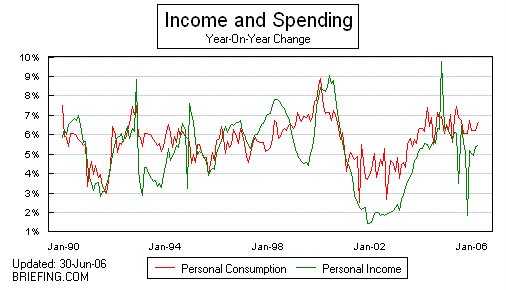
Subscribe to:
Posts (Atom)